Skip to content

A Mancunian noir classic capturing a lost city

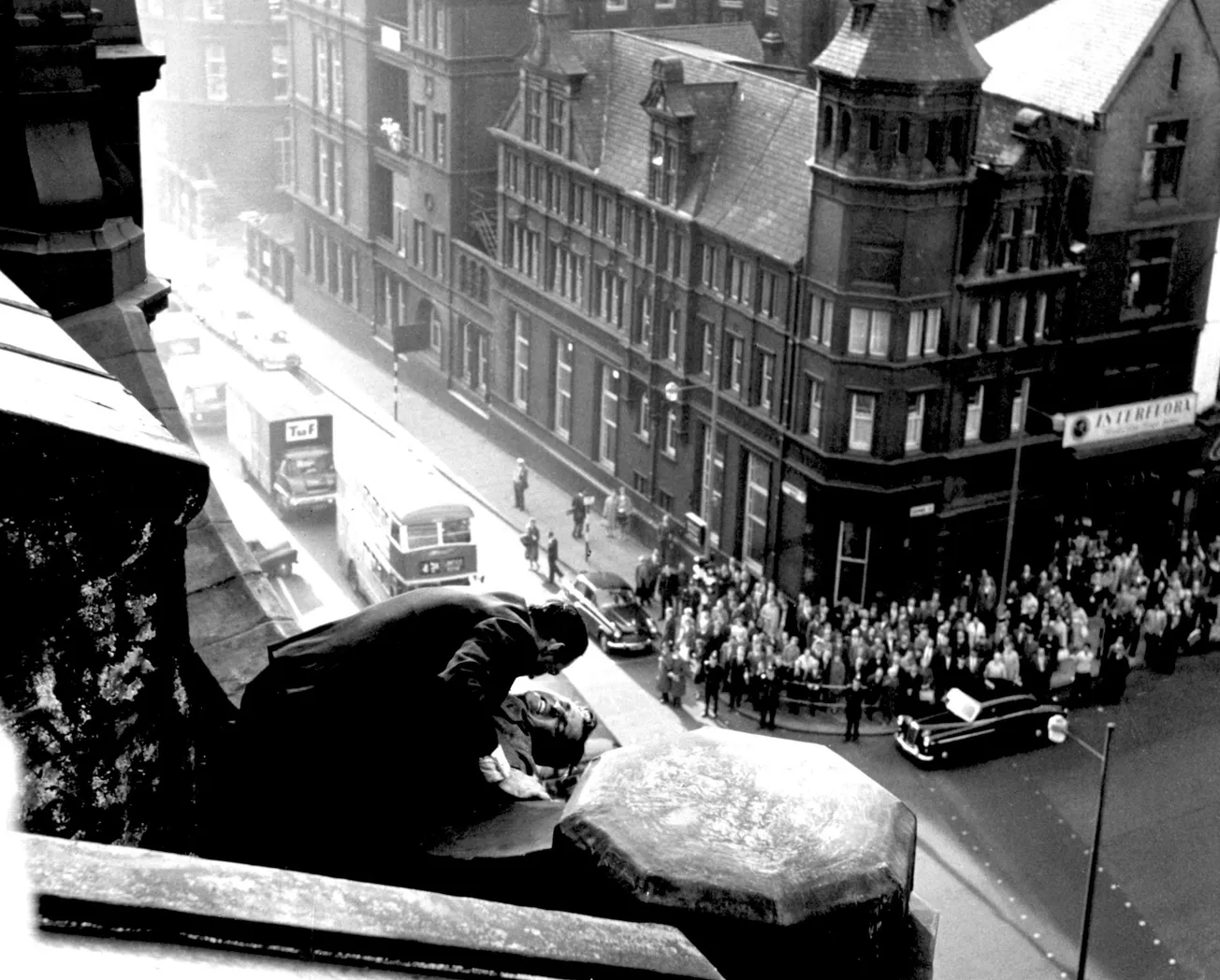
A climatic confrontation in Hell is a City. Photo: Alamy

In 1960, Hell is a City set the bar for neo-noir. Now it's a window into a past long demolished

Ah, the annual Christmas TV viewing tussle over another Chicken Run rewatch, or Love Actually. Want to break the deadlock and be the hero of your family? Can I suggest a 1959 black and white crime thriller, set in Manchester and Oldham? 

Ok, before you close this edition in despair, let me explain. A desperate criminal Don Starling (played by the American actor John Crawford) breaks out of jail, heading back to his home city of Manchester to retrieve a stash of stolen jewels. Waiting for him there is a moral, but troubled detective inspector Martineau (played by Stanley Baker, a huge British star at the time). What proceeds is an unbearably tense cat-and-mouse game of gangs, sex and violence. 

Promotional poster for Hell is a City. Credit: Hammer Studios

This is the plot of Hell is a City, filmed  largely on location in Manchester and Oldham in the autumn of 1959. It’s a fantastic film, strikingly modern in its choice of flawed protagonist in an era when detectives tended to be avuncular gentlemen scripted by the likes of Agatha Christie — Hell is a City was one of the first police procedurals which featured flawed officers who had difficult home lives. But watching Hell is a City today, the real star of the show — to borrow a cliche — is Manchester itself.     

Based on the book of the same name, written by Maurice Proctor in 1954, the film dispenses with ‘Granchester’, Proctor’s coy fictional setting (which he admitted was based on Manchester). Proctor started writing when he was a police constable in Halifax and produced 14 Inspector Martineau books with ‘Granchester’ as the backdrop, stories informed by his experience as a copper. The novels were praised for their realism and understanding of police procedure at a time when that wasn’t really a thing in crime fiction. 

The film is faithful to the book and is a strange hybrid. It is clearly influenced by the hardboiled Hollywood film noir school of the 1940s and 1950s, with its stark black and white cinematography and smart dialogue. But it is also part of the British New Wave of films like Look Back in Anger and Saturday Night Sunday Morning, both released the same year. The BFI website suggests that Hell is a City is “unaccountably overlooked” and suggests that it was ‘as important a film as Room at the Top’ (the 1958 film by Jack Clayton that launched the British new wave of ‘kitchen sink dramas'). They put this down to “critical snobbery towards its solidly commercial director Val Guest” as well the fact that it was one of the very few non-horror films made by Hammer Studios, not known for its high-brow output.  

In Hell is a City’s big screen adaptation, there are times when Manchester looks like New York or Chicago, particularly the nighttime shots of Piccadilly Gardens and Market Streets and the beginning and end of the film. As the BFI website says ‘the final shots of the newly promoted Harry Martineau wandering through the neon-lit streets of a newly re-built Manchester are as evocative as any in British cinema’. 

CTA Image

This story was published by The Mill: an award-winning email newsletter that sends you great stories, proper local journalism and peerless writing about life in Greater Manchester. 58,000 people have already joined our mailing list. Just hit that button below to join up for free.

Join The Mill for free

At other times the city is a vast grey backdrop of blackened buildings, slum houses, mills and chimneys. The city centre shots are full of people and energy but in the background there are large advertising hoardings around vacant sites. The sequences shot in Oldham, show a surreal moonscape, including a large vacant site where the civic centre now stands, and the stretch of old sandstone quarries on Oldham Edge. 

Twenty-five years ago my office did some government research into attitudes to urban areas, published in a report called ‘But Would You Live There?’. We carried out focus groups with MORI and made extensive use of Hell is a City as source material. It seemed to us to mark a point when the tide of public opinion turned against cities. True they could be exciting, but they were also where bad things happened and they were generally gritty, grimy and unpleasant. In short, they were hell. 

It is worth pausing the film during the indulgent shots over the city in the final rooftop scenes. As far as you can see there are mills and chimneys, terraced houses and roads lined with shops. Within two decades all of this would be swept away by slum clearance programs and economic decline. Back in the 1950s, the received wisdom was that the problem of cities like Manchester was that they were too big, congested and inefficient. Government policy was to clear the slums, move half the people out to new towns and overspill estates, build new roads, relocate industry and generally tidy up and disperse the messy chaos that places like Manchester represented.     

The reality was that Manchester was already in a long period of decline in the post-war years. Like other industrial cities such as Glasgow and Liverpool, it lost almost half its population between 1900 and 1981 and the policy of slum clearance and dispersal only served to hasten its decline. In the conclusion to our report with MORI we predicted that attitudes would change and the city would bounce back — as indeed it did. However, watching the film again, I can’t help wishing I could have experienced the Manchester of the 1950s when you could still see the great Victorian city that it had been before it was tidied up and swept away for something shinier and more modern. 

Locations

There is a lot of material online about Hell is a City and Manchester. One of the best guides is Levyboy, which focusses on the affluent suburban house on Erwood Drive in Levenshulme, where the bookmaker (Donald Pleasance) and his unfaithful wife (Billie Whitelaw) live. Here are some of the other locations in the film and what they are like today.  

Cromford Court

The film makes good use of Cromford Court that I have written about it before in my Mill piece on the Arndale Centre. It was an alleyway in the ‘Magic Village’ that was demolished to make way for the shopping centre and was also the name of the strange street of houses built on the roof of the Arndale that was destroyed in the IRA bomb. In the film, Cromford Court is home to the Lacy Arms, where Inspector Martineau rubs shoulders with the criminal underworld. The website Reel Streets suggests the pub was actually the Fatted Calf one of scores of pubs and clubs demolished to make way for the Arndale Centre.

Map supplied by David Rudlin

Cromford Court is also the scene of the crime where the gang seize a young woman carrying a bookmaker's money, who is subsequently murdered. The shots from the entrance to Cromford Court on Corporation Street look towards the Corn Exchange. I remember Longridge House to the left of the image, headquarters of Royal Insurance. The building had only recently been completed when the film was made and was destroyed in 1996 by an IRA bombing. The area behind the hoardings is now the Triangle on Hanging Ditch.     

Cromford Court today. Image: Google Earth

Oldham Edge

This cratered landscape of former sandstone quarries to the north east of Oldham town centre forms a dramatic backdrop to a scene in the film with an illegal gambling game involving tossed coins. The Oldham locations are dissected by Steam Chasers in a great YouTube video. Lookouts are posted in the nearby houses in case of a police raid on the game. When this happens, the sight of men scrambling over the waste heaps, pursued by police constables is one of the most memorable in the film.

The location is also used for Inspector Martineau’s home at the top of Crompton Street. Today the area is unrecognisable and the views obscured by trees but the strange disjointed terraces of houses are still there.  

Moss Lane East

This is looking from the garage to the grand houses on the northern side of Moss Lane, long demolished for a feature-less piece of grass. Still: Hell is a City

This is a taxi garage in an old church where two of the gang are arrested. I originally thought that it was Brooks Bar but Reel Streets places it further along Moss Lane East, on the site of what is now the Moss Side Powerhouse Youth Centre. I was amazed by the grand scale of the houses on the northern site of Moss Lane, long since demolished to make way for a council estate that turns its back on the road. The 53 bus also makes an appearance although if Reel Streets is right its route must have changed. 

Consensus online is that the above street is Moss Lane East. The church that has been converted to a garage stood on the site of what is now the Moss Side Powerhouse Youth Centre. Still: Hell is a City

Gaythorne to the Refuge Assurance Building

Don Starling is cornered in the attic of a two-storey furniture shop, before escaping through a roof light and being chased across the rooftops to the Refuge Building (Kimpton Clocktower Hotel). There he has a death defying fight with Inspector Martineau, high above Oxford Road. Hell is a City is so the geography doesn’t have to make sense — which it doesn’t. I was sure I recognised the furniture shop and eventually realised that it was a place I walked past every day in the 1980s when it was a car showroom selling vintage sports cars, since replaced by a block of flats.

A shot from the roof of the Refuge Assurance Building on Oxford Road showing Oxford Road Station under construction. Still: Hell Is A City

In the film there is a brief view along Hewitt Street which is still recognisable but then, all of a sudden, we are on the roof of the Refuge looking down onto the construction site of Oxford Road Station and St, Mary’s Maternity Hospital on the corner of Whitworth Street West. There is a mural in the Refuge bar by the artist Ben Eine, that commemorates its role in the film.

CTA Image

If you enjoyed this article and you're not yet a Miller, here's how to change that.

The Mill produces great reporting and peerless writing about everything from education to politics, crime to conservation in Greater Manchester.

The Millers, our readers, get all our stories direct to their email inbox, and are part of a brilliant community that sends us story ideas and debates the issues of the day in the comments. Just hit that button below to join up for free.

Join The Mill for free

Share this story to help us grow- click here


Comments

How to comment:
If you are already a member, click here to sign in and leave a comment.
If you aren't a member, sign up here to be able to leave a comment.
To add your photo, click here to create a profile on Gravatar.

Latest