
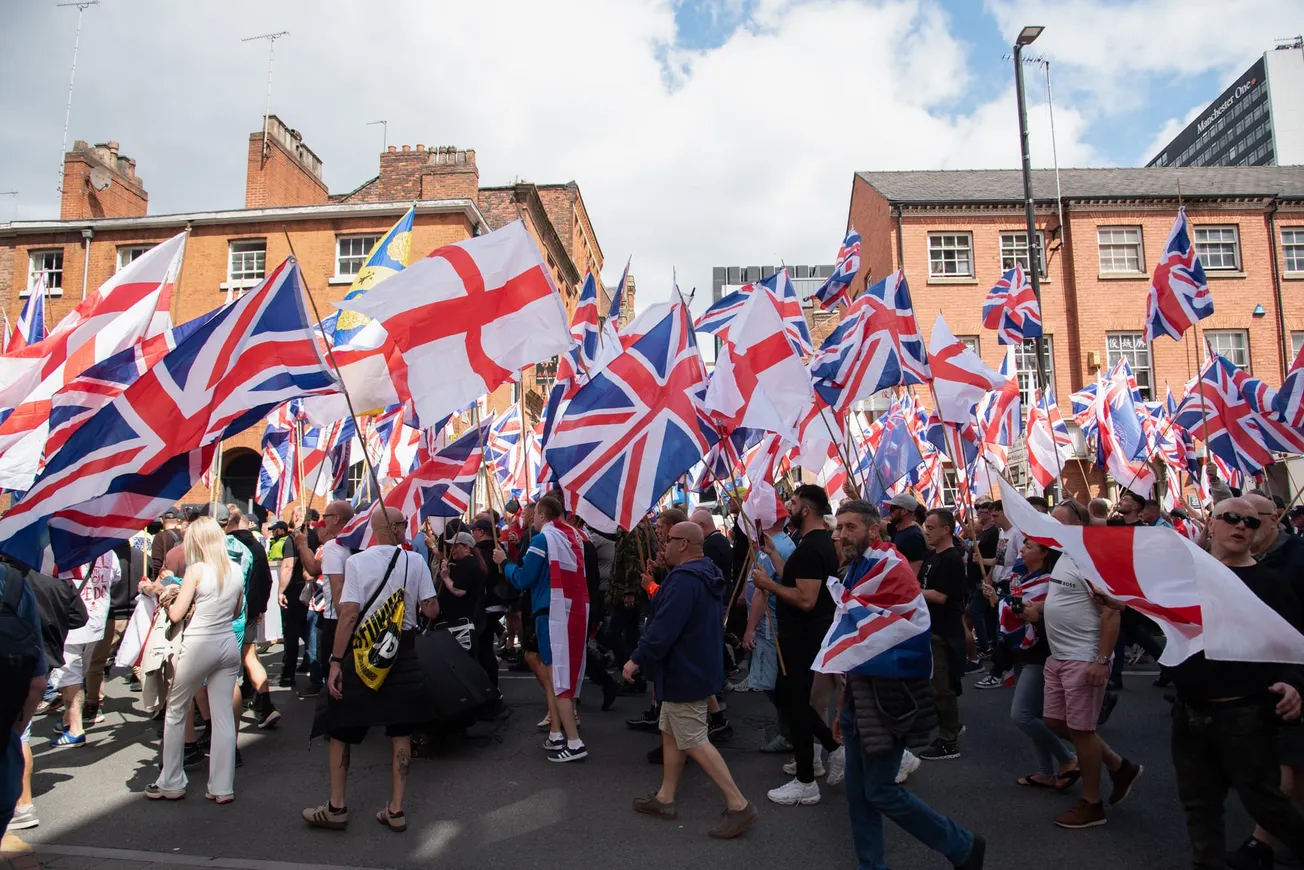
Dear readers — on Saturday, some 1,500 people were led through the streets of Manchester by Paul Golding, the co-founder of the far-right nationalist group Britain First.
A year after he was covering the riots in Southport, we sent Jack Walton to go and meet Manchester’s far-right. Yes, he met the marchers who think Donald Trump should “buy England” and heard plenty of concern about asylum seekers in hotels. But as he writes in today’s piece, some of the people on the march don’t fit the standard caricatures.
But first, your briefing, covering the latest set of towers set to be cleared by the council (sans affordable housing), a new upgrade to local rail and the Warehouse Project’s plans to ban phones from some of its events. Enjoy.
Your briefing
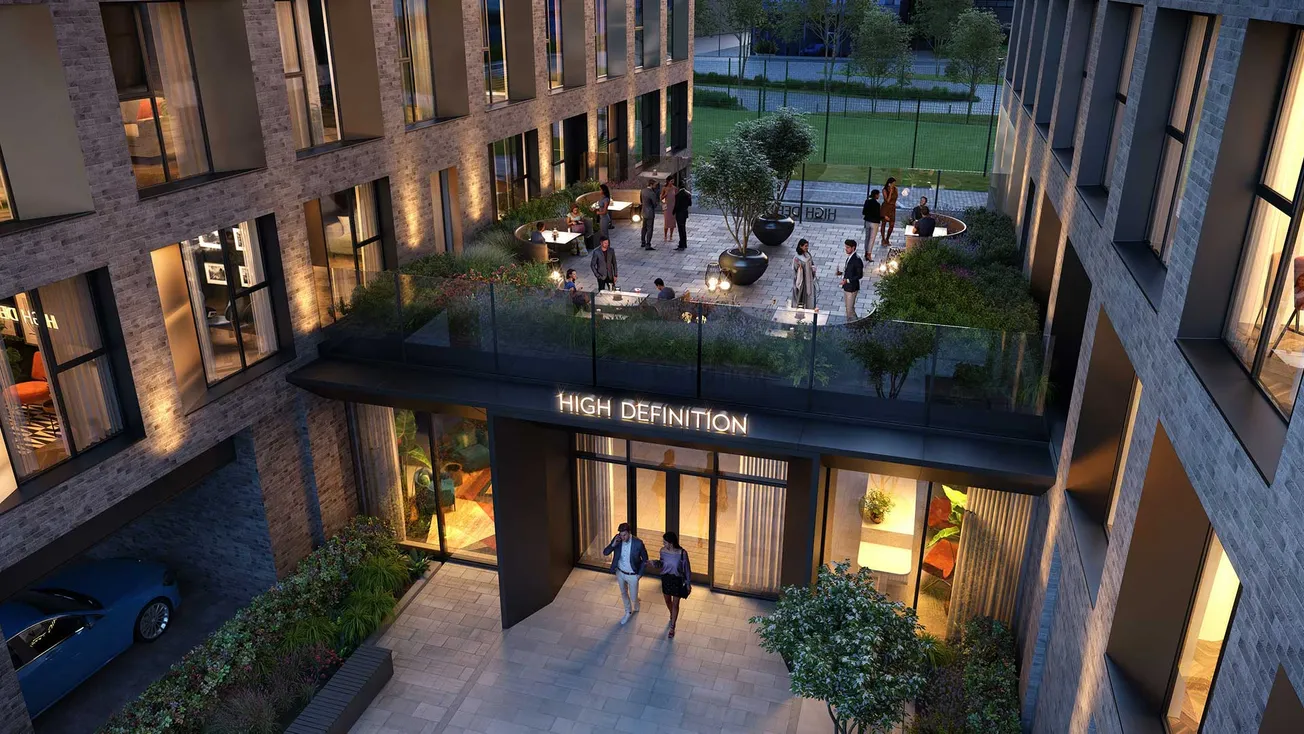
🏗️ Manchester City Council is about to sign off on the latest development by Renaker, the city’s leading developer of residential skyscrapers. This new scheme comprises five towers — including Renaker’s tallest at 71-storeys — worth over £1bn and is likely, like all of Renaker’s developments so far, to include no affordable housing. The council has published how much Renaker would need to pay in affordable housing, or section 106, contributions. It would be £114m, however the council agrees with the developer that having it do so would make its luxury scheme “unviable”. Place North West have helpfully highlighted the developers building similar buildings while also making good on their section 106 contributions. For example, Salboy is building an affordable block of 133 homes as part of its city centre Viadux scheme. Weis Group, who are trying to build two towers next to Renaker’s on Great Jackson Street, signed an agreement to pay £1m towards cheaper homes.
📵 The Warehouse Project has announced it will be encouraging customers not to use their phones at its events, with certain nights having a blanket no phones policy in which customers' cameras will be blocked with stickers. It follows other clubs in the city centre, like Amber on Circle Square, enforcing similar restrictions. “We feel that club culture is best enjoyed in the moment with your friends,” the Warehouse Project said in a statement, “and your phone in your pocket.
🚄 The £11 billion Transpennine Route Upgrade (TRU) is one step closer to completion as of yesterday, when the electrification of the Church Fenton to York rail line was finalised. Once completed in 2030, TRU will cut journey times between Leeds and Manchester by eight minutes, with up to six fast services an hour. Yesterday’s upgrade also enables electric TransPennine Express trains to run from Manchester Victoria to Stalybridge. James Richardson, Managing Director for Transpennine Route Upgrade, said that they had “reached a key milestone,” with 25% of the route now electrified “enabling greener, faster, and more reliable journeys”.
🏦 20 years after a listing application was made by the Twentieth Century Society, the Renold Building has finally been designated at Grade II. Designed by W.A Gibson and constructed between 1960 and 1962, the building formed part of the UMIST campus, and was considered an influential example of British modernism. It also contains within it an abstract mural by post-war artist Victor Pasmore. The listing application for the Renold Building was initially turned down in 2006, with Historic England citing “lack of high architectural quality”, but the latest assessment accepts that this verdict “now appears harsh”.
🎯 More than 60% of Trafford’s pupils on free school meals (FSM) had progressed to higher education by age 19 in 2023-24, compared with fewer than 46% of young people from all backgrounds, according to new data from the Department for Higher Education. That’s according to a new data modeller where you can build tables relating to your own area here.
Penned in behind fences outside Manchester’s Central Library, the self-described patriots who had spent the past hour hurling abuse at the “mainstream media”, the government, immigrants, as well as assorted “traitors”, “bummers”, “heathens” and ne’er do wells, fell silent. They watched on quietly, perhaps moved, perhaps just bored, as a video of Paul Golding, co-leader of Britain First, standing in a Wiltshire field played on a big screen. Stonehenge, Golding told us, was not dissimilar to Neolithic “Lego”, but if the pieces were much bigger and heavier. This, he explained, is what the British are capable of.
Two marches made their way through Manchester on Saturday. The first was large, drawing a crowd of about 1,500. It was headed up by Britain First, an anti-immigration and anti-Islam group co-founded by Golding in 2011. Quite how many people knew of the association between the march and Britain First is unclear — when The Mill wrote of “far-right” protests in our newsletter on Monday we received a handful of rebuking emails. These were just “ordinary” Brits, we were told, standing up for themselves, their children and their country.
The second march in Manchester at the weekend was actually larger still — it drew around 8,000 people. We’ll get to that one later.

A year ago, almost to the day, I was in Southport to report on a horrific knife attack on a group of girls at a Taylor Swift-themed dance class, three of whom died. Throughout the day news spread that a protest would be held that night. Posts in initially obscure Telegram channels urged “patriots” to “rise up” and defend their country against perceived external threats. I can remember ringing around a number of well-placed contacts to work out whether this would be the kind of serious protest that I ought to hang about for, or if I could justifiably jump back on the train to Manchester for a staff drinks planned that night.
By the end of that night in Southport, 39 police officers had been injured, 27 taken to hospital. Helicopters circled overhead, a police van was set ablaze, and I had to beg a hotel in the town centre to let me have a room after the vast majority of the Southport’s hotels had shut their doors in order to protect their guests. Within a week of that, rioting had occurred in cities and towns across England and Northern Ireland. Rioters attempted to set hotels on fire in places like Tamworth and Rotherham.
The rally in Manchester on Saturday, with its odes to Stonehenge and other more obscure British monuments (an extended video segment argued that Silbury Hill is as impressive as the Pyramids of Giza) lives in the shadow of last year’s riots. Greater Manchester Police confirmed that it passed largely peacefully, but for two arrests, as have most of the other protests in recent weeks against housing asylum seekers in hotels.
Before the march, I got chatting to a man called Steve in Piccadilly Gardens who attempted to explain to me the concept of the “matrix”: intricate networks of power spanning the police, the government and the media which act to suppress ordinary people. I ask him what he does for work and he tells me his job is to “observe humanity”. After a brief interlude in which he berates a policeman for failing to address him “as sir”, I’m able to repeat the question.

“My job is to observe reality…and AI,” he says this time.
“AI?”
“Yes.”
“But like, do you have a job?”
“No.”
When The Mill, along with its sister titles in Sheffield, Liverpool and Birmingham, wrote about how last year’s riots came to be as widespread and violent as they were, we found that the old school far-right — best represented by figures like Golding or Tommy Robinson — had been bolstered since the pandemic by a new cohort. This new group had no affiliation to organised far-right groups, but during the pandemic had come into contact with ideas that could be broadly defined as far-right. These were generally in WhatsApp groups or Telegram channels, and broadly concerned opposition to lockdowns and vaccines.
As Covid-19 faded into the backdrop the interest of these spaces shifted, most prominently to opposing the housing of migrants in hotels — a policy which increased significantly under the previous government and which Labour say they plan to phase out by 2029.
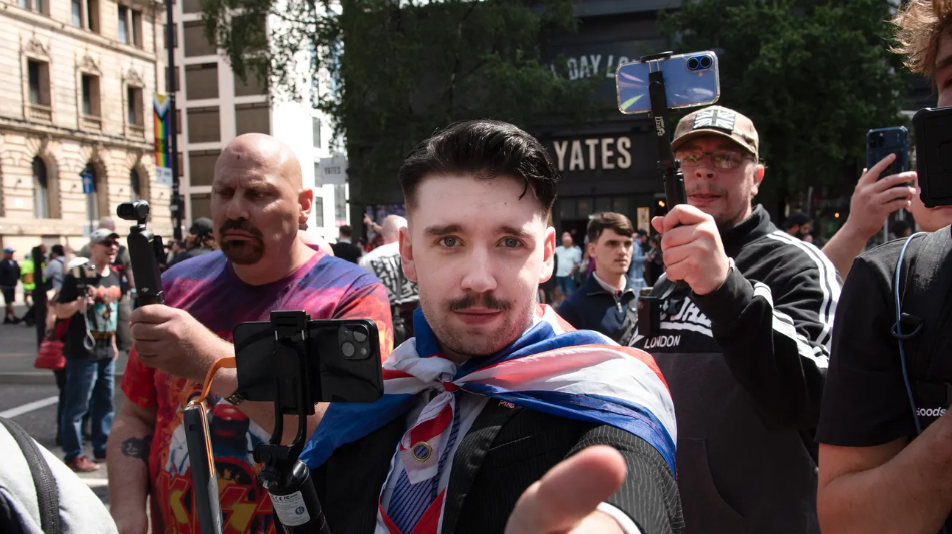
As such, despite the fact that this is a march organised by Britain First, with Paul Golding front and centre, a number of the people I speak to tell me they have no affiliation with the group. They’re worried about the direction the country is heading, they say, including their fear that immigrants with a different set of values are molesting British children.
Steve himself no longer follows any mainstream news channels, nor even any social media. He has no interest in joining any groups. I ask him how he keeps abreast of what goes on in the world. “I believe I can spiritually move realms,” he replies.
While Steve was busy astral projecting, I made my way back to the humble planes of reality, up by Piccadilly Station, where a man was making a passionate case for Donald Trump to buy England. The matter was a simple one, or so he insisted. If Donald Trump didn’t buy England, then Putin’s Russia would come straight over the border and have our guts for garters. “I’m not a racist,” he then clarified. “If you cut me open I’d bleed English”.
I wasn’t sure what the man’s name was, and nor presumably was he, going off the overflowing Morrisson’s bag of empty Morrettis in his swaying clutch. But any concerns for his welfare were put to rest by a friend of his who steered the man away from the various cameras and recording devices being poked in his face, cheerfully announcing “it’s five o’clock somewhere” (not untrue, but here it was barely midday).
You have to be careful when reporting on these marches. A group of five or six of us journalists had gathered around this man as he made his impassioned speech, with the swaying shopping bag, the boozy breath, the calls for England to become the 51st state. It’s easy to become drawn to these characters when the far-right are in town. They represent the writer’s ideal of what the far-right should be: blind drunk before midday, barely comprehensible and of the sincerely held belief that the president of the United States should purchase England to save us from imminent Russian invasion. Clownish and laughable, essentially, too far removed from reality to be taken seriously.

But then there’s Vlad. Vlad isn’t drunk, nor inane and rambling. Nor British, even. He’s tall, and has black shades as well as slick black hair. Vlad’s an immigrant to these lands, though he won’t tell me which Eastern European country he comes from because he suspects I’m not a journalist at all, more likely “MI5” or similar. He moved to Britain two decades ago, a “terrible mistake”. He had an idea of what Britain should be like: white, pastoral even. Then he saw the actual place.
The part of London he arrived in was full of signs in Hindi or other Eastern languages, he tells me. He felt duped and wanted to go home. It wasn’t until three or four years ago, at the tail end of the pandemic, that Vlad saw an online campaign from Britain First and felt “greatly moved”. Now he comes to these marches all the time.
Vlad is suspicious bordering on paranoid, but mostly friendly. He doesn’t seem entirely detached from reality like some of the cartoon villains who have turned up today to play a part, and his background doesn’t fit with the stereotype of a Britain First supporter. He’s the kind of character who turns up a lot in my former colleague Harry Shukman’s new book The Year of the Rat, which chronicles how seemingly normal people can arrive at far-right ideas via the routine disappointments of life: a poor run of luck in relationships or a confidence knock from having a bad boss. There are probably more Vlads in this movement, and mums who got sucked in via frustration at the government during the pandemic, than there are Paul Goldings or Tommy Robinsons.
Others are less courteous. Robert, who sits in a motorised scooter, is initially polite, telling me he’s “not far-right at all”. But he soon finds himself berating the “invaders” living in lavish five-star conditions in hotels across the country, enjoying lobster dinners and daily spa treatments. Another, much younger man, then bemoans the “weak pussy people” who have come along to counter-protest. I ask him to define a weak pussy person and he offers a number of examples: journalists such as myself fall into this camp, as do the “inbreds” among the counter-protestors who “don’t even know what gender they are”.
Speaking of gender, the second march in Manchester on Saturday was much larger than the Britain First march. It drew an estimated 8,000 people, according to the organisers. The Trans Pride Manchester march started at All Saints Park, with attendees gathering at roughly the same time as the Britain First supporters. A statement on Facebook thanked those who came along for a “powerful, beautiful reminder of what our community is capable of”. The Trans Pride march hasn’t received nearly as much coverage as the Britain First one though, and presumably didn’t offer the same supply of camera-ready ranting lunatics. Perhaps next year they’ll consider an extended tribute to Stonehenge.