Skip to content

Backstabbing, crying, and a ‘web of deceit’: Inside the fight to get into Trafford’s grammar schools

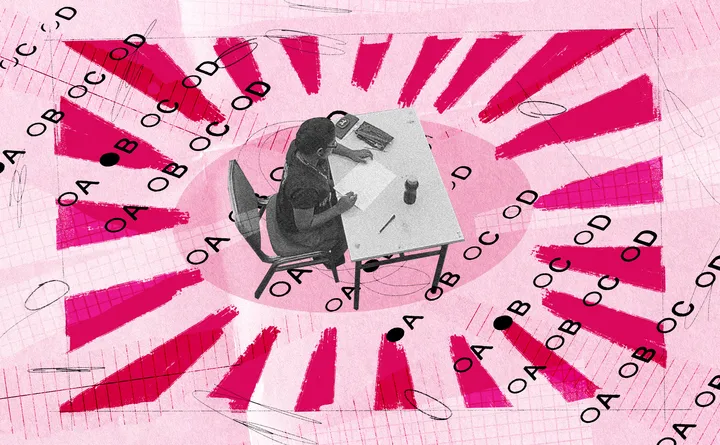
Illustration: Jake Greenhalgh.

‘I love my children more than I love the principle of meritocracy, apparently’

CTA Image

This story was published by The Mill: an award-winning email newsletter that sends you great stories, proper local journalism and peerless writing about life in Greater Manchester. 58,000 people have already joined our mailing list. Just hit that button below to join up for free.

Join The Mill for free

When I think about my primary school playground, which I don’t do very often, I think about the big metal gate. I have a handful of memories from inside the gate: the time I played ‘Lion King’ with a long-nailed fellow five-year-old and wound up with a permanent scar across my cheekbone; or when Lewis Ferguson stole my bobble hat and dipped it in a muddy puddle, shortly after which I smacked him across the face with it. But what went on outside the gate is something I’ve never quite gotten to the bottom of. My taller friends told me of a world of frowning dads, flirting mums, Nissan Almeras, and of the gossiping and arguing that went on — far worse than any playground spat. But whatever passive-aggressive scrapping occurred outside my playground gate at pick-up time, it likely doesn’t have a patch on what goes on in Trafford, because where I’m from we don’t have grammar schools.

The grammar school system wasn’t always the way it is now. One mother whose son goes to Urmston Grammar tells me that both her parents were working-class miner’s children who went to grammar school in the 60s. It raised them out of poverty and transformed their lives. Like many parents I speak to, she believes the system is now broken — with affluent parents paying for expensive tutors in order to earn their kids an advantage, breeding a culture of lies, competition, and betrayal. Nonetheless, she takes part in the system. “I love my children more than I love the principle of meritocracy, apparently,” she says.

Grammar schools are state-funded secondary schools that require an entrance exam to get in. This exam is known as the 11-Plus, and is taken by pupils at the very beginning of Year 6, testing them on maths, English, verbal reasoning (think word puzzles) and non-verbal reasoning (think picture puzzles). Only around 1 in 4 children pass it. Though grammar schools used to be reasonably widespread across the country, they are now confined to a small number of authorities in England and Northern Ireland. There are exactly seven of such schools in Greater Manchester, and every single one of them is in Trafford — creating a tense dynamic across the borough where parents are desperate to get their children into these establishments, or else risk dire consequences: coughing up thousands for private education, or sending their kids to school outside the area, and worst of all — facing the smug superiority of fellow parents.

Pupils at Altrincham Grammar School for Girls. Photo: MyNewTerm.

Rebecca is a mother of two pupils at Stamford Park primary school in Altrincham — a Grade-II listed Edwardian redbrick. Standing on the brink of the wide, concrete playground, in blue-striped summer dress and large oval sunglasses, she tells me that by the time her children were in the lower infant years of primary school, “everyone was talking about [the 11-Plus], everyone had a tutor.” She also tells me about the increasingly unreasonable amount of time and money expected from parents to get their kids to pass the test. Back in the 1940s, when grammar schools as we know them first came to be, pupils would simply sit the 11-Plus one day and if they passed, they passed, if they didn’t, they didn’t. But by the early 2000s, tutoring became popular among more affluent parents, who would pay for their children to be privately trained on the ins and outs of the exam.

Nowadays, according to the parents I speak to, things are a whole lot worse. It’s not uncommon for pupils to begin tutoring in Year 3, up to three years before the exam, often two or three times a week. I’m even told by multiple parents about pupils training five times a week, and going to specialised camps throughout the summer holidays, though no parent I spoke to confessed to doing this to their child. With prices for one-on-one tutoring ranging anywhere between £25 and £75 an hour, not counting additional summer-school prices, Rebecca tells me that this is virtually bankrupting some parents.

But while most parents I speak to seem to fundamentally disagree with the system, many tell me that if you live in Trafford, you have no choice but to comply. Rebecca’s son is only in Year 4, two years away from the test, and he’s already come home from school in tears due to the pressure of the 11-Plus. He's terrified that if he fails, he won’t be able to go to the same secondary school as his friends.

And it’s not just children feeling the pressure. Come exam time, Rebecca tells me that “there’s gonna be a lot of tears from parents,” too. For many parents of pupils at Stamford Park, the exams are a constant topic of conversation — but a guarded, competitive one. The amount of tutoring their child receives, and how much it costs, is something that the mums and dads of Stamford Park keep close to their hearts. “Some people won’t even tell you who their tutor is,” Rebecca says.

So why do so many parents take part in a system that they supposedly disagree with? In Trafford, if your child either doesn’t sit the 11-Plus or fails it, they may not have a regular comprehensive school in their catchment area to go to, as many of the other schools available are Catholic, private, or single-sex. But Danny (not his real name), whose son also attends Stamford Park, tells me that the problem goes deeper than this — that the grammar schools are actually a drain on the quality of the local comprehensives. In a Trafford comp, the most academically gifted kids have already been siphoned off to the grammars, leaving a school of pupils with only “middle to low” abilities. “It forces people to move to another area, or literally remortgage their house or take a second job to go to private schools,” he says. “Because if they don’t get to the top, they don’t want to go to the bottom.”

This system creates what Danny describes as “an entire cottage industry of private tutors who milk the parents.” He tells me that most parents receive targeted emails from tutoring companies every single day. “There’s an industry growing around it which whips up the fever, and adds to the drama,” he says.

Pupils at Stretford Grammar. Photo: Stretford Grammar.

Sarah is perhaps the perfect person to speak to about the Trafford grammar school drama: she has one child who went to one, one who didn’t (due to failing the 11-Plus), and she works at one, too (for this reason, we’ve changed her name). What does she think of them? “I think they’re a middle-class racket,” she tells me. “I really do.” Working at a grammar school, she tells me that she’s seen children in floods of tears on the day of their exam, telling her that they’ll be in trouble with their parents if they fail. “It’s not really a very nice thing to put your kids through.”

But the most alarming behaviour she’s seen undoubtedly comes from the parents themselves. Sarah tells me that it’s not uncommon for people to fake addresses in the catchment area of Trafford’s grammar schools, by using the address of a close friend or relative, or in extreme circumstances, purchasing a second home. As a result, other parents will ring up the schools to dob the liars in. “They’re always trying to stab each other in the back,” she says. “Maybe there’s a family feud or something.” Sarah also tells me about 11-Plus forums online, which she describes as “Mumsnet for psychos,” where parents sit around incessantly discussing tuition methods and exam results, using unnecessary chatroom codes — ‘DD’ stands for ‘Darling Daughter’, for example, and ‘DS’ for ‘Darling Son’.

Sarah isn’t the only one close to the system who tells me of such dodgy goings-on. I speak to an 11-Plus tutor, fake-named Chloe, who tells me that the stigma around their child failing the 11-Plus leads many parents to lie about exam results. “Every other person whose child doesn’t pass, they’ll say they missed it by two marks,” she says. Some parents even pretend their child has passed when they haven’t. “That’s a very complicated web of deceit,” she says, “because if they don’t then leave the area, how do you explain your child not going to grammar school? It just shows how badly people feel stigmatised.”

Chloe also adds a crucial point — that in certain circumstances, people living outside Trafford can go to the borough’s grammar schools without even faking their address. At least two of Trafford’s Grammar schools (Urmston Grammar and Stretford Grammar), allocate 20 places a year to the top-scoring students to have sat the 11-Plus, irrespective of where they live. Chloe has heard of pupils travelling from as far as Glossop and Warrington — a fact that appears to be a major source of anger among Trafford’s parents. Multiple parents express the belief that entry should be restricted to those paying tax within the borough. Danny tells me Trafford residents “pay a premium” to live in the area because they know the schools are better. “If you do that, and then find your kid can’t get into the school because somebody from Burnley is going, it feels a bit wrong,” he says. (It’s worth noting that multiple tutors told me that if you live in Trafford and pass the 11-Plus, you are effectively guaranteed a place in one of the grammars).

So what do the much maligned tutors have to say about all this? Yvonne Bissett (real name!) has been a one-to-one tutor for the 11-Plus in Trafford for 17 years. She tries her best to operate ethically — only taking pupils in Year 4 or 5, only tutoring them once a week, and recommending no more than an hour’s homework. She’s absurdly over-subscribed: right now, she’s taking bookings for 2030. Yvonne tells me that she loves the job, but she fundamentally disapproves of the system, which she sees as unfair. In an ideal world, she tells me, her job would not exist. “I think we shouldn’t have tutors,” she says. “Because I don’t want to be the person taking money away from someone who can’t afford it.”

Illustration: Jake Greenhalgh.

This is the overwhelming message I’m hearing from parents and tutors alike: that a once-effective system that gave working-class children the opportunity to receive exceptional education, has turned into a bizarre aspiration for families that narrowly miss the mark of affording private school. Of course, there are allocated spaces for children from disadvantaged backgrounds, but ultimately, children are more likely to get into grammar school if their parents can afford tutoring, summer school, sometimes even private prep school. Most importantly, they’re more likely to get in if their parents can afford a house in Trafford. Sarah explains that the whole experience can give children serious self esteem issues long after they’ve sat the 11-Plus. “Overall, I would say it’s a net negative,” she says, reminding me that the younger of her two sons went to the local comprehensive school — which was absolutely fine. “At the end of the day, I wish I’d never put them through the test,” she says. “I’d say it wasn’t worth it. Any of it.”

Writing this article from a café due to the unbearable office heat, I’m sat next to a friend of mine, who I know failed the 11-Plus as a child, and is now a neuroscientist with a PhD. I ask him if he thinks missing out on grammar school hindered him in life at all. “Nah,” he says. Then a few seconds later he adds, “but I only failed by two points.”

With additional reporting from Ollie Nicholls.

You can read Part Two of the Trafford grammar school saga here.

Grexit: should Trafford keep its grammar schools?
Some want them everywhere, others want them gone
CTA Image

If you enjoyed this article and you're not yet a Miller, here's how to change that.

The Mill produces great reporting and peerless writing about everything from education to politics, crime to conservation in Greater Manchester.

The Millers, our readers, get all our stories direct to their email inbox, and are part of a brilliant community that sends us story ideas and debates the issues of the day in the comments. Just hit that button below to join up for free.

Join The Mill for free

Share this story to help us grow- click here


Comments

How to comment:
If you are already a member, click here to sign in and leave a comment.
If you aren't a member, sign up here to be able to leave a comment.
To add your photo, click here to create a profile on Gravatar.

Latest