
He leaned back with a grin. Jack preferred dynamic positions, and he quickly steered the game into something sharp. Within a few moves the board had transformed into a King’s Indian–style structure, with Jack preparing a kingside attack while Ophira built a solid centre.
Ophira took her time. Thirty seconds. Forty-five.
Then she played c5, locking the centre and gaining space on the queenside. Jack raised his eyebrows.
“Ambitious,” he said. Jack’s pieces suddenly sprang forward.
…f5.
…e4.
His pawns rolled toward Ophira’s king like a gathering storm. But Ophira didn’t react immediately. Instead, she calmly placed a rook on c1, then a knight on d2, reinforcing her position piece by piece. Her plan was slower—but deeper. Jack’s attack began with a flourish.
After a long think she slid her bishop to g3, a quiet defensive move that also opened a hidden diagonal toward Jack’s king.
Jack attacked anyway.
…f4!
The pawn crashed forward, ripping open lines. For a moment the board looked terrifying for Whites. But Ophira calmly captured, traded, and simplified. One by one the attacking pieces disappeared. Jack’s initiative— so bright a few minutes earlier—began to fade.
If you overlook the mildly smutty undertones here (my preference for “dynamic positions”, Ophira’s “sliding bishop”), that was an astonishingly accurate description of me and my colleague Ophira playing chess. It captures Ophira’s neurotic, glacial style — its most glaring inaccuracy is that “45 seconds” should read “half an hour” — as well as the fact she always wins. At least she does when she’s playing me. It was written by ChatGPT.
Using ChatGPT to produce your copy, at The Mill, is a sacking offence, and rightly so. Using ChatGPT to produce titillating copy about yourself and a colleague, is worst still — probably the sort of faux pas that renders you unemployable for a few years. But here I think I can justify myself. For there exists a story linking chess, Manchester and the history of AI, but it’s coiled like a roll of film. I hereby intend to unspool it.
It was in 1944, while stationed at Bletchley Park in hushed secrecy, that Alan Turing first spoke of “building a brain”. The story of this part of his life — the part where he looks like Benedict Cumberbatch and cracks the enigma code — is very well known. But the brain-building part, and his early role in the field we now know as AI (the field surely responsible for many of the essays filed to dismayed lecturers at his alma mater), is less told.
The man who brought Turing to Manchester in 1948 was called Max Newman. Newman was a mathematician who’d taught Turing at Cambridge, then worked alongside him at Bletchley Park, and was now in Manchester where he’d been given £30,000 by the government to build a computer. While at Cambridge, Newman had posed his students a philosophical question about the limits of mathematics as a field. Turing (and this sort of behaviour was typical of Turing) produced in response a paper where he imagines a machine that works like a brain. It's the first evidence we have of a theme that runs through Turing’s life — his fascination with the idea that a machine might be taught to think.
The other notable thing happening in Manchester at that time was that three men — Frederic C. Williams, Tom Kilburn, and Geoff Tootill — were in the process of having a baby. The Manchester Baby was the world’s first-ever “stored programme” computer. The Baby was freakishly large. It filled the entire laboratory room: a dusty, dirty room in the old Victoria University of Manchester on Coupland Street. The Baby was also largely what made Manchester attractive to Turing: a testbed for his ideas.
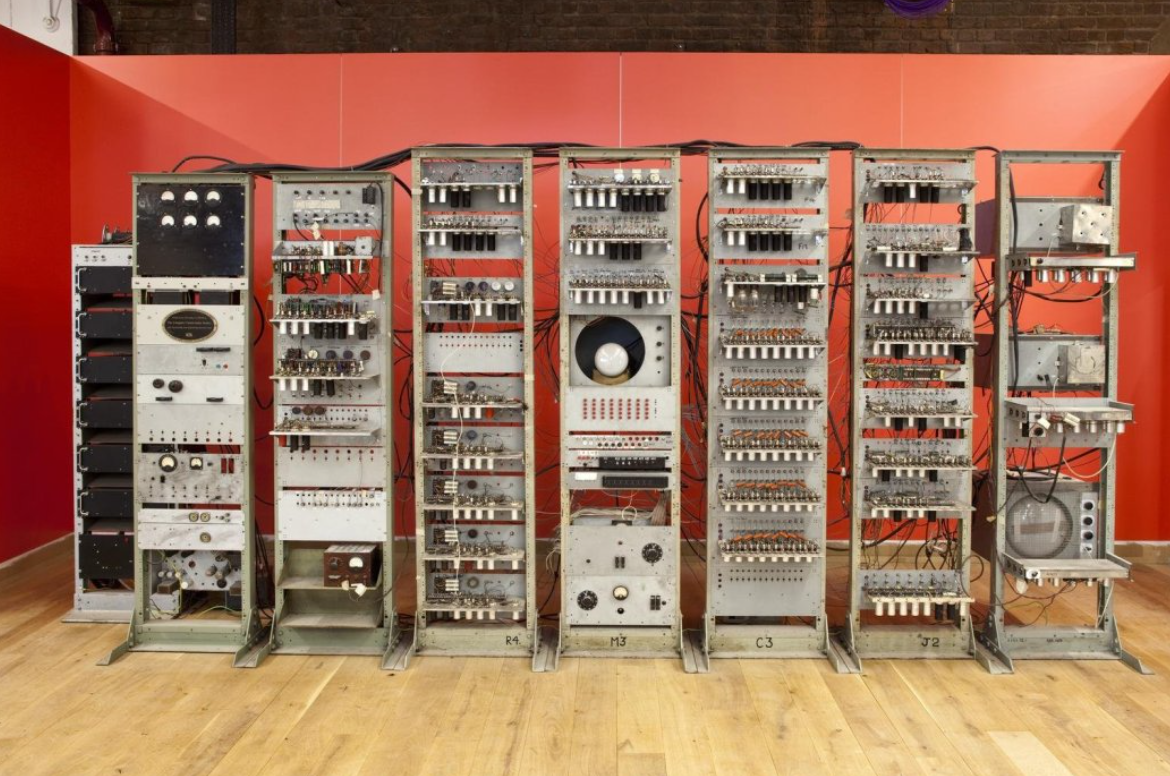
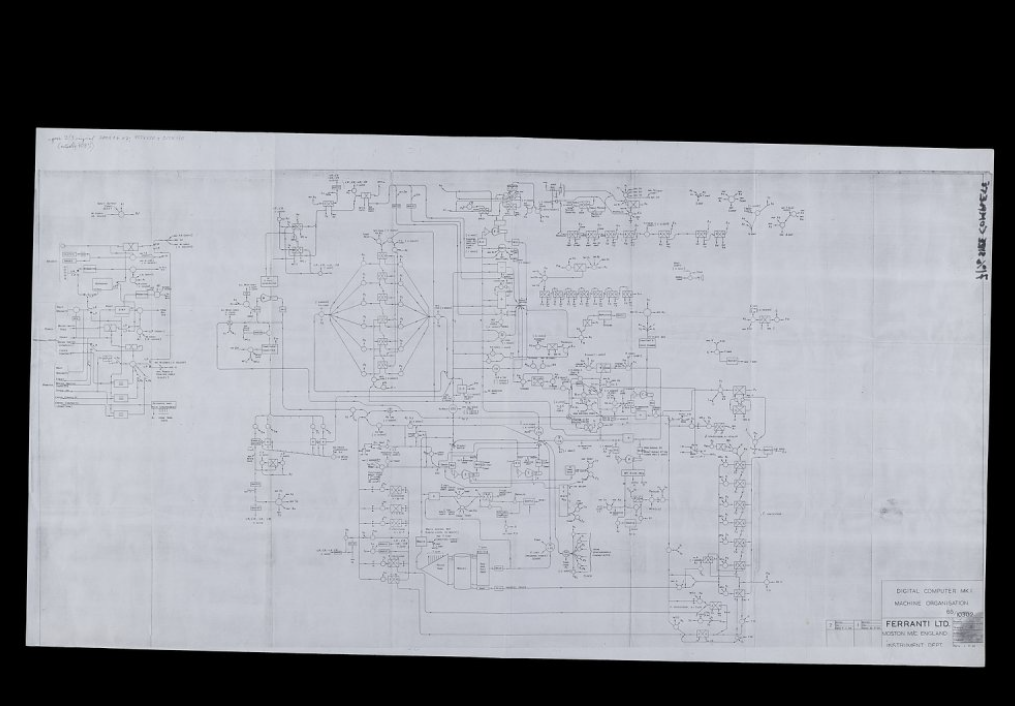
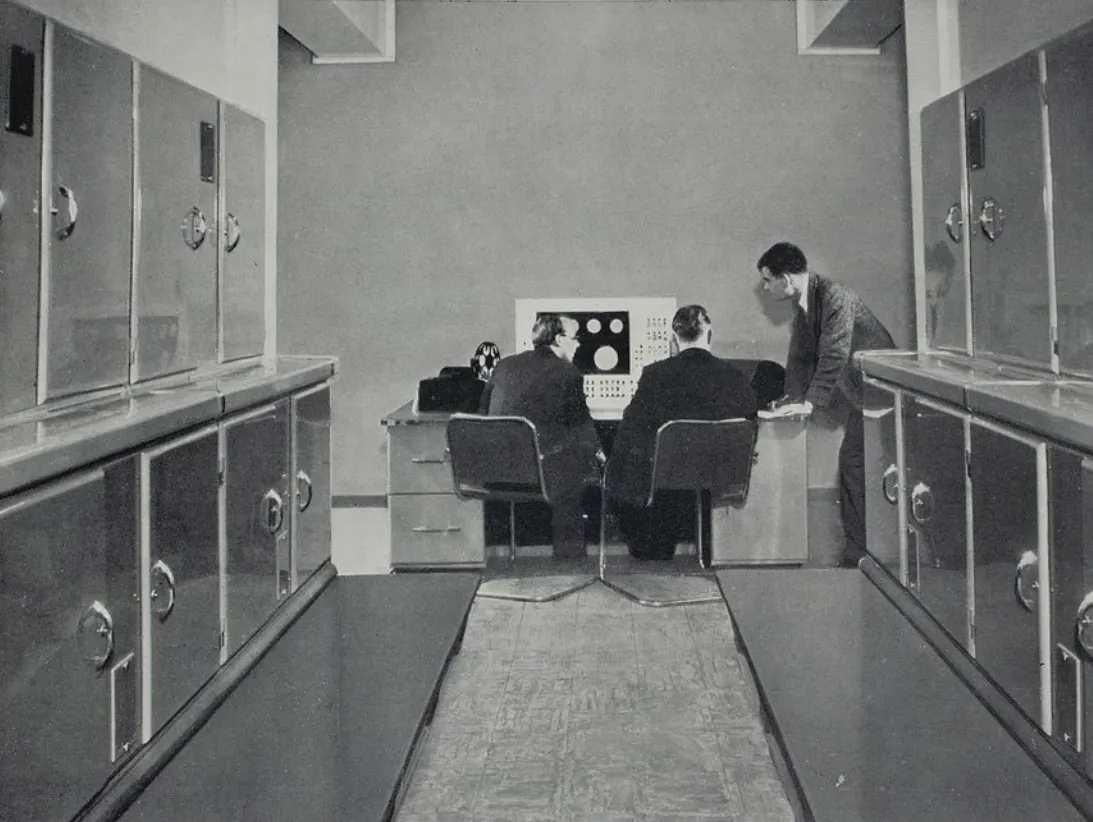
Left: Replica of the Manchester Baby at the Museum of Science and Industry. Right: Ferranti Mark 1 logic design. Credit: Science Museum Group Collection © The Board of Trustees of the Science Museum.
Turing and Newman had a shared interest in the idea of a machine acting as a brain. Turing was more open about this, Newman less so (the latter weighed up the practical consideration of accessing grant funding, while the former did as he pleased) but a shared interest it was. In October 1949 the trailblazing female philosophy professor Dorothy Emmet hosted a seminar at the university, The Mind and the Computing Machine, which we can label, retrospectively, the first public intellectual debate on what came to be known as AI.
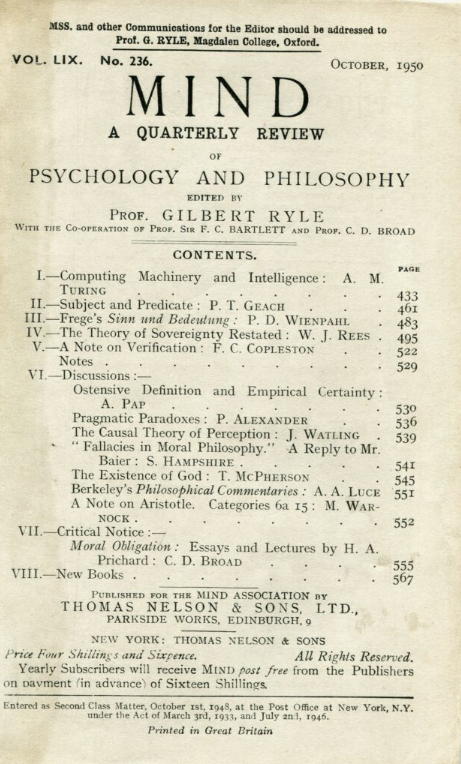
Also in 1951 an essay by Turing appeared in the philosophical journal Mind, with the opening line: “I propose to consider a question, can machines think?” A Manchester Guardian piece in 1951 talked about how Turing had “come to the conclusion that eventually digital computers would be able to do something akin to "thinking" and also discussed the possibilities of educating a ‘child-machine.’”
The problem was, not everyone was so invested in these ideas. The engineers saw the machine as the point in and of itself, or a means by which calculations could be done at rapid speed. Turing saw something more abstract. In James Sumner’s essay, Tools versus minds: two Manchester computing traditions, he describes this bifurcation of ideas as representing a bigger battle playing out at the university over “what counted as Mancunian”.
The University of Manchester did not see itself as wannabe Cambridge, a place where Turing-types sat about pontificating. Its identity was distinctly practical, tied to the city’s industrial heritage. They had companies like Ferranti (which built electrical equipment) and Metropolitan Vickers (things like generators and turbines) on the doorstep: companies who could actually build the things they designed. In some ways, this focus remains. When the university’s computer science department is recruiting it still emphasises the industrial. Come and play with the nuts and bolts.
According to some historians, Turing saw the engineers as the water-carriers and orange-peelers of the computer science department. He saw them as “technicians to create the machines that his ideas could be tested on”, as Sumner puts it to me. But to them, the inverse was true: Turing’s role was redundant. He was the moodler-in-chief, Professor of Pondering, haunting the halls of the university with his lofty thoughts and tedious philosophising, while they did the actual graft.
But it was The Baby that led to the Ferranti Mark 1, the world’s first ever commercially available computer, otherwise known as the Manchester Ferranti. Working for Ferranti at the time was Conway Berners-Lee. In 1955, two years after the Manchester Ferranti launched, and three years after the Manchester Baby, Conway had his own baby, Tim Berners-Lee, who would go on to invent the World Wide Web.
Which brings us to chess. In fact, I only started looking into all of this in the first place because of chess. It was after another agonising showdown against Ophira (in the time it takes Ophira to pensively nudge one pawn into the next square, her brow furrowing as though an ambling worm resides in her forehead, Turing could have cracked the enigma code two, maybe three times over) that I started to weighing up alternative strategies. Such as cheating.
In the late ‘40s and early ‘50s Turing had begun to look at chess as a means of — in a very crude, early sense — exploring how you might be able to recreate a mind. To this end he invented Turochamp, the world’s first ever chess engine, alongside David Champernowne. While Turochamp itself never developed into anything that could trouble a serious chessman, it eventually inspired many programmes that could. Chess cheats the world over have a lot to thank him for.
Turing himself was a middling chess player at best. His old chess foe at Bletchley Park, the writer and later International Grand Master Harry Golombek, would play a match right to the point where Turing’s King was about to keel over, then offer to trade positions, only to win from the apparently helpless position. Golombek, in fact, was one of the many leading UK chess players Bletchley Park recruited for its code-breaking operation (two main exceptions here: B.H. Wood, a suspected Communist, and William Winter, a card-carrying Communist).
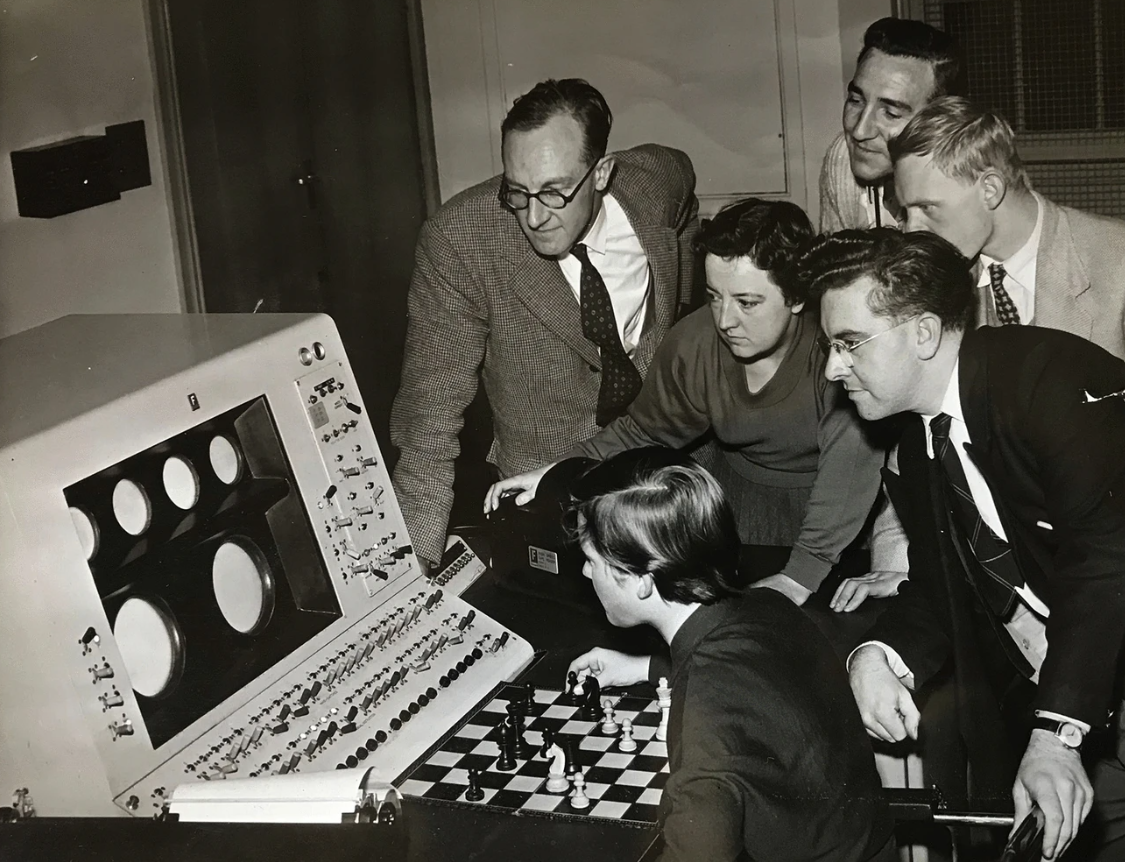
According to Champernowne, and here we must park our queries about what sort of husband goes bleating such a thing, his wife faced down Turochamp and lost. Turing tried to convert the program to be used on the Ferranti Mark 1 computer project in 1951, but it was too complex for the machine. Jack Copeland, who has written a number of Turing books, has said that this didn't bother Turing. He was certain that the evolution of computers was moving at such a speed that it would very soon be possible.
This never came to pass. In 1952 Turing was trialled as a sex offender for being a homosexual. Newman stood by him, as a character witness at his trial and by convincing the vice chancellor to retain him, but Turing found himself coming into the university less and less, or at odd hours, from then on. He took his own life in 1954. His ideas about teaching the Baby to think, as it were, never really developed in Manchester. AI as we understand it eventually picked up pace elsewhere (AI itself, in the form of ChatGTP, tells me that Manchester can be considered one “cradle” in which the ideas grew, but if we’re looking for a proper “birthplace” the closest and best answer would be Dartmouth, USA).
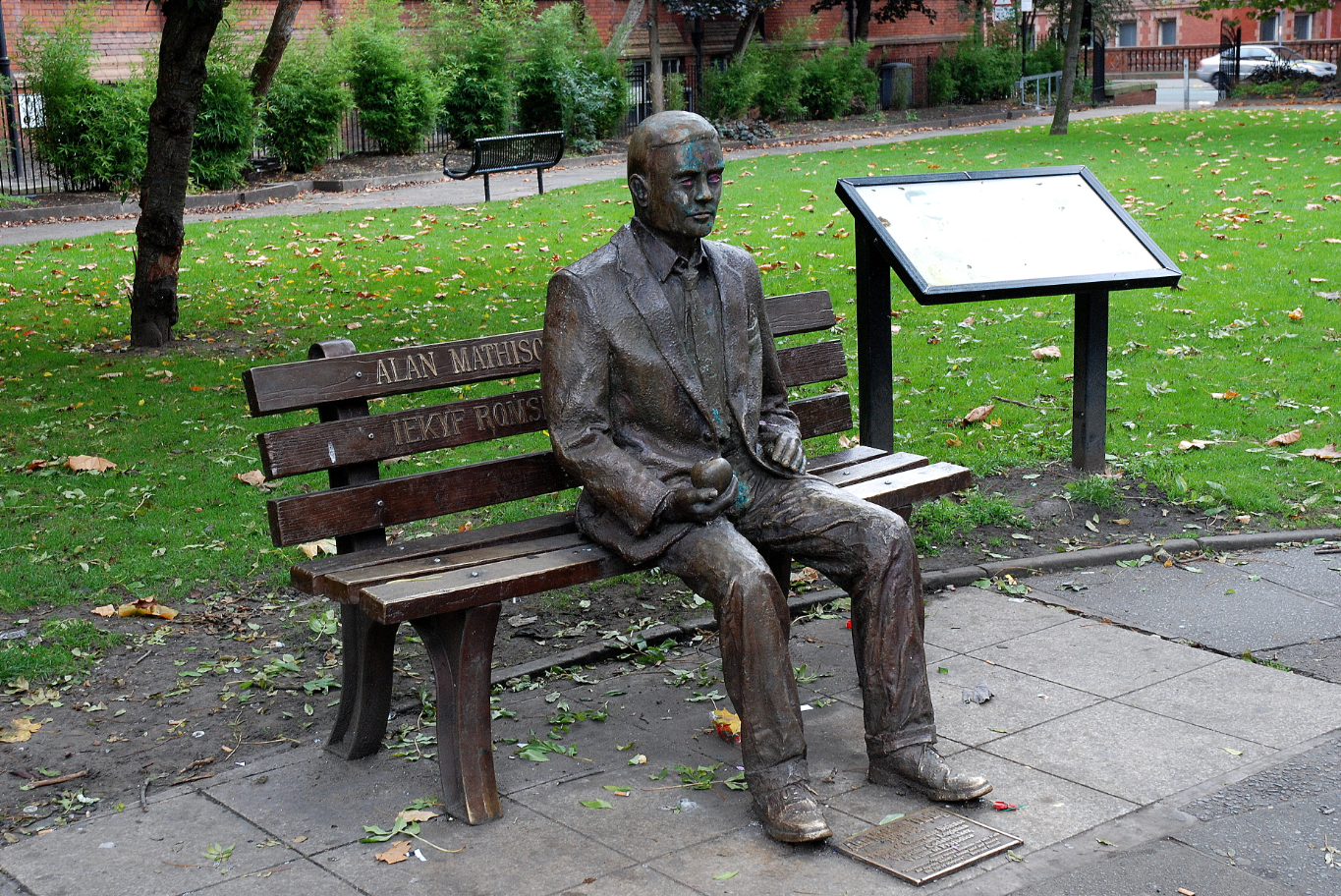
Thus, gauging the legacy of Turing’s material contribution is tricky. When I ask Sumner to give me a sense of his impact on the development of AI as a concept, I’m hoping he’ll give a response to justify a headline like: “Is Manchester the Birthplace of AI?”. But he's too academic for my tabloid hackery. “I don’t think a concept as big as AI could have been born in one place.”
The AI of Turing’s generation was highly limited, now seen as the first of three distinct waves in the development of the concept. It wasn’t good at much — chess, perhaps, but was it even that good at chess? Sure, it was better than David Champernowne’s wife. Eliot Hearst, professor of psychology at Indiana University, wrote in 1976, a full 22 years after Turing’s death, that “the only way a current computer program could ever win a single game against a master player would be for the master, perhaps in a drunken stupor while playing 50 games simultaneously, to commit some once-in-a-year blunder.”
But then another 21 years passed. 1997: the year the greatest chessman under the sun, the Russian icon Garry Kasparov, faced down Deep Blue, a supercomputer of which Turochamp is the primary antecedent. Deep Blue won the contest. It was the first time a reigning world champion had been defeated by a machine. Kasparov later compared Turochamp to “an early car… you might laugh at them but it is still an incredible achievement”.
Turing’s reputation had all but sunk to the bottom of the deep blue by the time Deep Blue won that contest. Various things, his 1952 prosecution, the fact his Bletchley Park work remained top secret for a long time for security reasons, and the university’s longstanding failure to recognise him, all contributed. When, in 1998, the 50-year celebrations of the Baby — aided by the marketing talents of Tony Wilson — billed Manchester as the “birthplace of the computer”, Turing’s name wasn’t even mentioned. In the years since, various things, such as a desire to celebrate the city’s gay history, and the production of a big Hollywood movie, have illuminated Turing’s legacy, and he now stares back at us from bank notes, and from a bench in Sackville Gardens. He has become, as Jonathan Swinton’s book Alan Turing’s Manchester puts it, a “patron saint” of the city, but even still the prescience of his thinking on what has become the global question is perhaps undervalued.
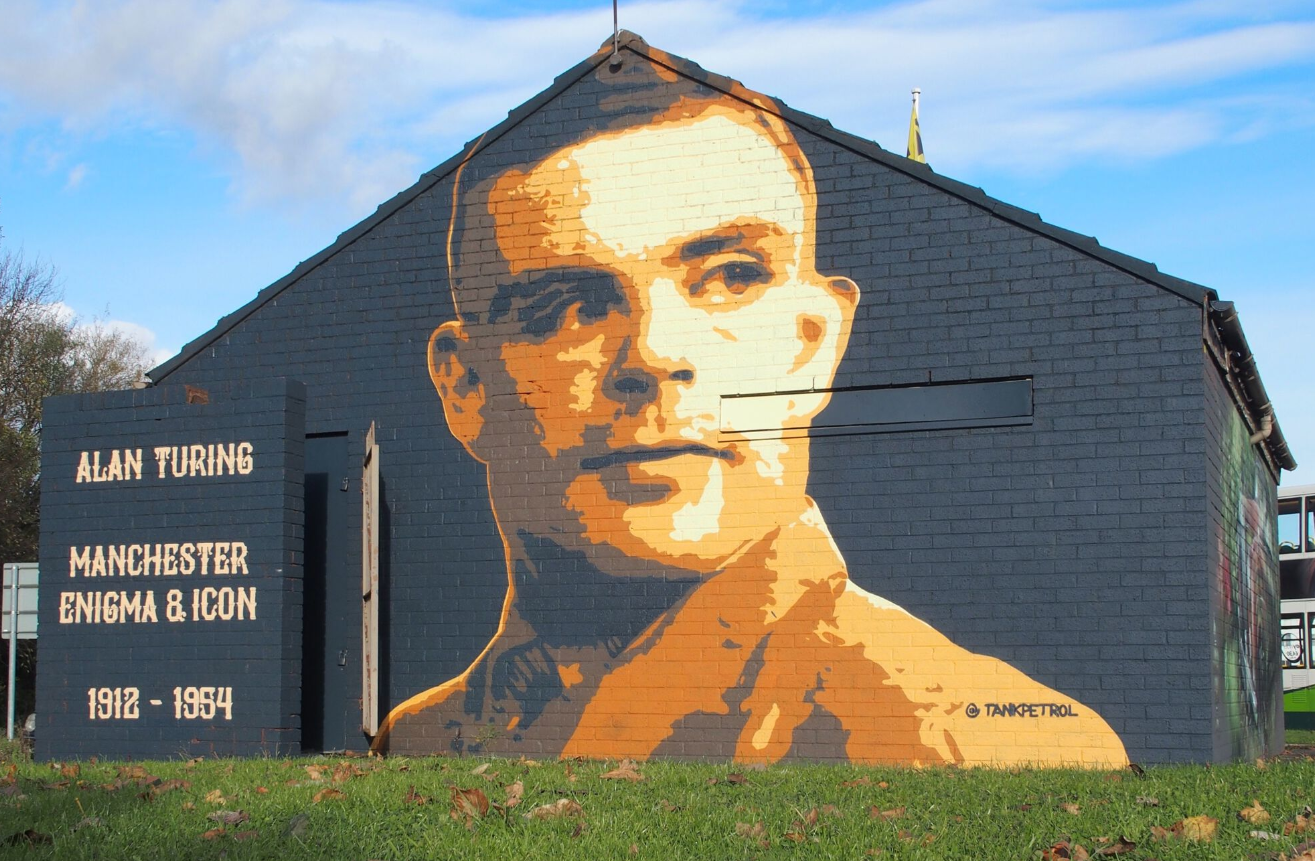
In Swinton’s book, he cites a letter from Max Newman’s wife to a friend. In it, she listening in on a conversation between her husband and Turing sat in the garden, shooting the breeze. Turing was talking on a pet topic: teaching the machine to “learn”. They talked about the machine as though it were a child. How they would teach it to see a joke, or go about “punishing” it if it got something wrong. Newman’s wife felt "very queer and uncomfortable" listening to them. There may be no direct Turing-AI throughline, but it would be fair to say the queasiness in the pit of Mrs Newman’s stomach that day is now felt the world over.
Over the past five years, AI has shifted from a niche technological tool to a pervasive force embedded across everyday life, reshaping industries. In journalism, AI has become particularly influential: newsrooms increasingly use machine learning systems to analyse large datasets, detect trends, transcribe interviews, and even draft initial versions of articles. While these technologies have improved efficiency and expanded reporting capabilities, they have also sparked ongoing debates about accuracy, transparency, and the role of human judgment in the news production process.
I hope that paragraph made you sufficiently queasy, for example. It was written by AI, and it isn’t very good. Read it again: unbearable! Likewise the dreadful opening section of this article. Have we yet built the brain Turing envisaged? I’d say there is some way to go. But AI isn’t always wrong. When I asked ChatGPT who would actually win in a chess contest between Mill writers Jack Walton and Ophira Gottlieb, it told me it couldn’t say because “neither are serious players”.