
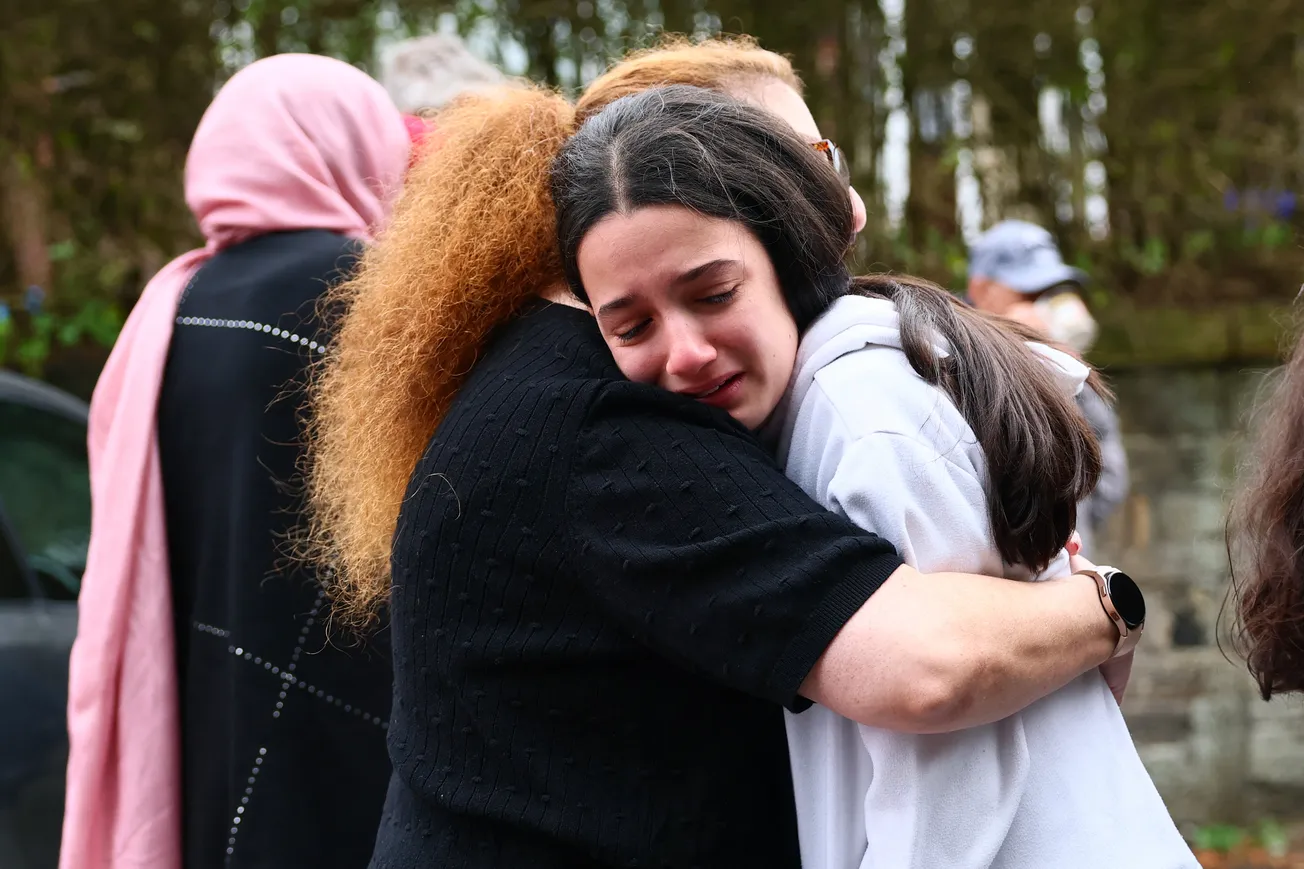
News of the attack moved slowly through Crumpsall. As people around the world learned the full horror of what had happened at half past nine this morning outside Heaton Park Hebrew Congregation, some of the area’s most observant Jews were still deep in prayer.
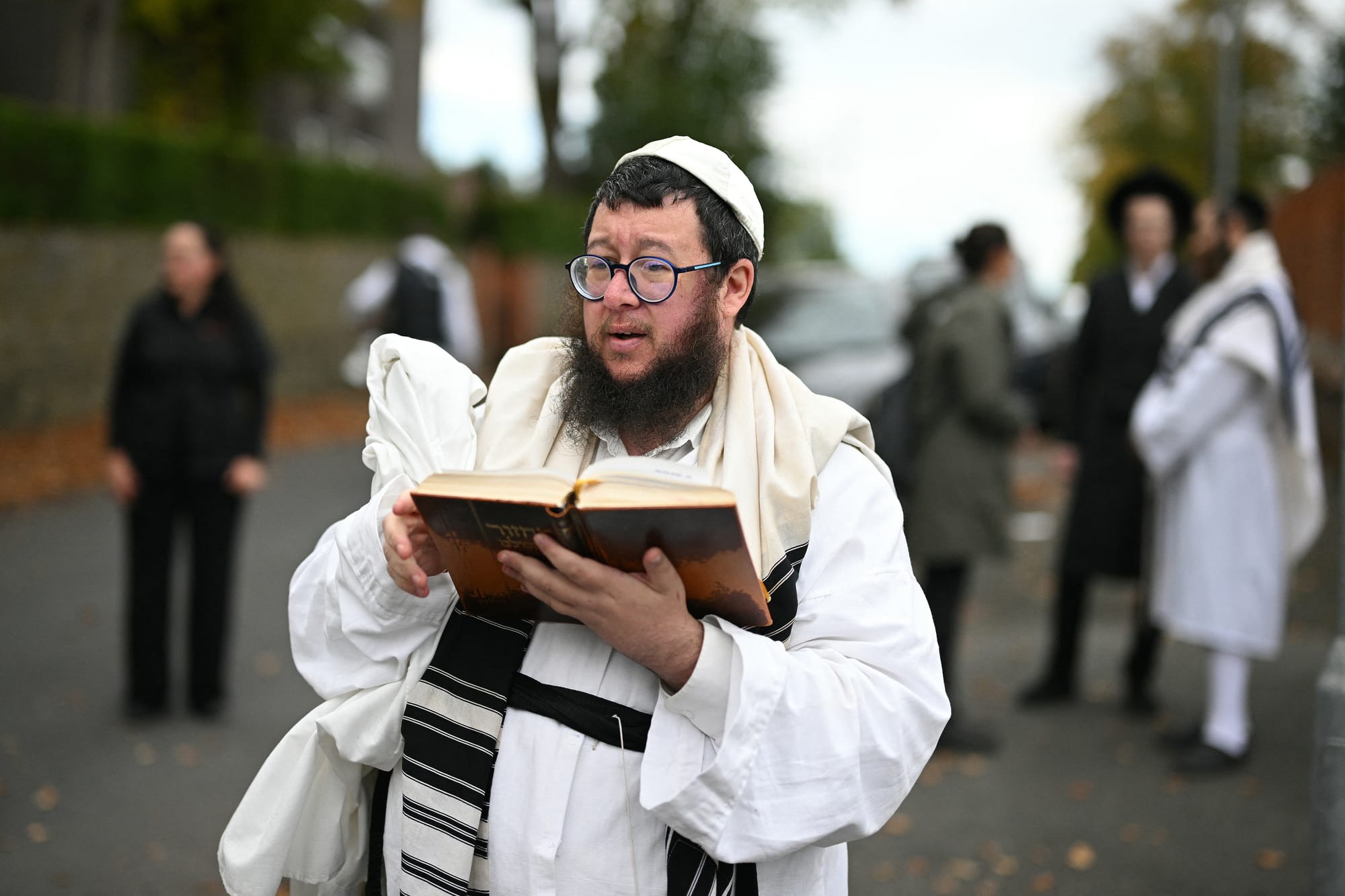
Today is Yom Kippur, the holiest day in the Jewish calendar, a day of fasting in which you don’t eat, drive or even use your phone. Many Orthodox Jews stay in synagogue all day long and pray.
More than four hours after the attack, in a makeshift synagogue in an abandoned hotel a few minutes’ walk away, a room full of women are praying on the floor, young Jewish girls kneeling over golden bibles. Elesheba, a woman aged about 50, turns to our reporter and explains the sacredness of the biblical passages in a hushed voice.
In the room there have been whispers of an incident nearby. Next door, the men sing loudly to drown out the sound of the sirens, and the helicopter flying overhead. Do they know? “One man knows,” Elesheba whispers. “But he doesn’t want to worry the rest of us.”
She looks at our reporter expectantly, who tells her what has happened: that there was an attack at Heaton Park shul, that multiple people were stabbed, that two are dead, that the alleged attacker has been shot by police.
Elesheba covers her face with her hands for a minute or two, and breathes deeply, as if trying not to cry. Then she takes her hands away, finds the right passage in her golden-paged bible, and resumes her prayer.
‘Screaming, then another shot, then screaming’
Simon Collins was scrolling on his phone when he heard screaming from outside his window. Then, he heard gunshots. He has lived in a block of flats across from Heaton Park synagogue for over 15 years — and was once a member — but this morning he couldn’t bring himself to look out of the window.
He went downstairs and stepped outside. He saw the pale face of a man he vaguely recognised. The man had been stabbed and the white shirt he wore was drenched in blood. Another man was in a gurney with paramedics working to save his life. People were screaming; police were everywhere.
Simon knew his son and his son’s stepfather were going to the synagogue for Yom Kippur. He called his son and was relieved to learn that he hadn’t left his house yet. Then a friend called from inside the synagogue. He and the other congregants couldn’t leave, but he said he was okay.
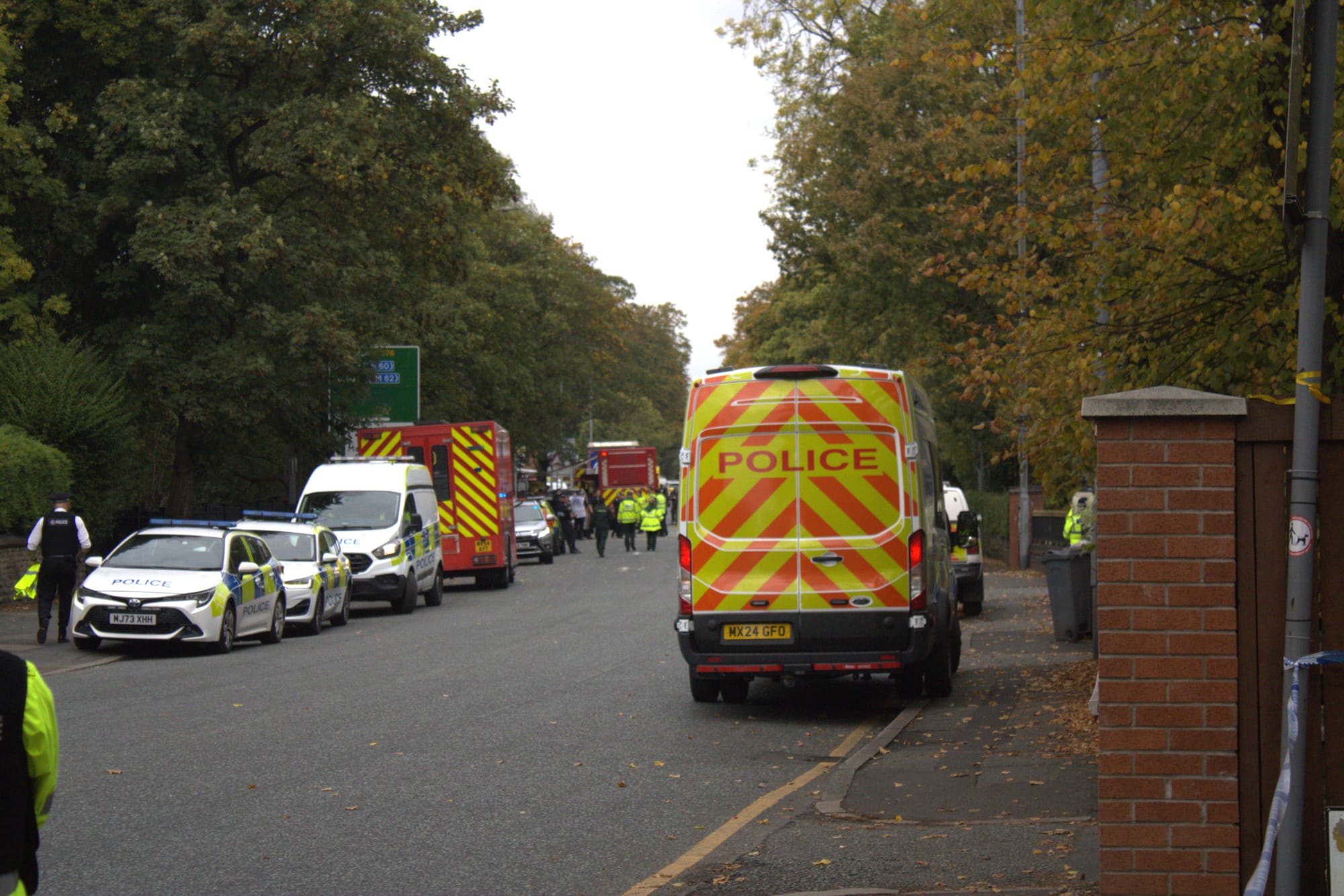
After about 20 minutes, fire service staff banged on Simon’s door and told him to evacuate the building. He found Middleton Road closed, dozens of police officers on the streets and helicopters flying overhead.
Elsewhere in the block, Mary, who is in her late 70s and has lived in these flats since 2009, says the first thing she heard was the car colliding with something outside the synagogue.
“The bang was horrendous,” she says. From her window, she saw a man wearing one of the distinctive yellow hats of the Community Security Trust or CST, an organisation that provides security at Jewish places of worship, running up the road. Then a series of gunshots.
“There was one shot, then screaming, then another shot, then screaming, then another shot, then more screaming,” she told The Mill. Soon, she was escorted out of the building by the fire service.
Another woman, wearing a red headscarf and blue duffle coat, says her day began with gunfire. “It woke me up when I was still in bed. I just woke up and could hear these bangs.” As she’s talking about what happened to her, a woman near the cordon urges her to inform the police, and she walks away.
At that moment, a woman wearing a pink hoodie comes down the road in a state of panic, saying she’s been unable to contact her father in the past two hours. Her dad was planning to attend the synagogue at some time today, although she’s unsure when. A few people attempt to reassure her he’s likely safe.
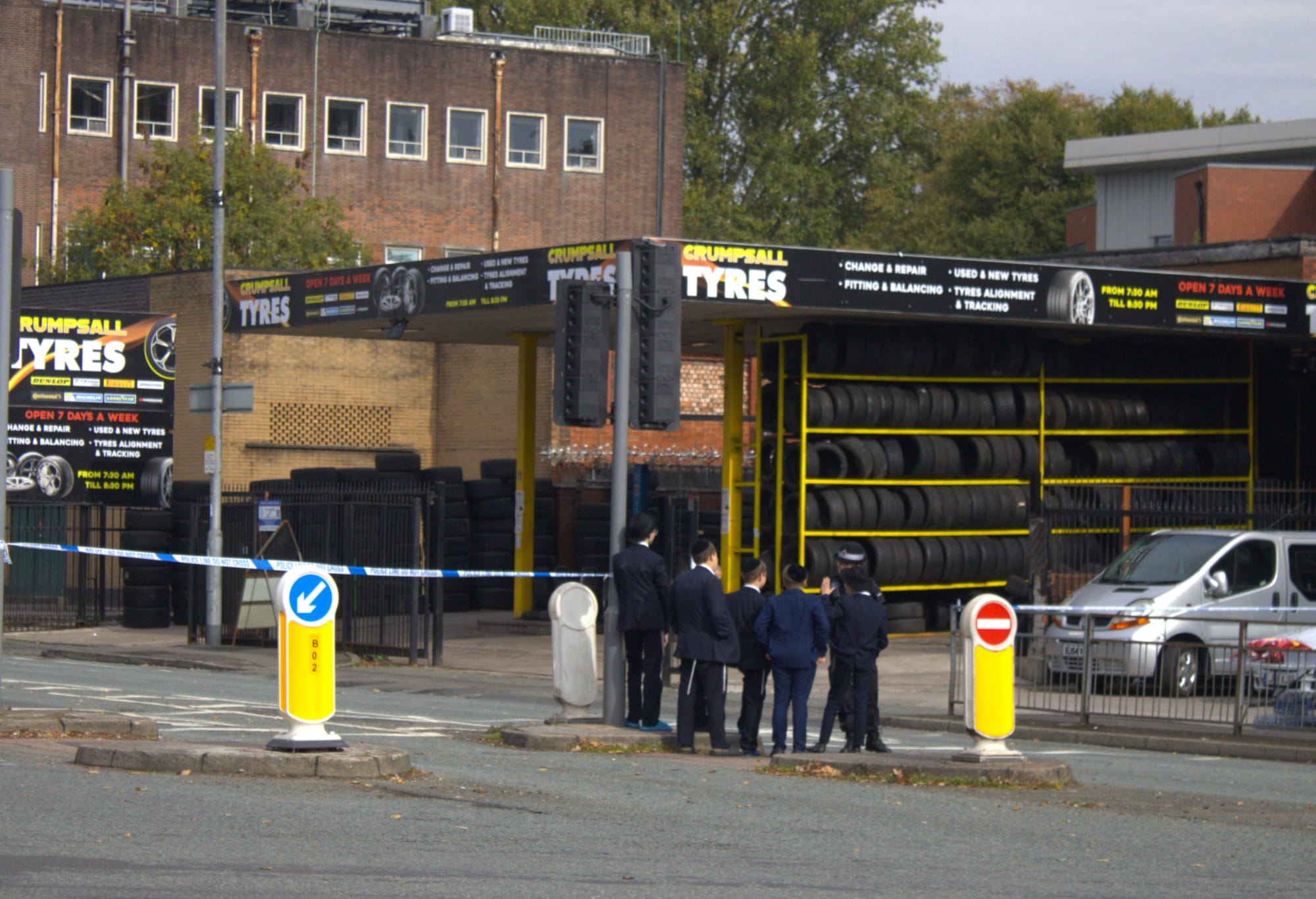
On Seymour Road, about five minutes from the shul, a large group of orthodox schoolchildren stand outside the B’Yachad Youth Project, hastily gathered for their own safety. A few of them lift themselves up to peer over the fence and out onto the street, where a security guard has been stationed to protect them.
One boy asks us what’s happened, eyes wide as he peers around the gate to ask: “Is anybody dead?”
‘He has a bomb’
Greater Manchester Police were alerted to the attack at 9.31 this morning. Someone reported that he had seen a car being driven towards members of the public, and that one man had been stabbed. The attacker then attempted to force his way into the Heaton Park synagogue on foot but was stopped by security. Rabbi Daniel Walker, who has led the synagogue since 2008, barricaded the door.
Three minutes later, at 9.34, firearms officers were deployed, as the police received further reports that a security guard had been attacked with a knife. The police declared PLATO, the code name used when the authorities believe they are facing a marauding terrorist attack.
According to the police’s timeline, its officers shot the suspect at 9.38, just seven minutes after the first call came in from a member of the public. Paramedics arrived at 9.41.
Shortly after the attack, a video showing the suspect being shot by police circulated online, as well as an image in which he had some kind of white object around his waist. In the video, an officer can be heard ushering members of the public away from the scene, saying: “If you're not involved, move back, get away... he has a bomb, go away,"
At this stage, police were unable to officially comment on the suspect’s condition due to “suspicious items on this person”. A bomb disposal unit arrived on the scene in the afternoon and a loud bang was heard — believed to be a controlled explosion to enter the suspect’s car. It was later confirmed that the device worn by the suspect was “not viable”.
Just after midday, police confirmed that two people, plus a third — presumed to be the suspect — had died. Four more are in hospital.
An eye witness told the Press Association he had seen two men in handcuffs being led away on White House Avenue, close to the synagogue. “There were six or seven police cars with armed police,” the man said. Police later confirmed two further arrests had taken place, and that the attack had been declared a terrorist incident.
“It’s my synagogue that was attacked,” a local worshipper told us. “I only knew my parents were safe when I saw my dad walking around on Sky News. Our worst fears have come true today.”
The darkest moment
Today’s attack is not only Britain’s worst attack on Jews for several centuries, but also appears to be the first antisemitic killing in Manchester – if that’s what we can presume this was – since Jews first settled here in the eighteenth century.
The name Synagogue Alley appears on a town plan from 1741, a place where a group of hawkers met “to replenish their stocks, exchange communal gossip and make up a quorum for public worship,” according to The Making of Manchester Jewry by the historian Bill Williams.
Williams writes that this timing shows that, contrary to popular perception, Manchester’s Jews did not come here originally because they were escaping persecution in the late nineteenth century. Rather, they came - as jewellers, watchmakers, hawkers and small shopkeepers - for commercial opportunities like everyone else, as the city exploded into a hub of industry.
“Manchester Jewry grew with Manchester,” Williams writes.
Over almost 300 years, the city’s Jewish community has faced discrimination along the way – including persistent allegations of being industrial spies during the Industrial Revolution, and antisemitic harassment in recent years – but today’s attack is the incomparable nadir.
“Manchester stands with our Jewish community at this darkest of moments, and will come together as a city,” said Manchester’s council leader Bev Craig. Danny Franks, president of the city’s Reform Congregation, said: “We will not be cowed by violence. We will continue to gather, to worship, and to live proudly as Jews.”
And now, as the Yom Kippur fast comes to an end, many of the city’s most pious Jews will learn the magnitude of what has taken place.

This story was published by The Mill: an award-winning email newsletter that sends you great stories and peerless writing about life in Greater Manchester. 58,000 people have already joined our mailing list. Just hit that button below to join up for free or become a paying member to support our work.