
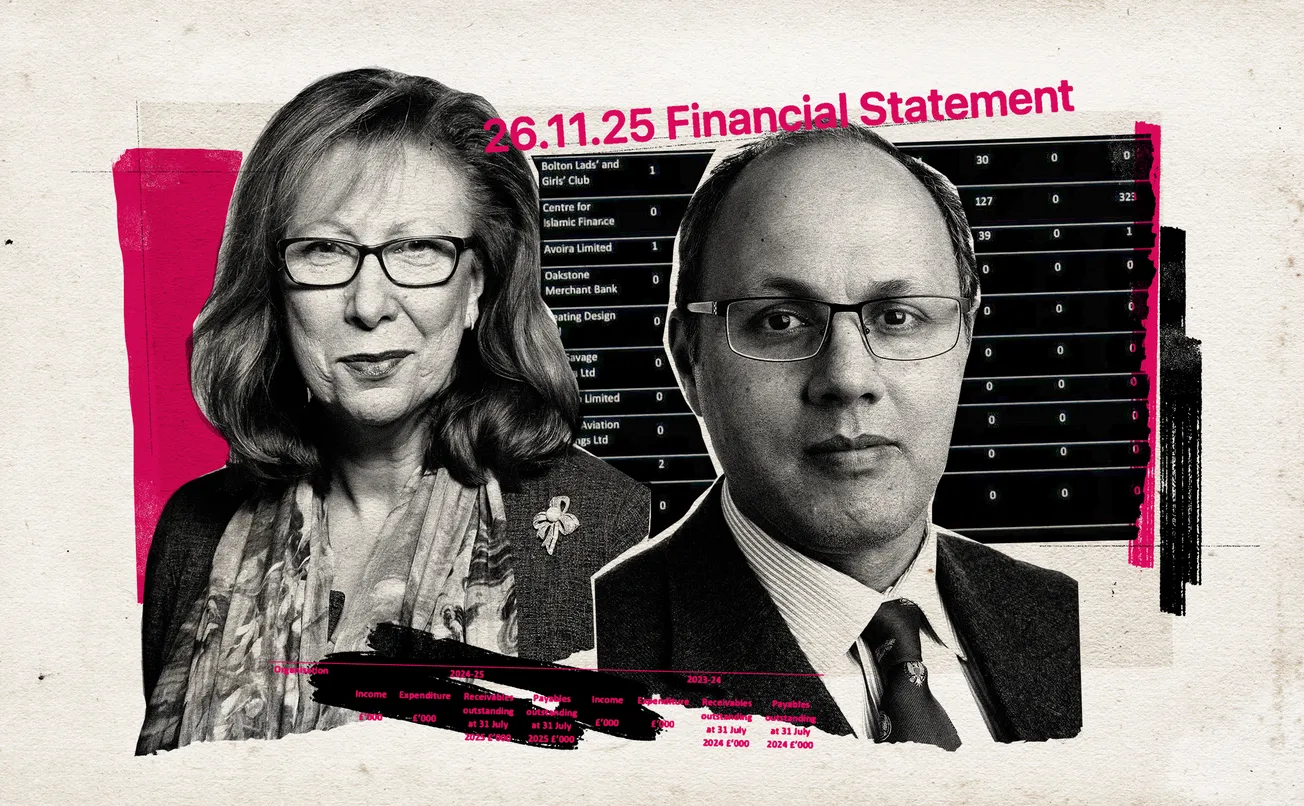
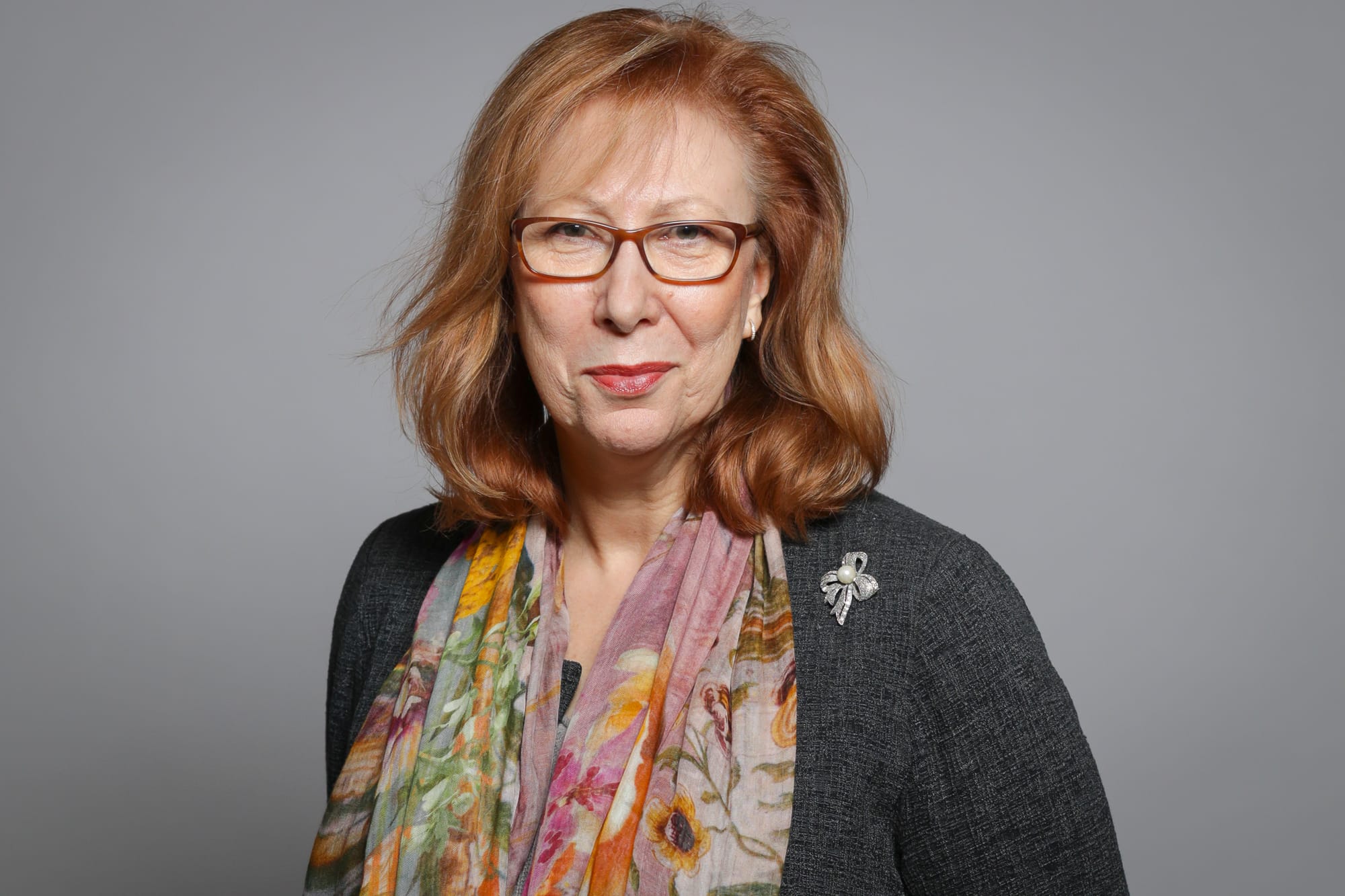
Prospective students hoping to study at the Centre for Islamic Finance at the University of Greater Manchester may be impressed by the name on the door — or at least the top of the website. The centre’s homepage carries a welcome from its chairman, “The Baroness Morris of Bolton OBE DL”, along with a smiling photograph of the baroness wearing a university gown.
Baroness Morris, 72, is a Conservative member of the House of Lords, and a former shadow minister in the early noughties, later serving as prime minister David Cameron’s trade envoy to Jordan, Kuwait and the Palestinian Territories. She and her husband are leading figures in Bolton and they live in a grand farmhouse in the nearby countryside.
On the university’s website, Morris expresses her pride in watching the Centre for Islamic Finance (CIF) going “from strength to strength”, including attracting students from around the world to its postgraduate courses. But in recent months, we’ve been told by staff inside the university that the centre has become a source not of pride but of increasing concern. One senior staff member describes the centre as “a flagrant breach” of the university’s governance rules, and the local MP has told us that he finds the CIF’s arrangements “extremely worrying”.
The university has been in turmoil since our reporting earlier this year led to the suspension of the vice chancellor George Holmes and a police investigation into suspected “fraud and bribery”. One of the themes of our reporting so far has been questionable relationships between the university and outside contractors, including companies in which senior employees have a controlling interest. Arrangements that look dubious to an outsider can often have an innocent explanation, and every time we have published an article, we have given the university and all the key characters mentioned a full chance to respond to our reporting. That’s no different this time.
Unusual arrangements
The CIF was launched in 2012, when Morris was the university’s chancellor (that’s when it was still called the University of Bolton) and offers a range of courses including Islamic Insurance & Risk Management and an MBA in Islamic Finance. In the past couple of years, these courses have become much more popular, with enrolment rising ten fold from 25 to 265 between 2022 and 2025, according to internal documents seen by The Mill.
But several things might strike an outsider as strange about how the CIF operates. For one thing, the centre appears on the university’s website to be part of the university. But public filings at Companies House reveal that it is in fact a private company which receives large payments from the university.
According to the university’s most recent accounts, the university was due to pay the CIF £1.3m for the 2024-25 financial year. Multiple sources inside the university have told The Mill that one member of the board — a private jet entrepreneur called Uday Nayak — raised concerns about the payment and indicated that he wouldn’t approve the accounts until it had been satisfactorily explained. In total, CIF has received £3.2m from the university since 2019. Nayak told us he couldn’t speak for the university and referred us to a solicitor who didn’t respond to our questions.
What exactly is the company behind the CIF? According to public filings, it has no employees. Further, they show that it is controlled by Baroness Morris and two other people: a London-based accountant and Mohammed Abdel Haq, a former banker and longtime associate of hers who is also an assistant vice chancellor of the university.
Neither the university, Morris nor Abdel Haq have taken the opportunity to answer our detailed questions about these unusual arrangements in recent days. Abdel Haq sent us a one-line statement via his lawyers, saying: “The Centre for Islamic Finance is satisfied that its contractual arrangements with the University of Greater Manchester are transparent and accord with good practice across the higher education sector.” Morris hasn’t replied at all.
The university told us in a statement it “routinely reviews its contractual arrangements with commercial partners to ensure they reflect good practice”. But it didn’t specify who exactly is responsible for reviewing those arrangements, nor did it address another apparent conflict of interest: namely that the chair of its board of governors William Morris, a former judge at Bolton Crown Court, is the husband of Baroness Morris.
We explained the situation to Phil Brickell, Labour MP for Bolton West: the university is paying large sums to an organisation that appears to be part of the university, but is also a private company, with no employees, and that is controlled by one of the university’s most senior academics and a former chancellor of the university who is married to the chair of its board of governors.
He said: “It's extremely worrying to read about further potential conflicts of interest and unusual commission structures at the University of Greater Manchester.” Brickell told us he intends to discuss his concerns with the university’s senior management in the new year.
The baroness and the banker
Abdel Haq is a 61-year-old former investment banker who has served as assistant vice chancellor for research since 2020 and is also described as a Professor in Banking. He ran to become a Conservative MP for Swansea West in 2005, and despite losing the race, he appears to be well connected in political circles, including having a longstanding relationship with Baroness Morris.
It’s tricky to work out exactly how much Morris and Abdel Haq benefit from being directors of the CIF. It’s set up as a company “limited by guarantee” which means it has no shareholders and pays no dividends. That also means that it has no shareholdings that might need to be declared by a public servant like Morris. We’ve asked both Morris and Abdel Haq how much money they receive from the centre and whether this has been declared to the university’s board of governors, but neither answered that or any of our specific questions.
As a Member of the House of Lords, Morris has to disclose certain arrangements to the Parliamentary Register of Interests. Her sole current entry reads “Category 1: Remunerated employment etc. - Chairman of the Centre for Islamic Finance”. Using the term “employment” is slightly confusing here, given that CIF’s accounts say it has no employees. But Morris’s disclosure seems consistent with the idea that CIF is paying her fees (that is, not salary, and not dividends) in her capacity as a director of CIF since 2014, and currently as Chairman.
Morris does not have to disclose how much remuneration she receives from chairing the CIF, but in the past the CIF itself has provided some disclosure. Back in 2014 and 2015, its accounts included a footnote saying it had paid three of its then directors a combined £41,200 across both years. There’s no way of knowing what services CIF paid the three directors for back then, or where CIF got the money to pay them with. After 2015 CIF stopped disclosing even this limited information.
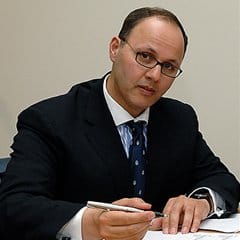
Part of the governors’ job is to supervise relationships such as the one between the university and CIF. The university accounts duly disclose both this connection and the total amounts involved. They do not, however, disclose how much, if at all, Morris has benefited personally from the £3.2 million that CIF has charged to the university.
There’s another connection between Abdel Haq and the Morris family that shows up in public filings. Back in 2012, when Baroness Morris was the university’s chancellor, her daughter Katharine Morris became a director of a private company controlled by Abdel Haq. We’ve asked Abdel Haq if Katharine received any financial benefit from this arrangement, and whether it was declared to the university’s board of governors, but he has not responded to that question.
We also asked the university and Abdel Haq why Oakstone Merchant Bank, a company controlled by Abdel Haq that seems to have been mostly dormant, received £4,000 from the university in the 2024/25 financial year. While small in absolute terms, the sum represents a quarter of the total turnover Oakstone Merchant Bank has reported in its thirteen years of existence. Neither took the opportunity to explain what this payment was for.
A £3.2m mystery
What exactly has the CIF done for the university in return for the millions of pounds it has been paid in recent years? The payments appear to be some kind of commission on student fees, paid in return for the centre attracting students to the university. According to our calculations, the CIF could be earning a commission of around 30% of each student’s first year fees.
The contention of several university employees, who spoke to The Mill on the condition of anonymity for fear of retribution from their employer, is that this is an unusual arrangement because commissions are usually paid to third-party agents which have no connection to the university (and tend to be in the range of 20-25%). By contrast, the Centre for Islamic Finance is closely related to the university.
“It’s a flagrant breach of our own governance requirements,” says a senior university staff member, who says that the centre is “profiting to an unjustifiable level”.
How much work does the Centre for Islamic Finance do for this above average commission? A former senior academic recalls its office workers were responsible for the operations of the Islamic Finance courses, including approvals, delivery, operations and student support – but in the words of this academic, “all of that [work] is already done through the university”.
“I have no idea what he does,” says another senior staff member, referring to Abdel Haq. “These are questions we’ve all asked. What does he do to warrant this commission?”