Yesterday, I spoke to someone who must be The Mill’s youngest reader. One of the youngest, at least.
Sofia King is 16 and she’s the editor of her school newspaper. She came to a talk I gave at the Lit & Phil last week, accompanied by the school’s librarian. I didn’t get to meet them after the talk (as you can imagine: after a lecture about the history of local journalism, the selfie line was long). But she responded to a callout we did on Instagram, asking to speak to young readers about how they get their news.
How do Sofia’s friends get their news? “Probably TikTok,” she says. As a wannabe journalist, Sofia reads online news from leading sources like The Mill and The Times. Shockingly though, it turns out this is not typical of her peers. “I don’t know any kids my age who read journalism from media sources,” she told me. “It will mostly be from TikTok.”
As a 36-year-old, I have very little idea of what TikTok is, beyond the fact that it’s a Chinese social media app that lets you scroll through lots of incredibly hyper videos, many of which last about 25 seconds. I can confirm that having a car companion who likes TikTok is a deeply irritating experience (three seconds of a Taylor Swift song – swipe - two seconds of a leading conspiracy theorist confronting a police officer – swipe – five seconds of the AI Queen rapping), but let’s hear from the experts.
Sofia says her friends started using the platform heavily during the pandemic, when they had a lot of free time, and “were constantly scrolling”. Now it’s the most-used app among her age group, and not just for fun dance videos. She says most of the news-related videos she sees on TikTok have an American focus – Jeffrey Epstein content is trending at the moment.
“I would say I hardly see any local news, it’s more global,” Sofia tells me. “And when I do see it, it’s ‘This woman was stabbed’ — the more gruesome violent stuff.” She mentions seeing lots of videos about homelessness and crime in Manchester — filmed by “content creators” like Charlie Veitch, whose videos tend to portray the city centre like some kind of lawless ghetto (a title of one popular video: “Dirty Manchester: 3 miniature criminals”). “It’s more like a TV show, like what you’d see in Shameless or something. It’s aggressive, getting in your face, screaming. It’s not a good reflection of Manchester in my opinion,” Sofia says.
Some of the videos her peers see are overtly misleading, or even AI-generated. In her politics class, she notices that some people have seen things on TikTok that are “clearly not real”. Maya, a 17-year-old family friend of mine, says that she’s noticing more and more AI-generated videos on social media. “It's amusing to watch, but unnerving and extremely hard to tell what's real now,” she says. Just yesterday, Oldham’s council leader Arooj Shah condemned a “racist and malicious AI video” that has been posted by a local wine merchant on social media.
But perhaps the biggest problem about young people getting their news from TikTok is that, even if a video is portraying something real, it usually lacks the necessary context: the backstory; the change over time; the data that puts things in perspective.
As Sofia masterfully describes it: “You won’t see what led up to all the shouting in the video. You’ll just see the shouting.”
A 20-year-old medical student who has written for The Mill and also uses TikTok (and who would prefer that we don't use her real name), makes the same point. She recalls seeing videos created by a Scouse ‘content creator’ who goes to Cheetham Hill to interview sex workers. The videos aren’t fake: these are real stories, and there is value in hearing them. “But he doesn’t have any analysis or any rebuttal,” she says. “He’s not giving figures or facts or context.”
The student notes that she gets a lot of her information from Instagram and TikTok. Although, at the moment she doesn’t have TikTok on her phone: she deletes it during term time “because I find it so addictive”.
My TikTok-using interviewees are pointing at one of the most significant trends in media since the invention of the printing press: that for the first time in hundreds of years, there is now a generation of people whose primary account of what is going on in the world is chosen not by human beings but by algorithms. A survey by Ofcom this year found that 75% of 16-24 year olds in the UK use social media to get their news, compared to just 43% from TV or 28% from radio. If we go down one age group, 12-15 year olds say social media is the way they most often access the news. TikTok is the top access point for news for this group, followed by YouTube and Instagram.
This is an epochal change in how we get information and perceive the world. What these young people see on all of these platforms is governed by an algorithm rather than a human editor making a decision about what is important or what is true. Generally that algorithm favours the outrageous and the entertaining — that’s what keeps people coming back. “You’re seeing this because it’s got six million views because it’s funny, not because it’s necessarily factual,” says Dr Jo Hickman Dunne, who researches young people’s use of social media at the University of Manchester. “You just see what the algorithm wants you to see.”
And what does the algorithm want you to see? A fascinating new study by researchers at the universities of Arizona and Miami analysed 578,000 political videos on TikTok, and found a “very strong” effect in the data: emotionally charged and conflict-heavy content did well, including videos featuring insults, attacking someone’s character, mocking opponents and videos with an aggressive or hostile tone.
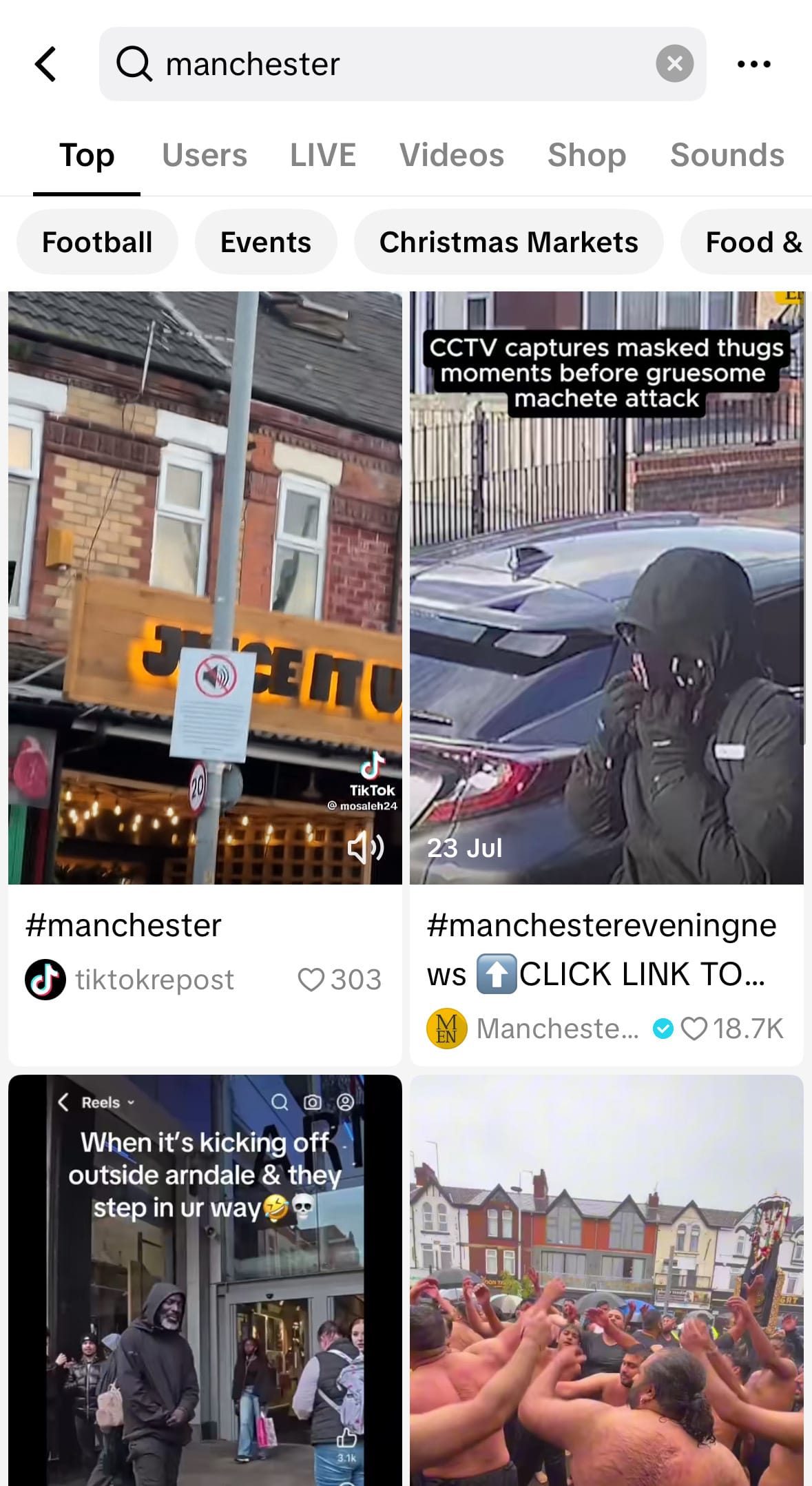
Search for Manchester on TikTok and voila! A video of a bunch of teenagers fighting on Market Street; a creepy video of young women in night out outfits taken without their permission; a comedian pretending to be scared of being in Moss Side; a bunch of men confronting and shoving someone they believe is shooting the creepy nightlife videos; a local creator who specialises in confronting police officers confronting a police officer in the city centre; and a man being interviewed about why “Manchester is badder” than London because it’s supposedly infested with knives. These are not the worst examples: they’re the first six videos that the algorithm recommends.
“My worry about this is, where does it go?” says Alun Francis, former principal of Oldham College. He says in classes with his students, he emphasises that “there is no editorial control over what you see, so you don’t know about the truth of it”. He knows that the children in his classes are not dupes, and the survey data backs this up: young people trust social media sources much less than newspapers or broadcast news. And yet, if you’re using one source much more than the others, it’s going to seep into your thinking.
That’s why, the first of our six campaign pledges is about sending The Mill’s journalists into local schools. The aim is not to patronise the students, or to tell them that TikTok is bad. They are almost certainly more discerning about what they see on social media than older people who didn’t grow up with it, and they don’t need to be lectured. But we would like to excite them about the value of proper investigative journalism, and for our reporters to use examples from their most interesting stories to pass on some skills about how you can look for context, and how you can get the full story.
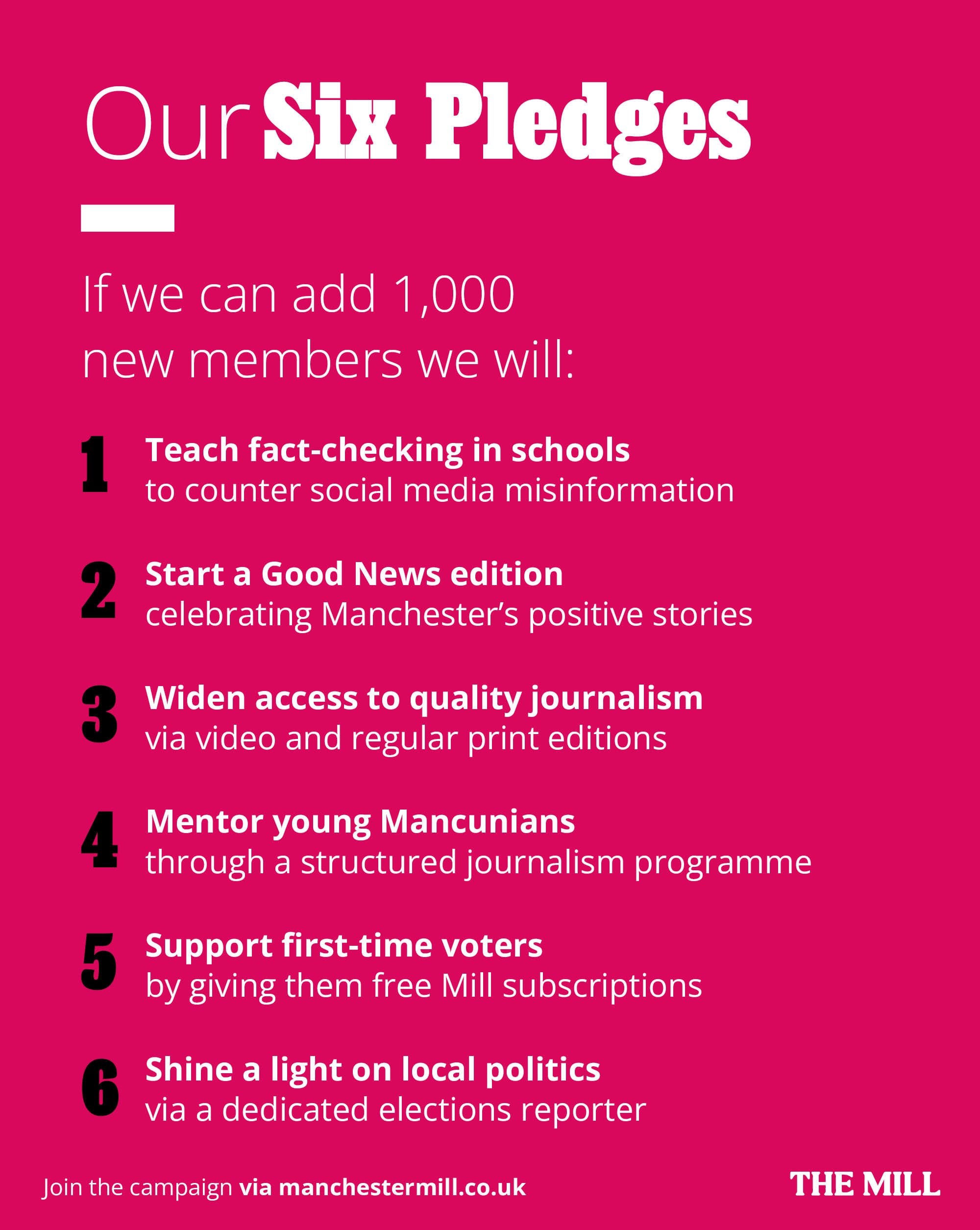
That’s what Mill journalism is all about, and I think hearing it from (relatively) young journalists who have had huge success and won big awards for their work will be inspiring and fun. And it may also connect a new generation of Mancunians with what good quality reporting is, and why it’s worth paying attention to. Instead of telling the students not to use TikTok, we’re going to encourage them to learn some Mill-style fact checking techniques, and use them to call out bogus videos and make investigative videos of their own.
When we asked our members to vote on which pledges we should pursue, that top one about going into schools was the runaway favourite, and two other pledges are also linked to young people: number three (about widening access to our journalism via video) and number five (about giving free subscriptions to first time voters). Clearly many of you want us to use our platform and our experience to help to inform and empower young people, and we’re very up for the challenge. In fact, Sofia’s school librarian wants us to come and speak there early next year, so they can be our guinea pigs for the new scheme.
That’s if we hit 1,000 new members, of course. All of our pledges are linked to us hitting that target, and that’s not an arbitrary goal: it’s the kind of members boost we need to do what we want to do next year: take the next step up with our journalism, and embark on these new projects that we think will have a positive effect on the city.
As part of our campaign, you can choose the price you think we're worth for your first two months of membership. Mill members get lots of extra members-only reporting, including great analysis of the big issues in the city, big scoops about local wrong 'uns and the best cultural writing money can buy.
Becoming a Mill member also means you're someone who believes in proper journalism and having a rational, nuanced view of the world. That's you! Join up now and help us to get to 1,000 new members in the next few weeks. You can cancel any time.