
Dear readers – there was one thread left dangling in Joshi’s widely-read essay about Andy Burnham, and it was about homelessness. Joshi noted that rough sleeping had fallen sharply after Burnham became mayor. But what was the number at the official count last year?
Every year, the GMCA publishes a press release, usually early in the year, announcing the new number (based on an official count that takes place on one night in November) and taking credit for the progress made. Ending rough sleeping by 2020 was, after all, Burnham’s most high profile promise when he was elected, and even when 2020 passed, it continued to be a major priority, with millions spent on his flagship A Bed Every Night scheme.
This year, they still haven’t made such an announcement. So we dug into the figures from the government and checked them with Burnham’s team.
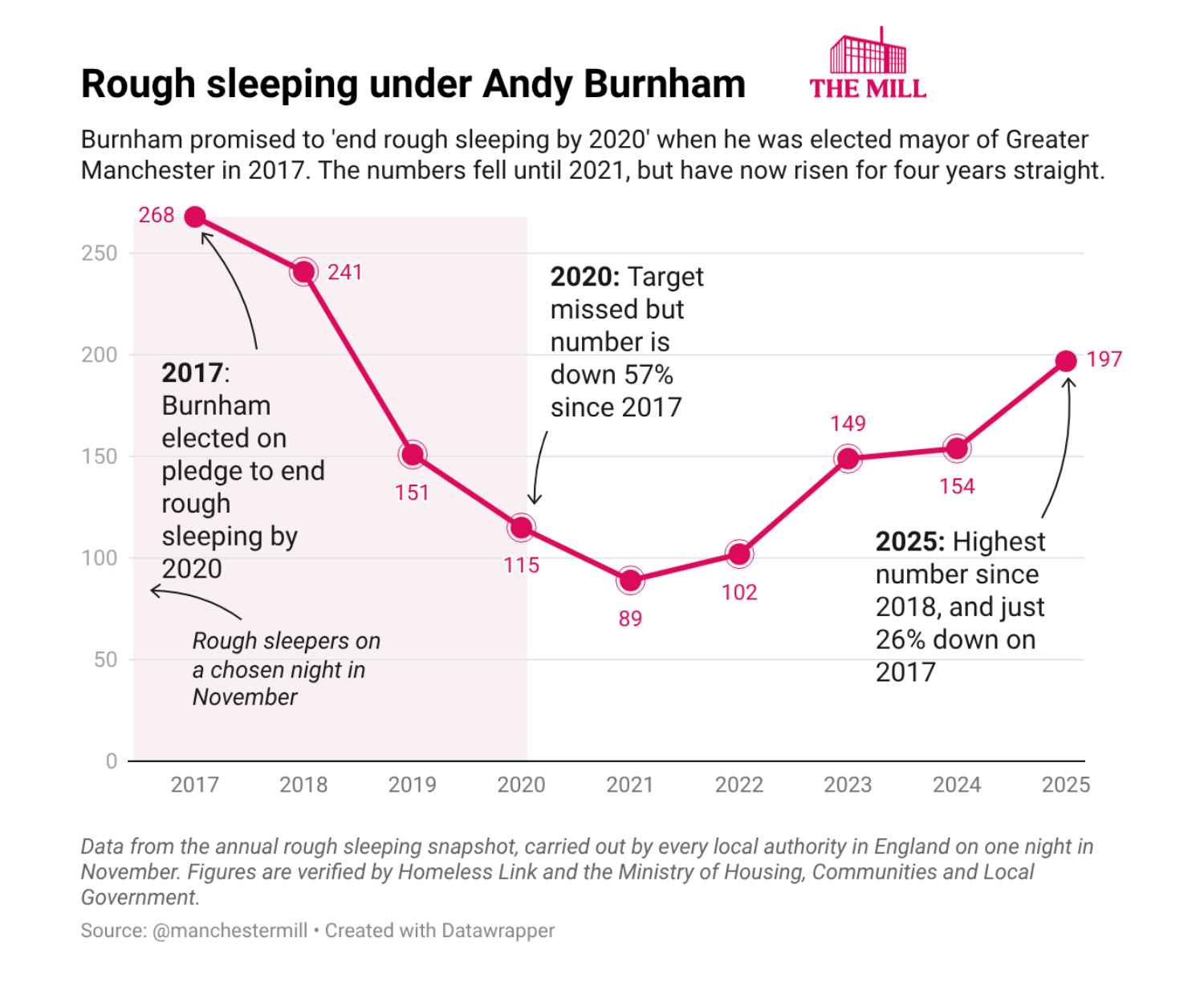
The upshot: The number increased to 197 last year, up from 154 in 2024. It means that the number of people seen sleeping rough on the official annual “snapshot” count has risen for four years in a row and has more than doubled since 2021. The number is now closer to the count when Burnham took over (which was 268 in 2017) than the lowest count that was achieved in 2021, when 89 rough sleepers were counted.
Here’s our graph showing how rough sleeping has gone down and then up again since Burnham became mayor:
Was there a reason that the GMCA didn’t announce its 2025 numbers as they normally do, in a period when Burnham was in the national spotlight, first when he tried to run for Gorton and Denton and now in Makerfield? “No, there is no specific reason why no announcement has been made this year,” a spokesperson told us.
The GMCA says that the increase in 2025 is consistent with a national trend in recent years, but four years of increasing rough sleeping suggest that the Greater Manchester model is no longer the exemplar for how to tackle street homelessness. Government data shows that London, Yorkshire and The Humber and the East Midlands all saw decreases last year, and Salford was one of the local authorities with the latest increase, rising from 18 to 41 between 2024 and 2025, an increase of 128%.
The combined authority is accommodating a lot of rough sleepers via A Bed Every Night – it increased the bed spaces from 550 to 600 this time last year. Burnham’s officials point to the freezing of Local Housing Allowance rates, increased evictions from the asylum system and the complexities of accommodating people with unmet health and social care needs as factors that are pushing up rough sleeping across the country. It’s also clear that the Everyone In initiative during the pandemic may have kept numbers artificially low in 2020 and 2021.
Does Burnham want to build?
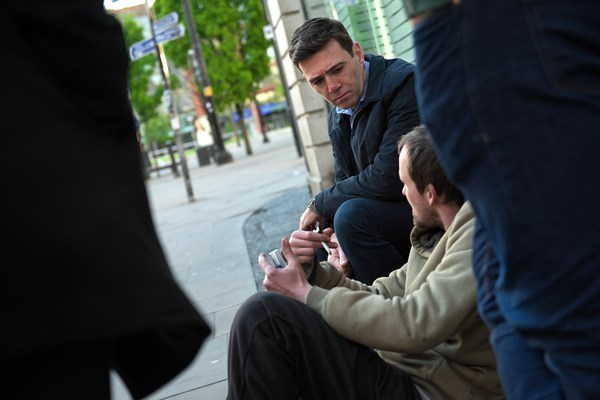
Tackling homelessness has been central to Burnham’s agenda as mayor. When the number of rough sleepers fell to 89 in 2021, he said that Greater Manchester's “ground-breaking approach to rough sleeping” was changing people’s lives. In his Makerfield campaign, he hasn’t spoken much about the issue, and it doesn’t get a mention in his essay in The Times today, in which he responds to Tony Blair’s intervention earlier this week.
What Burnham does talk about – and has made a theme of his campaign – is the closely related issue of housing. “The failure to reform right-to-buy and fully restore the public housing stock is the root cause of today’s housing crisis,” he writes. Naturally, his critics on the Right contest that point, asking why he isn’t talking about a key plank of Manchester’s recent economic journey: private home-building.
So what does the mayor’s record tell us about what he believes about housing, and what he might do in government? Jack Dulhanty has dug into those questions for Part 2 of our Burnham Blueprint series: a special set of articles examining Andy Burnham’s record and what he believes in. How much has the mayor interacted with property developers? And, crucially, has he achieved his promise to build thousands of new social homes?
This piece - and all of our Burnham Blueprint editions until election day - is only for paying members. Join up now to get the best insights into the man who might become prime minister, from the team who have been covering him for years.
‘Tangible sense of tension’
At a property and infrastructure conference held in Leeds last week, attendees were nervous about the dawning realisation that Burnham might be on his way to Number 10. “There was a tangible sense of tension among some delegates representing Greater Manchester” at the catchily acronymised UKREiiF event, according to one attendee, the former MEN journalist Simon Donohue.
In a blog post, longtime Miller Donohue – who now works in the property industry – noted that Burnham’s run for parliament in Makerfield “leaves a sizable hole in some of the certainties that have helped deliver a property boom in parts of Manchester and Salford over the last decade.”
What does he mean? Well, for one thing, if Burnham is replaced by a Reform mayor, the build-at-all-costs mentality that has characterised Manchester’s recent history might well be shown the door, even though most of planning policy falls to councils rather than the GMCA. “Everybody’s fear, that I have talked to, is that it isn’t a certainty that a Labour mayor would succeed Andy Burnham,” one senior property executive in the city told me.
Donohue notes the mayor’s “sensitivity to the politics of planning” and says his “preference is for growth led by town-centre renewal, regeneration and brownfield sites, while trying to limit the public backlash that can accompany green-belt release or poorly explained environmental measures.” Burnham has already expressed sympathy for campaigners opposing local developments in the Makerfield constituency.
We’ve heard a mix of views from property industry insiders in the past week. Some say he hasn’t been a major player in this space and that development isn’t really his thing. Others say his true focus is to spread prosperity and growth beyond the M60 into the outer boroughs.
There’s no doubt that the GMCA’s access to huge pots of public money has made Burnham a de facto kingmaker in the world of housing, however much the topic interests him. Indeed, next month, in the middle of his by-election campaign, one developer will take his combined authority to court for allegedly distorting the local property market.
‘He doesn’t get his hands dirty’
As Joshi covered in his piece last weekend examining the elusive concept of “Burnhamism”, by the time the mayor arrived in Greater Manchester, Richard Leese and Howard Bernstein had already worked to attract enormous private investment into the city centre. The party was in full swing, and it was the councils who handled most of the key decisions when it came to property development.
“He doesn’t get his hands dirty on those sorts of matters,” says an executive at a big developer in the city. “He’s the figurehead, he creates the stable landscape.” The executive says Burnham, unlike Manchester’s director and deputy directors of planning Julie and Dave Roscoe (who are married) or city council leader Bev Craig, isn’t a significant figure in “the village” of Manchester development.
Instead, Burnham’s focus has been on pushing development into the outer boroughs. “Knock yourselves out in the city centre guys, but be aware I'm putting lots of other things out of the city centre too,” is how close Burnham ally Tim Heatley sees the mayor’s development philosophy. Developers like Heatley — founder of “social impact developer” Capital and Centric — have built more in places like Bolton, Stockport and Wigan. “Under Howard and Richard, Greater Manchester complied,” Heatley tells me. “Manchester came first, they held the whip. Burnham's encouraged things outside of the centre.”
Take, for example, Capital and Centric’s Farnworth Green, in Bolton. It would have been inconceivable for that area, a dilapidated precinct, to have attracted a major developer in the Leese and Bernstein years. Burnham set up a “town centre challenge”, into which councils could apply for funding to help do up their town centres, which helped pave the way for the work.
Heatley bought into the idea that people moving to Greater Manchester for the first time would move there, telling us at the time “because of the university, so many people come from Brighton or Belgium or Bristol or Berlin, and they have no preconception of what Bolton is like.”
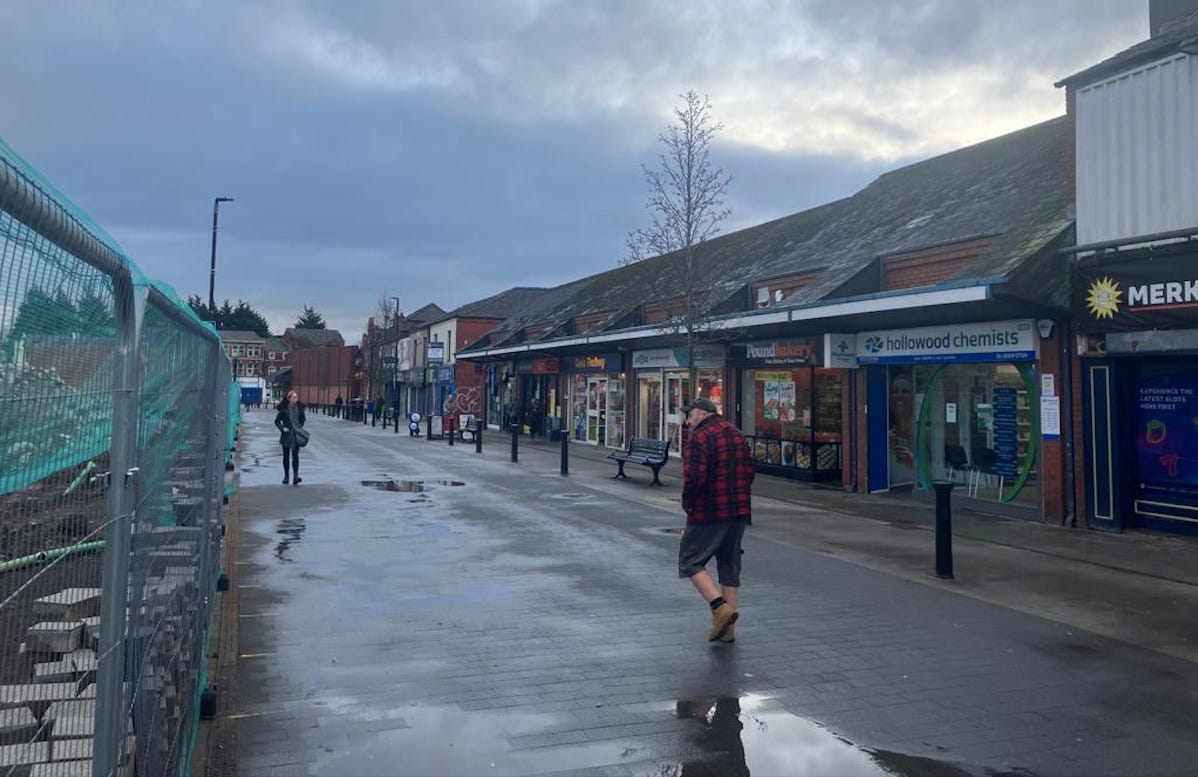
An achievement in this vein that Burnham can point to is his Mayoral Development Corporations. These “MDCs” were set up in 2011 to give metro mayors powers to assist the development of a specific area. In some cases, mayors take control of local planning to help grant faster permissions or lower business rates to attract investment. Burnham has either established or committed to establishing MDCs in nine areas of Greater Manchester. All are outside of the centre, in places like Rochdale, Bolton, Tameside and Wigan.
The most successful of Burnham’s MDCs is the one covering the west of Stockport Town Centre, which was set up in 2019 and has since become the first MDC in the UK to be expanded, taking in the east of the town centre too. The western MDC has delivered 1,200 homes as of February this year (promising to build 4,000 total) and a new transport exchange. The new eastern MDC is looking to build a further 4,000 homes, a new secondary school and a health hub.
The first MDC’s constitution left planning and business rates in the control of the local authority. The GMCA’s role was directly investing in the town — such as commissioning, alongside the council and TfGM, the construction of the transport interchange designed to link in with the Bee Network — and reassuring developers like Heatley’s Capital & Centric that the area was a place worth investing in, because it was a political priority.
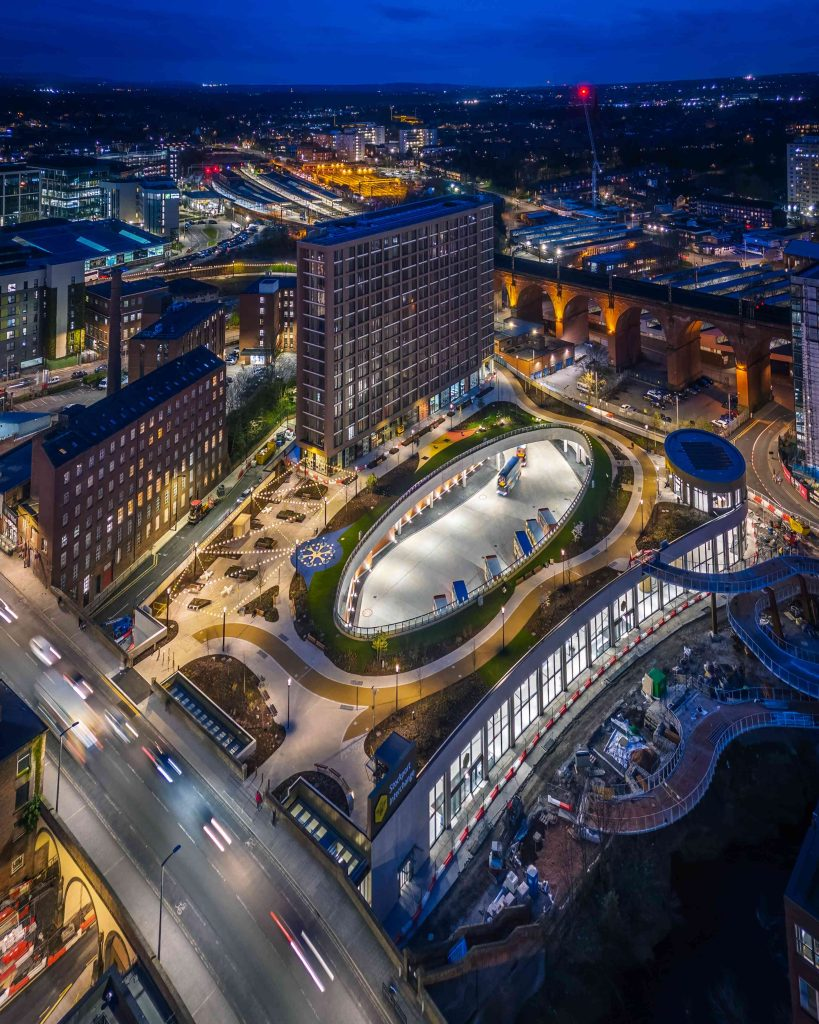
By 2024, the end of the MDC’s first seven-year cycle, Stockport had been named the best place to live in the North West by the Sunday Times. When Burnham was being interviewed by the New Statesman, he took them along to a talk he was giving in the town: “The area is a vision of Burnhamism if ever there was one,” the piece said.
Mark Hunter, the leader of Stockport council at the time of the bulk of the MDC’s development, sent a letter to the magazine highlighting that this feat was in fact delivered under a Liberal Democrat council. You could see that as an example of cross party support of the mayor’s vision, or, as Hunter put it to me with a note of sarcasm: “what you can get done when you don’t mind who gets the credit — that sums Andy up.”
The planning blowback
The year was 2017, and Burnham was making a lot of promises. Just over a year removed from his second failed bid to become Labour leader, Burnham was setting out his stall to become mayor, and alongside city centre homelessness, the other hot topic was planning.
Greater Manchester’s councils had delivered a final draft of the catchily named Greater Manchester Spatial Framework, a regional plan for housing, infrastructure and new employment land. Public consultations received thousands of complaints about the amount of greenbelt that would be developed under the plan, and Burnham, in campaign mode, promised a “radical re-write” of the plan that would preserve green spaces.
One planning consultant remembers the draft GMSF plan as ready to go to final consultation, with the support of all ten councils, to be adopted in 2018. But then Burnham was elected and had Paul Dennett, the mayor of Salford, set about rewriting it.
Now called Places For Everyone, the plan only covers nine boroughs after Stockport pulled out in 2021. “It took him seven years to get the Places for Everyone taken up, but reduced the housing target and lost Stockport in the process,” says the consultant, who was close to the plans, adding “if you measure the process from start to finish, it took a decade for a plan that only lasts 15 years. A large part of that was Burnham cycling in the background trying to make everyone happy.”

Now, you might say, that’s what a planning consultant would say. Burnham is a politician and there was a lot of very vocal opposition to the spatial framework’s use of green belt. Facebook groups (Bury Folk Keep it Green, Save Royton’s Green Belt, etc) were full of posts calling on the plans to be changed.
It made sense as a campaign promise, but with hindsight many wonder whether it was a necessary one. “There was a bit of grief on Greenbelt allocation, so Andy promised to take them all out,” one former political assistant to a council leader recalls.
Shifting focus from greenbelt to urban development meant, theoretically, young people staying in their areas. This appealed to council leaders, even those with less green belt development earmarked for their areas. Allen Brett, the leader of Rochdale at the time, told me: “I disagreed with (Burnham) on many things, but that was one of the big things we agreed on”
Places for Everyone still attracts controversy. In late 2024 councillors in Oldham tried to appeal to the secretary of state for housing to help them withdraw from the plan, and the rise of Reform in council chambers across Greater Manchester could spell trouble. But in its latest monitoring report it is surpassing its targets for new house completions: 10,407 so far, which is 1,344 more than projected. 2,797 of those new homes were affordable, an increase of 383 from the previous year.
Big pots of cash
“If you look back over Burnham’s tenure as mayor,” one developer told me recently, “his importance has changed as the combined authority has become a much more central vehicle for the receipt of government money.”
When Burnham became mayor in 2017, he didn’t have much access to cash. But over the years, he has agreed further devolution deals with Conservative and Labour governments that have given the GMCA access to billions of pounds. The mayor’s ability to “reach out and influence the chancellor and ministers” has been key, the developer says.
In late 2025, the combined authority announced a Good Growth Fund, which had an initial investment pot of £2 billion to invest in new homes, regeneration and transport projects. That figure is made up of loans, grants, money borrowed by the GMCA and investment by the Greater Manchester pension fund.
Money from the fund has so far been loaned to Bruntwood’s “innovation campus” Sister in Manchester City Centre, and regeneration projects in Prestwich and Oldham. It has also invested £70m in new roads and cycling lanes in Bolton to support the town’s bid to host the Ryder Cup golf tournament.
Funding pots like the good growth fund make the GMCA, and Burnham by extension, someone worth having on your side if you want to build in Greater Manchester, in a way they were not previously. But this dynamic has invited criticism too.
Plenty of you will have seen a viral social media posted by Zoë Bread, a zany but effective citizen journalist I wrote about earlier this year. In one of her videos, Bread skewers the relationship between Burnham’s GMCA and Renaker, the city centre’s most prolific developer, which has gone from a relatively modest outfit to a multi-billion pound business responsible for much of Manchester’s glittering clusters of skyscrapers.
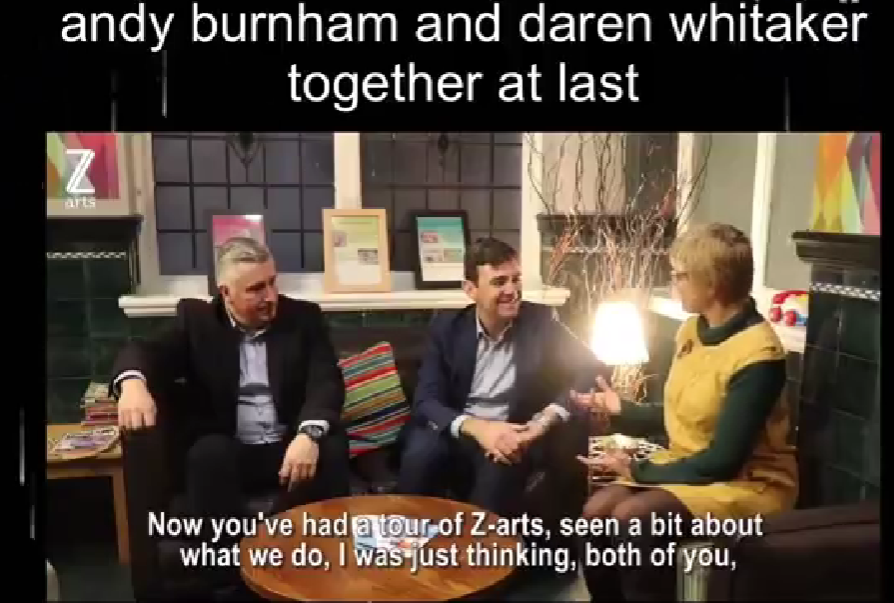
In her video, Bread suggests Renaker was unfairly subsidised by the GMCA, lent millions in loans to build skyscrapers, making its owner Daren Whitaker worth £797m (up £99m in one year according to the latest Times Rich List) before he moved to Monaco (he moved back after backlash). Under Burnham’s vision of “business friendly socialism”, Renaker appears to be a very dear friend indeed.
Returning to that warm May day in 2017, when Burnham was telling reporters about his housing plans a few days after his election, he was keen to stress that he wanted more focus on building more social housing. “In recent times there has been a focus on flagship development, on high-end development.” Burnham said those schemes were worthy but that “now, the focus needs to change.”
The property website Place North West described the new mayor’s statement as a swipe at the Greater Manchester Housing Investment Loans Fund, a £300m pot of money given to the city region under the 2014 devolution deal, to be loaned to developers as a leg-up to deliver housing. Burnham said too much of the money had been loaned to build luxury privately rented properties. In fact, before his election, Burnham wrote in Inside Housing that, if elected, “I will renegotiate the aims of this fund so that we can fully focus it on the long-term goal of an affordable home for all”.
But in March this year we uncovered a report commissioned by the GMCA but never published. It found the loans from this fund were “heavily skewed” towards Renaker. In the nine years between 2015 and 2024 — seven of which Burnham has been mayor — the GMCA has lent £984m from the fund (which cycles the repaid loans back out to developers). The fund, the committee of which Burnham chairs, has given some £600m of that figure to Renaker.
There’s no suggestion that the mayor decides who should get the money on his own. But David Smith Milne, the founder of affordable housing developer Place Capital Group, believes Burnham should have taken more responsibility to ensure the money as used to deliver for more people: “the politicians should have held the system to greater account for affordable housing, and he is without doubt the most important one.”
A social homes promise
Burnham has won three successive mayoral elections, and each campaign came with a new top priority. When he ran in 2017, he promised to end homelessness by 2020. When he won in 2021, he committed to better jobs, homes and transport. In 2024, his top priority was to end the city region’s housing crisis. “Greater Manchester can’t achieve its full potential as long as it remains in the grip of a housing crisis,” Burnham said.
But how does Burnham plan to do this? The GMCA doesn’t build homes itself, but it can funnel money from funds it has won from the government to the local authorities. Manchester City Council, for example, got £26m from the Good Growth Fund in March this year and is using it to build 233 socially rented homes, 81 affordable homes and 109 homes for those with additional needs in Wythenshawe.
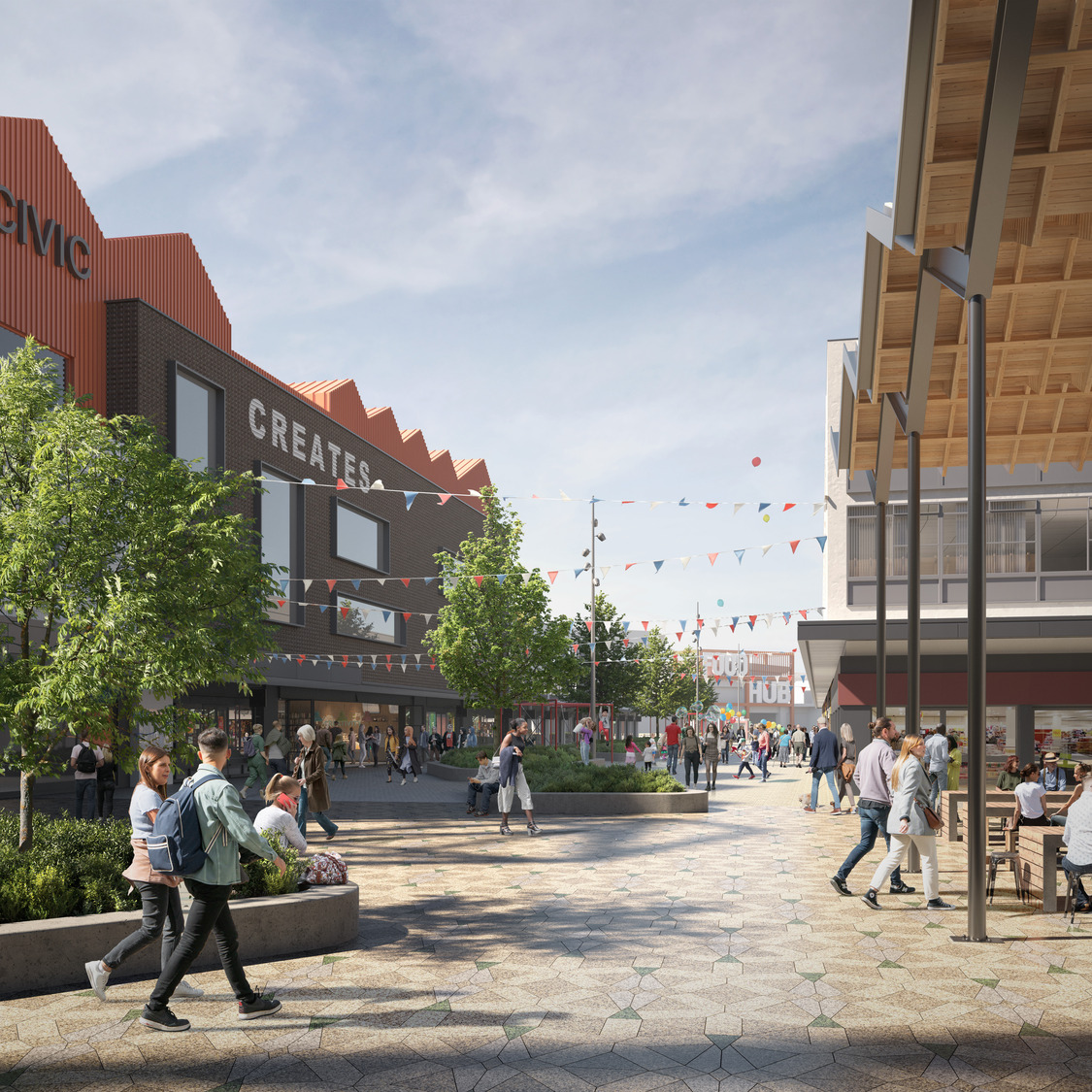
After his re-election in 2024, Burnham announced the launch of the GM Housing First Unit. One press release from May 2024 says “a new GM Housing First Unit will bring a plan by the end of the year” on how to build 10,000 council homes, at least one thousand in each borough, by 2028.
Writing in the Guardian that same month, Burnham wrote: “I will build at least 10,000 council homes”. In fact, the new unit submitted a plan to the government for the funding from its Social & Affordable Homes Programme, so that councils and Homes England could do the building.
The plans drawn up by the unit to be submitted to the government don’t appear to have been published anywhere, nor were there any announcements as to whether the government adopted it. When we asked the GMCA to see the plan, we were directed to the Greater Manchester Strategy for 2025-35, which also mentions building 10,000 social homes, but now it says by 2030 instead of the 2028 deadline Burnham previously promised.
So how many have actually been built since the 2024 pledge? The GMCA says that 611 new social homes were completed between 2024 and 2025, which suggests the programme is going much slower than expected. On the one hand, there is clearly a lot more social home building than previously: the highest level since 2011/12, the combined authority says.
On the other hand, there is little chance that Burnham can deliver his pledge in the Guardian that he will “build at least 10,000 council homes” by the end of this mayoral term (2028), and the current rates suggests that only around a third of that number would be built by 2030.
Social housing is a big theme of Burnham’s campaign in Makerfield and his pitch to the country. The numbers suggest progress, but as with his famous pledge on rough sleepers back in 2017, delivery that is well short of what he promised.