
Five years ago, I had a phone call with Andy Burnham, who had recently been re-elected for a second term as mayor of Greater Manchester. Burnham’s victory in the 2021 mayoral election was widely predicted, but the scale of it was staggering: he had won not just in every borough of the city region but in every council ward. The deep red electoral map proclaimed that Greater Manchester was now Burnhamland.
Our call wasn’t supposed to be about Burnham, per se. I was writing a profile for The Mill about Sir Richard Leese, the outgoing leader of Manchester City Council, who was stepping down after 25 years running the city, and Burnham had agreed to contribute his thoughts. I wondered if the call would be awkward. The two men had known each other for 20 years but had a difficult relationship.
“We’ve had our moments,” Burnham said, with what we both knew to be considerable understatement. After Burnham became mayor, he had asked Leese to be his deputy, but the region’s two most influential figures were odd bedfellows, and they regularly clashed.
“I am different in style, I guess,” Burnham said, when I asked him to explain what the difference was. Burnham admitted that as his first mayoral term wore on, Leese would accuse him of bringing in his “Westminster ways,” — like announcing things without getting proper sign off. “So, there was a bit of a culture clash.” Leese, he said, “Brings a rigour to what he does, which…” he paused. “I wouldn’t say I lack, but I am a more instinctive politician, in that I will have a feel for something.”
Who is Andy Burnham and what kind of prime minister would he be? I’ve been covering him up close in Manchester for six years now, a period during which few people south of Stockport have cared about the answer to that question. Now, Burnham is running in what might be the most consequential parliamentary by-election in British history, with the chance to grab the prize he’s coveted for his entire career, and suddenly every man and his dog wants to know.
The national media, which rarely covers Manchester in any depth, has this week produced a firehose of podcasts and essays about Burnham and ‘Manchesterism’, his supposed political programme. There are, broadly, two stories being told. In one telling, he’s the saviour Labour needs: a man with a radical analysis of what ails the country and a playbook for change that has been forged and perfected in Manchester. In another, he’s a cynical chameleon – a master communicator who lacks substance and will say anything to advance his career.
Both analyses, I think, miss what Burnham’s great strength really is. And neither deals with what may prove his fatal weakness.
The late-night call
Two weeks after Burnham was first elected mayor, he called Leese in the middle of the night. Just after 10.30pm on 22 May 2017, the Islamist terrorist Salman Abedi detonated a nail bomb in one of the entrances to the Manchester Arena, killing more than 20 concertgoers, including an eight-year-old girl.
It was a nightmarish start to his mayoralty, and Burnham rang Leese to discuss how they should respond. The next morning, they appeared outside Manchester Town Hall in dark suits, addressing the assembled mourners and a bank of cameras. “We are grieving today, but we are strong,” Burnham told them — urging the city to go about its day as far as possible as normal. His short speech struck a tone that balanced grief with local resilience, but he looked and sounded like a politician: appropriately stoic in a moment of mourning.
Three years later and the two men were again standing next to each other in a moment of national crisis, this time outside Bridgewater Hall, flanked by other local council leaders. Half an hour into the Covid-19 press conference, Leese stepped forward to show Burnham his phone. He’d just received a message from colleagues in Westminster confirming that the government was about to impose Tier 3 restrictions on Greater Manchester, offering only £22m in relief funding after talks between the two parties had broken down.
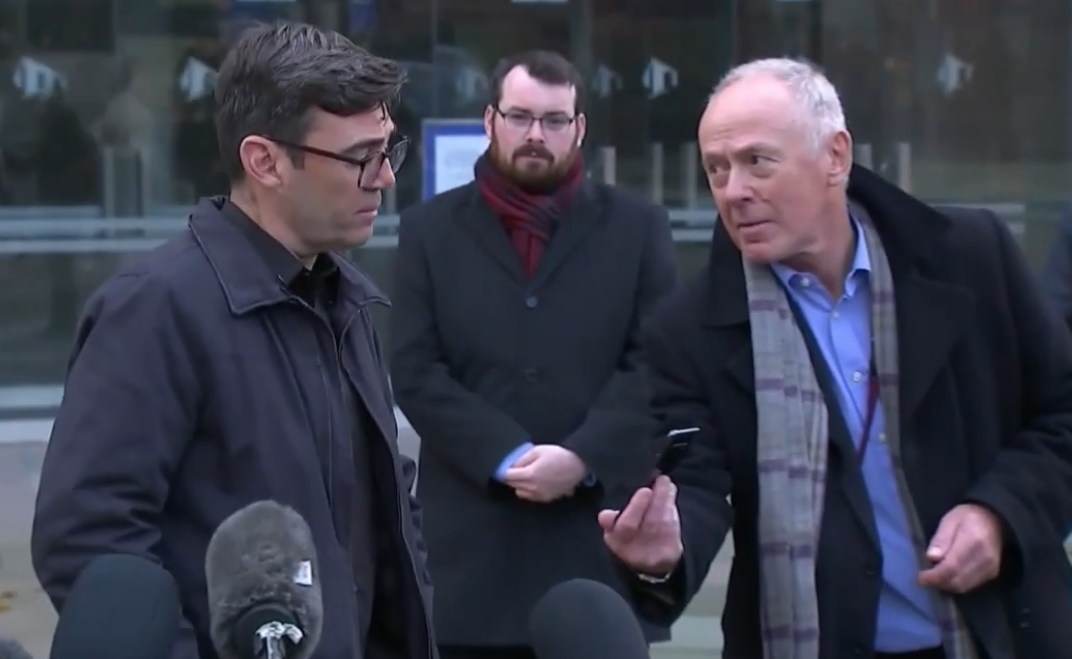
In the video of that moment, you can see Burnham composing himself as Leese reads out the details from his phone. “DISGRACEFUL” someone shouts from behind the cameras and microphones. Burnham screws up his face and looks at the ground. “It’s brutal, to be honest, isn’t it?” he says. Then he finds his range.
“This is no way to run the country in a national crisis, it isn’t. This is not right. They should not be doing this. Grinding people down, trying to accept the least they can get away with.”
It was instinctive and brilliant. In that moment, Burnham had found something inside himself that we hadn’t seen before, not even after the Arena bombing: a brand of moral leadership that perfectly captured the powerlessness many people felt. No longer a New Labour apparatchik, he had put on a garb we associate with great municipal leaders of the past: charismatic, non-partisan figures who offer their cities solace in painful moments, some guiding values and a sense of protection from the wolves at the gate.
Within minutes, social media was alive with memes christening Burnham the King of the North. Some in the national media felt the phone routine was hammy, even staged. But in Manchester, many of us could feel that Burnham had embodied the anxiety of a city.
“Richard [Leese] is ten times more intelligent than Andy, but Richard couldn’t do that,” says one person who has worked with both men when I mention that scene. The next year, Burnham won his landslide re-election victory.
Long term bets
When he came to Manchester, Burnham was joining a mature political project whose progenitors worried he might mess things up. “My worry was that he wouldn’t get it,” says Dame Diane Coyle, now a professor at the Bennett School of Public Policy in Cambridge and then one of a small group of economists whose work informed the city’s strategy. Coyle was one of the authors of the most influential document in Manchester’s revival: the Manchester Independent Economic Review, first published in 2009.
The review emphasised that the city needed to make long-term investments in things like early years education, transport and public health if it was serious about getting economic growth. Only places with a strong set of infrastructure can get on and do economically valuable things, the thinking went. “What happened in Manchester was a willingness and capacity to make those long-term bets,” Coyle recalls.
Coyle says her concern about Burnham didn’t turn out to be warranted: he seemed to understand what he had inherited and ably kept it on track. “I think he’s very self-aware about not being a policy wonk himself,” she told me. “He has a clear set of values — about making the economy work for working people.”
Something else stood out to Coyle in her conversations with Burnham. “He listens to people,” she says. “A lot of politicians I come across are really not very good listeners.”
Nevertheless, Burnham represented a change in emphasis from Leese and his dynamic council chief executive Sir Howard Bernstein, who had created the structures of Greater Manchester with their own fiefdom – Manchester – very much first among equals. Bernstein was a “Manchester man”, as one colleague of his puts it, and the city region’s growth was heavily predicated on attracting private investment and government largesse into central Manchester, plus parts of Salford and Trafford. Manchester was building a services-led economy centred on the universities, the BBC’s move to MediaCity and a cluster of digital companies and public agencies that had been prised away from London.
Burnham, on the other hand, seemed more interested in the peripheries of Greater Manchester and “left behind” places that had voted for Brexit not long before he was elected in 2017. “I don’t think Andy has ever been comfortable with the idea that we prioritise the regional centre because that is where the investment wants to go,” says one person who worked at the Greater Manchester Combined Authority in those early years.
The dirty work that Manchester’s revival was built on – striking hard deals to get capital flowing into the city, sometimes giving away public land and holding your nose about who you were giving it to – didn’t energise the new mayor. “Andy has always been interested in the people side of the economy, but he’s never shown much interest in the harder infrastructure and investment side,” the former colleague of his says.
‘We don’t ask serious questions’
What Burnham had a real flair for, however, was the symbolic side of leadership. Early on, he announced that he would give away 15% of his salary to help the homeless, something he has stuck to ever since. “I think that’s genuine,” says Vaughan Allen, who leads Manchester’s Business Improvement District. “His ability to embody and enunciate a vision is incredibly good.”
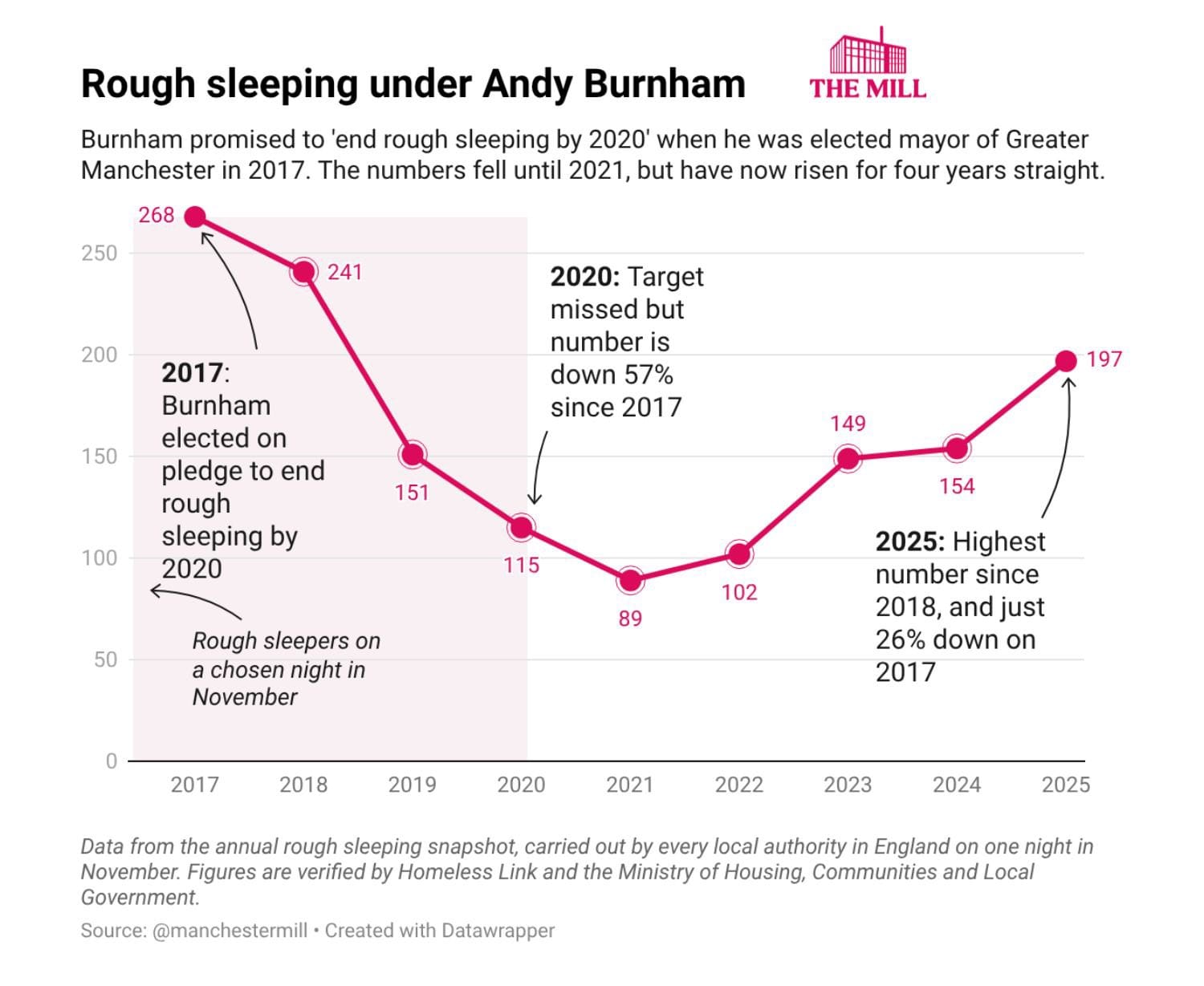
Allen also observed that Burnham’s public profile and tendency to make bold gestures was a double-edged sword. The new mayor’s most well-known promise was “to end rough sleeping by 2020”, a campaign commitment designed to address widespread concern about homelessness at the time and the ongoing “spice” epidemic on the streets. People working in the system saw Burnham’s promise as “ludicrous”, as one puts it, and utterly unachievable.
Allen, whose role involves trying to improve the state of the city centre on behalf of local businesses, realised that having a famous mayor using the phrase “A Bed Every Night” – the name of Burnham’s initiative – on TV was creating its own problem. “Once word got out, we got an influx of homeless from all over the country because they thought they would get a bed,” he recalls.
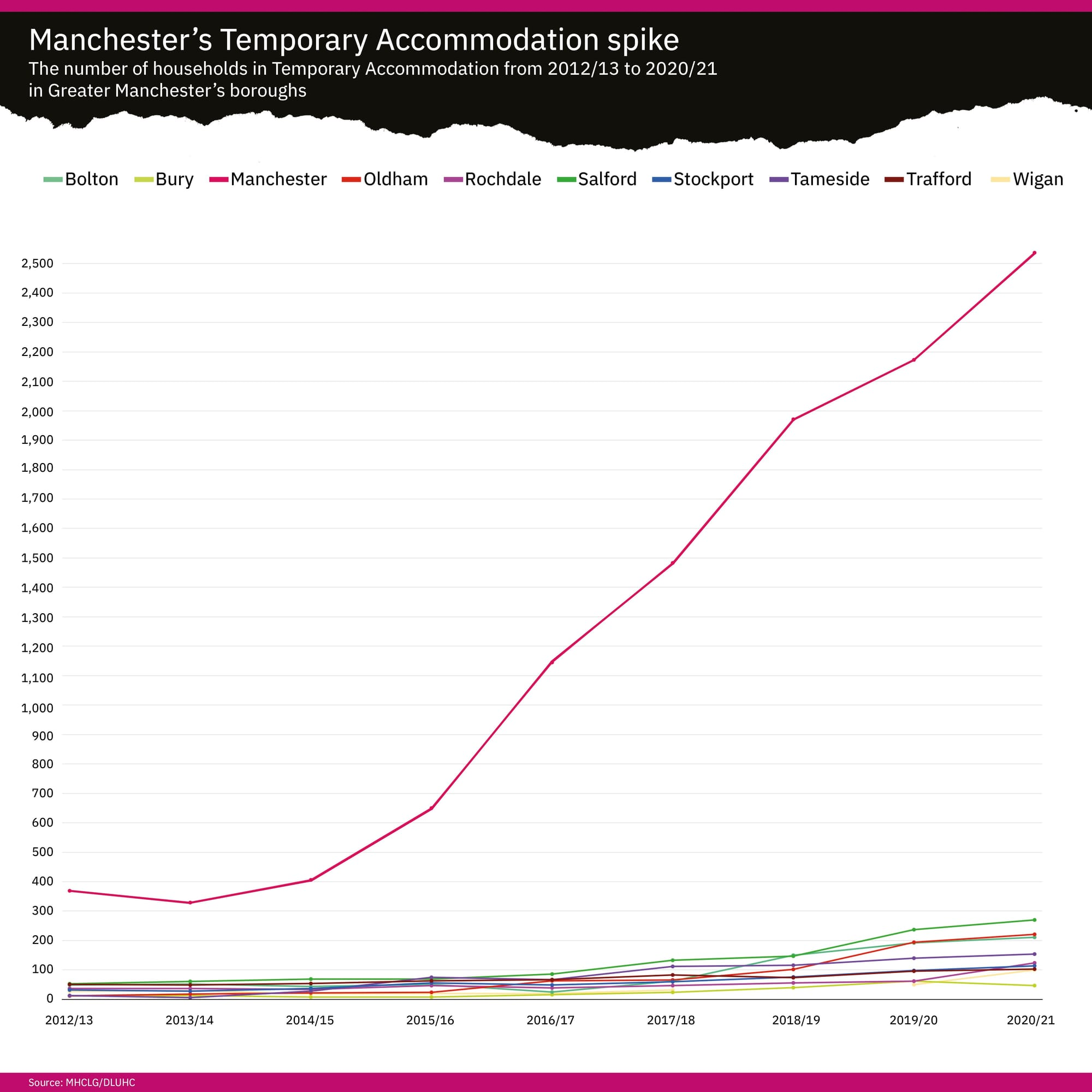
When The Mill did a big investigation into homelessness in 2022, working with a team of data science students from the University of Manchester, we found that Manchester was warehousing an astonishing number of people in temporary accommodation: up 600% from fewer than 400 households in 2013 to more than 2,500 in 2022, including several thousand children. That rise was nine times faster than the national average, and was costing the council more than £30m a year.
Burnham’s A Bed Every Night (ABEN) scheme had been a success on its own terms: it reduced the most visible form of homelessness, the number of people sleeping on the streets across Greater Manchester, from more than 250 in 2016 to 89 in the official count in 2021. This number rose again to 154 in Autumn 2024, and I can't find any announcement on the GMCA website about the 2025 count. (Update: After publishing this story, we requested the latest data from the GMCA, which shows that the number rose again to 197 last year – see graph below).
But we obtained a confidential report written for Manchester City Council by a leading homelessness expert who found that ABEN was having an unintended consequence: people referred via the scheme – some of whom were “at risk” of sleeping rough rather than doing so – were getting priority for social housing ahead of those warehoused in grim temporary accommodation blocks and hotels, for example disabled mothers (the Greater Manchester Combined Authority did not deny this was happening). A scheme designed to tackle one form of homelessness hadn’t been properly synced up with the system that housed a much larger group of homeless — the ones in so-called “temporary” accommodation, who we found were staying there for an average of 441 days.
“If what you’re doing is making sure everyone is off the streets straight away, you create a conveyor belt where people just know, come to Manchester and that’s a quick way to get a place to live,” one former senior council worker told us. “I don’t think there is any political ambition to look into this to see how well it [ABEN] is working because I think it will uncover the fact that it creates an anomaly”.
This, in a nutshell, is the sceptic’s case against Andy Burnham as leader: he likes doing big things but he doesn’t like asking the kind of uncomfortable questions that turn great ideas into durable policy. This is what Burnham was hinting at when he said Leese was sceptical of his “Westminster ways”, and what he meant when he told me that Leese was “analytical”, and that he himself was more “impulsive”.
This critique extends to the kind of people Burnham surrounds himself with, or so I’m told by one former advisor. The mayor has a positive, affirmative style of leadership at the combined authority, regularly holding all-staff meetings in which he gives praise and credit to his colleagues, in stark contrast to the more traditional style of Bernstein. But he tends to appoint staff who are “very much in his own image,” this person says. “We don’t ask serious questions about ourselves”.
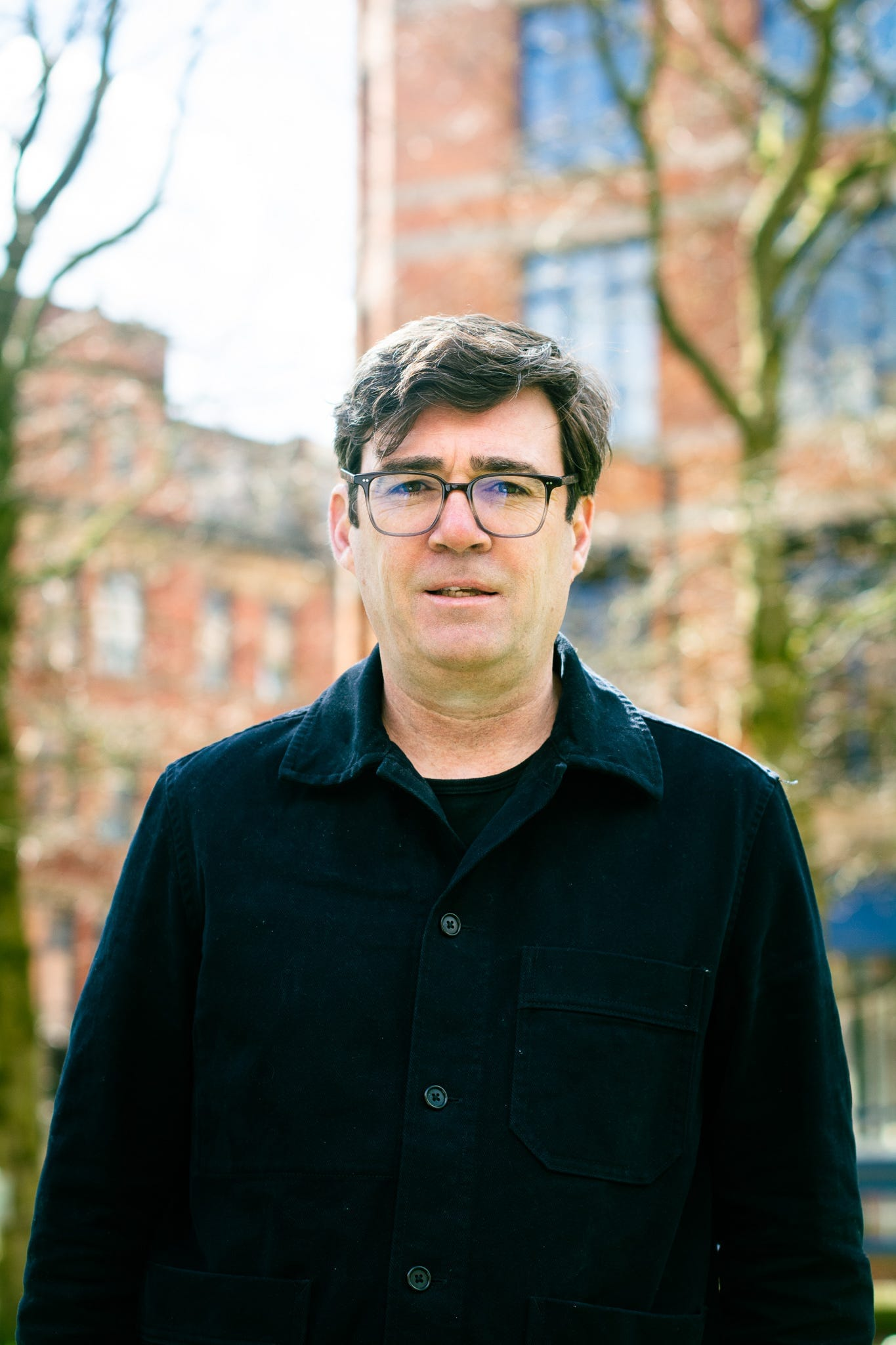
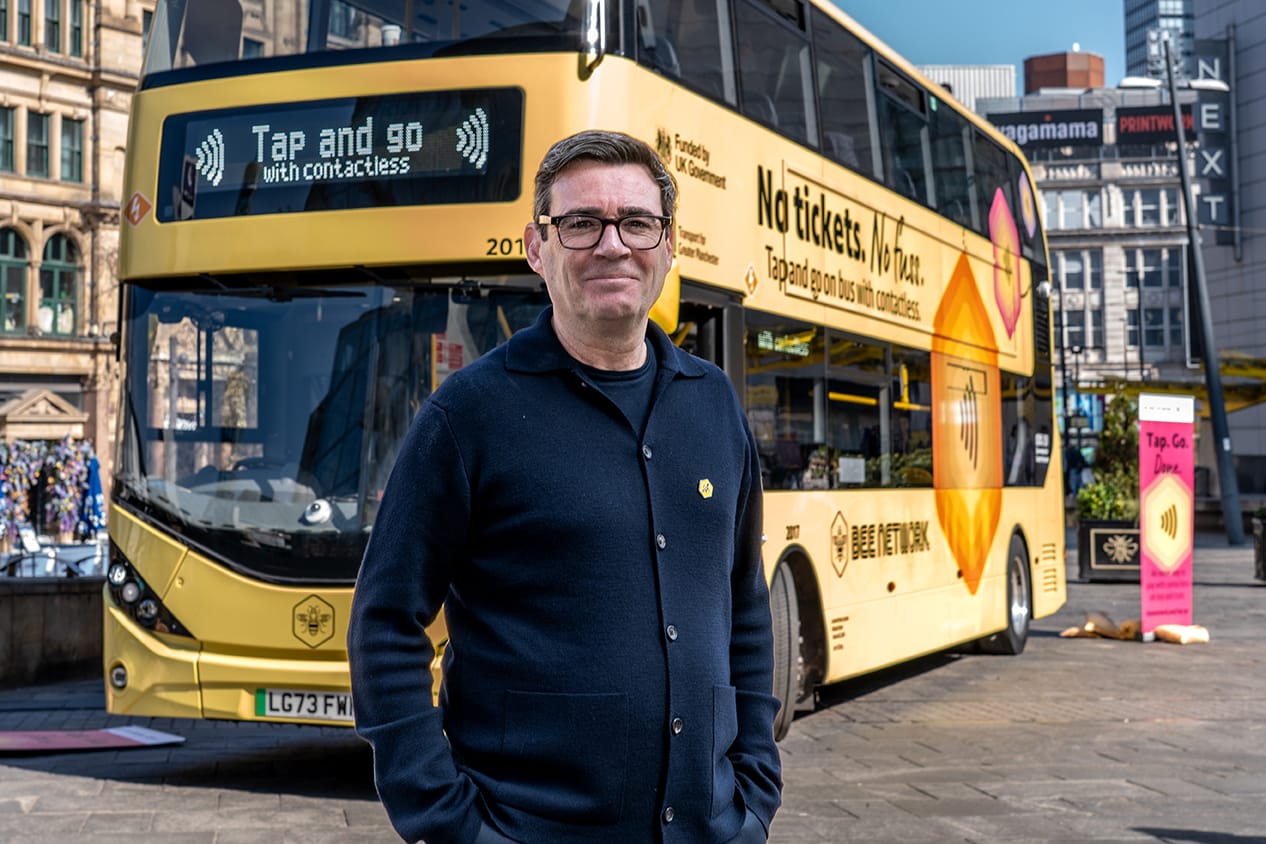
His most high-profile policy success – bringing the buses under public control, so that Transport for Greater Manchester can determine routes and prices – owes a lot to Burnham’s skill as a salesman. He was the perfect hype-man for a new system, appearing in clever videos explaining the problems with the unregulated private system ushered in by the Thatcher government and posing for endless very yellow press photos. But even the dogs in the street know that Burnham didn’t create the Bee Network. Rather, the Bee Network created him.
Bus reform was a major plank of the devolution deal negotiated with the Conservative government years before Burnham came back north, and Leese was a Bee Network believer avant la lettre. In the early days, Leese “repeatedly reminded” Burnham that bus reform was “the only reason” he had agreed to George Osborne’s proposal for a directly elected mayor of Greater Manchester, Burnham told me back in 2021, and Leese confirmed.
The other big transport initiative of Burnham’s period – the Clean Air Zone – is such a well-known disaster that it hardly bears repeating. Burnham tends to bristle when asked why he spent many millions on a project that caused such anger in the suburbs of Greater Manchester that it had to be abandoned even after the signs announcing the scheme to motorists were already in place: the CAZ was imposed on us by the Conservative government, he says. And yet, it was his team who designed it, and it was their failure to create the right carve-outs for delivery vans and other commercial vehicles that led to an angry revolt in places like Makerfield, which he now seeks to represent in parliament.
When the GMCA faced a situation where it needed to ask hard questions, our reporting often found that it preferred to dodge the questions entirely. The combined authority had a headline target, dating back to before Burnham’s election, to reduce cancer deaths by 1,300 per year by 2021, a 20% reduction, which was supposed to be one of the benefits of devolving health and social care budgets.
But when the Greater Manchester Health and Social Care Partnership, of which the GMCA was a key part, released its progress update in 2021 (under the title “Taking charge is working in Greater Manchester”), the cancer target had simply disappeared. When we asked for the updated numbers, we saw that cancer deaths had in fact gone slightly up. No one had highlighted this failure, and it felt like one of the most important aspects of devolution was barely being scrutinised — a sign of the GMCA’s curious reluctance to build proper mechanisms for accountability at the Greater Manchester level.
The lack of proper checks and balances around Burnham was best exposed in 2024, when my colleague Jack Dulhanty published an extraordinary scoop. Sacha Lord, a local nightclub entrepreneur whom Burnham had appointed as his unpaid Nighttime Economy Advisor, had grossly misled the government when one of his companies obtained just over £400,000 of Arts Council relief money during the pandemic by lying about what it did.
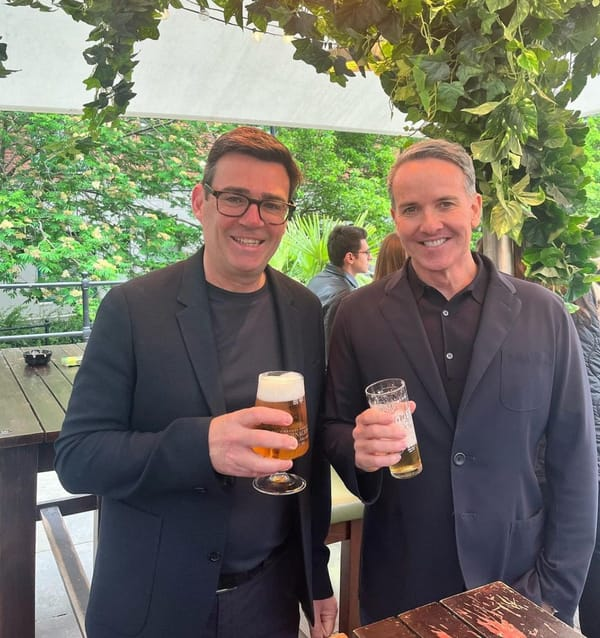
Upon hearing about the story, Burnham should have sacked Lord or initiated some procedure to scrutinise his unelected advisor and close friend. Instead, he stood by Lord for a few days until the evidence against him became overwhelming and then launched an investigation that misled the public about its narrow remit. Seven months later when the Arts Council vindicated Jack’s story and asked for the money back, Lord was forced to resign.
On a human level, the episode pointed to a fatal weakness on Burnham’s part: he wants to be liked and he’s not particularly ruthless. He “gets taken in by the blarney”, says someone who has known him for years, especially if the blarney comes from someone working in the music industry, which Burnham adores. “He was warned by people who he is very close to, for years, that he needed to move away from that relationship,” this person says. “Is that a sign that he’s loyal, or that he’s a bad judge of character? I think he’s a bad judge of character.”
Click here to join The Mill's free mailing list. We will send you a few great pieces about Greater Manchester every week, produced by our team of real journalists, with no AI nonsense, celebrity clickbait or pop-up ads.
The forlorn hunt for ‘Manchesterism’
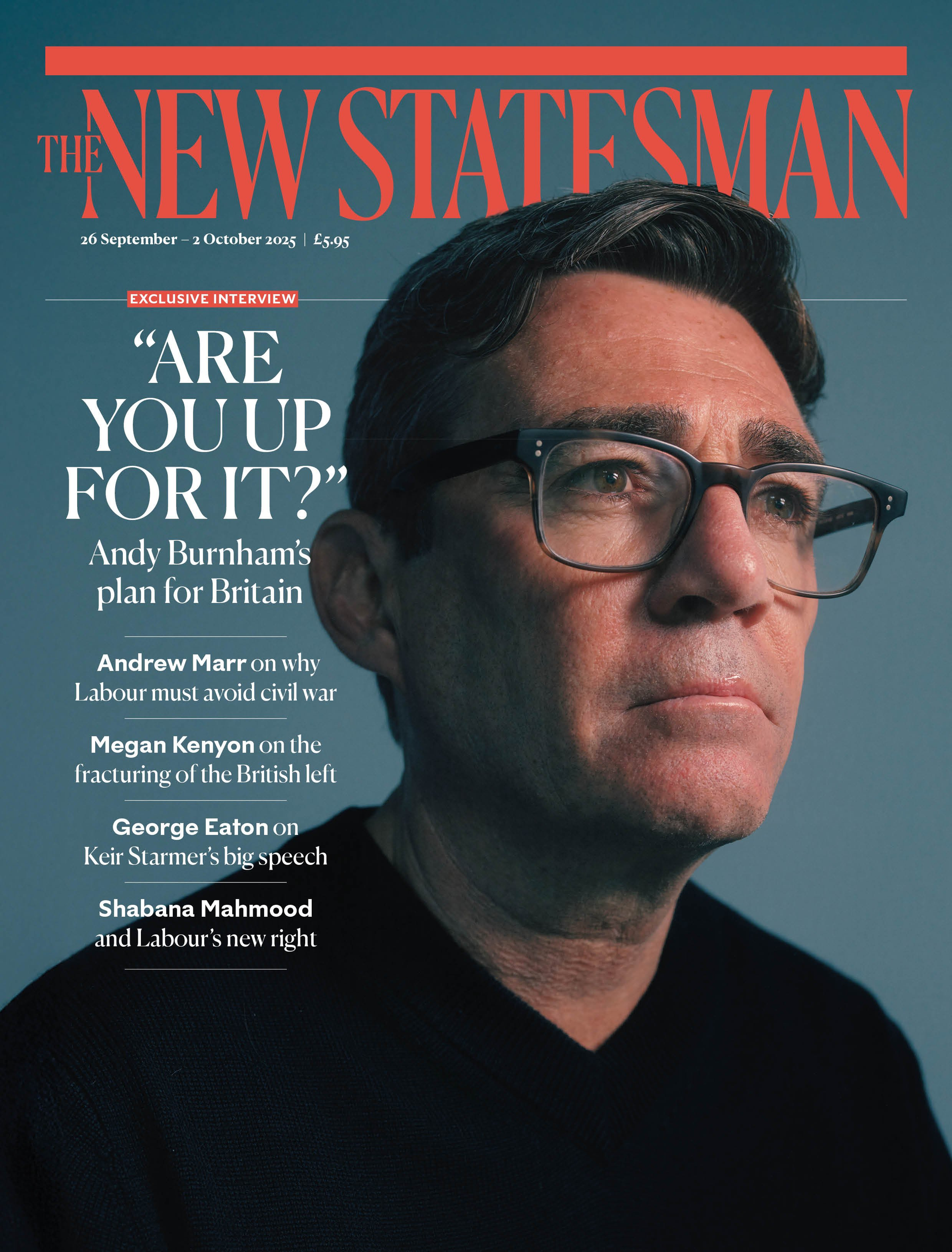
Last year, the editor of the New Statesman visited Manchester to meet with Burnham. The prime minister’s poll ratings were already under water and Tom McTague, who had recently taken over the magazine, had correctly intuited that this was a good moment to profile the King of the North.
McTague is an excellent journalist, but he sits at the chin-scratching, intellectual end of the British commentariat. What he wanted to know from Burnham was what Westminster journalists usually want to know when they meet a politician: which tribe do you belong to? What’s your ideological programme? What is Burnhamism?
To many politicians, this question would make sense and would be mechanically answerable. National politics tends to be satisfyingly demarcated by tribes that end with ism, if for no other reason than to maintain the sanity of lobby hacks and make politics legible to the public. This is the world in which everyone’s favourite joke about Burnham (some version of: a Blairite, a Brownite and a Corbynite walk into a bar. ‘What are you drinking Andy?’) makes sense. Burnham hates the joke, but it’s quite funny, if only in a very dorky Ed-Miliband-must-have-come-up-with-it way.
But asking Burnham to outline his cogent political programme is like asking my cat, who came from a shelter near the Etihad, whether she supports Man City. You’re asking about something she has no interest in and that forms no part of her life. The terms of the question wouldn’t even make sense to her. She’s a cat! He’s Andy Burnham! He’s a genius at doing one important thing in one specific context and you’re asking him to answer questions about something he’s not interested in and has spent eight very successful years not having to think about.
The result of asking Burnham this question has been farcical. Burnham humbly replied that his programme was not Burnhamism but “Manchesterism”, a concept over which gallons of ink have been spilled in recent days and which only becomes murkier as the by-election carnival progresses. Is Manchesterism the hard-nosed developer-friendly opportunism of Leese and Bernstein, or some soft municipal socialism that Burnham seems to be hinting at and which he has certainly never come close to enacting? How does bringing buses back under public control (a concept he reluctantly embraced) provide a template for other public utilities, like water or trains, which are already – like the Bee Network – mostly run by private companies with oversight from the state? How, as Burnham has suggested, can working well with other parties be considered ‘Manchesterism’ when for most of his mayoralty, he has run a city region composed almost entirely of Labour councils? Without meaning to, McTague has sent the media on a wild goose chase for a political programme that doesn’t exist, from a man who is known for not having one.
The perfect job
Does this make him a cynical chameleon, a shapeshifter, a flip-flopper — all the terms that appear by his name in off-the-record newspaper briefings? I don’t think it does. He appears to be those things when he tries to play the Westminster game, a game that by his own admission he didn’t used to enjoy and that his abject failure in two Labour leadership contests in 2010 and 2015 suggests he wasn’t very good at.
Since 2017, he’s done what we all hope to achieve in life: he’s found a job that he is really good at. Being the mayor of a combined authority like Greater Manchester is a relatively new role in British politics and is markedly different from the roles above it (cabinet minister) and below it (council leaders) in the food chain. Council leaders must manage statutory, mandatory frontline services like social care, and they spend their time cutting library hours, raising taxes and reducing the frequency of bin collections to free up money. Cabinet ministers, as Burnham learned as a young health minister in 2009-10, have similar constraints. Both jobs are structurally associated with scarcity and management.
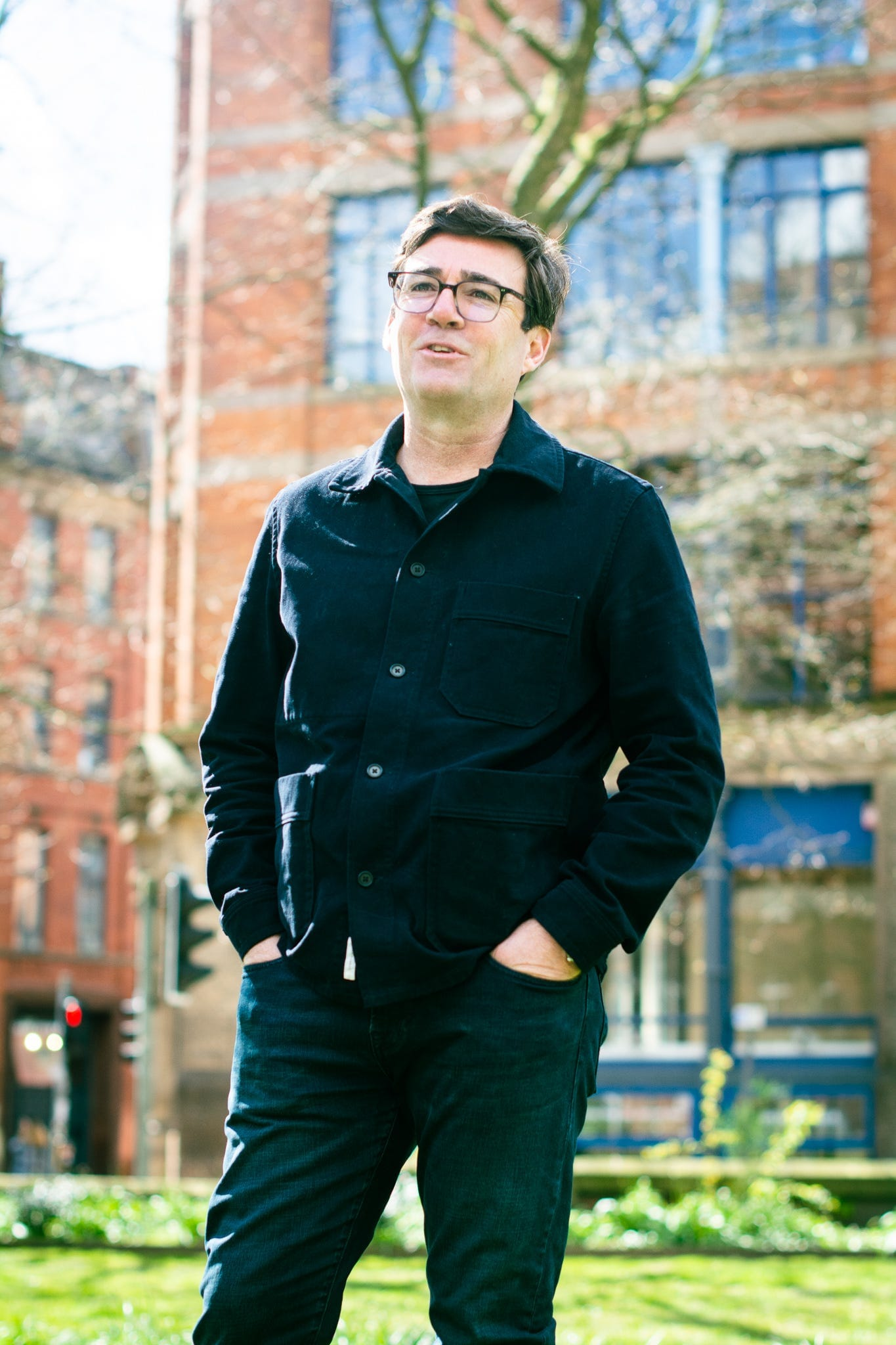
Metro mayors barely run anything. They have few hard powers, and their budgets are devolved from Westminster specifically for “strategic growth” initiatives: exciting projects like building tram lines, regenerating brownfield land or making investments in green energy. They are there to spend money and build things.
Crucially, they don’t face anything like the scrutiny that Westminster leaders do – no daily trips to TV studios; no hostile questioning from reporters working for partisan newspapers whose mission it is to make you look silly. If Burnham speaks like a normal human being, that’s partly because he doesn’t operate in the media environment that turns our national leaders into robots.
Burnham used to receive tough coverage from the terrier-like MEN political editor Jennifer Williams, but when she left to join the FT in 2022, the MEN left her role open for over a year and have never found an equivalent figure to replace her. Now, the paper largely acts as a cheerleader for the mayor, rarely writing anything remotely critical. The Mill has scrutinised the GMCA, but our editorial budget is roughly a quarter of what the combined authority spends on marketing and communications (£1.3m last year, according to data they release).
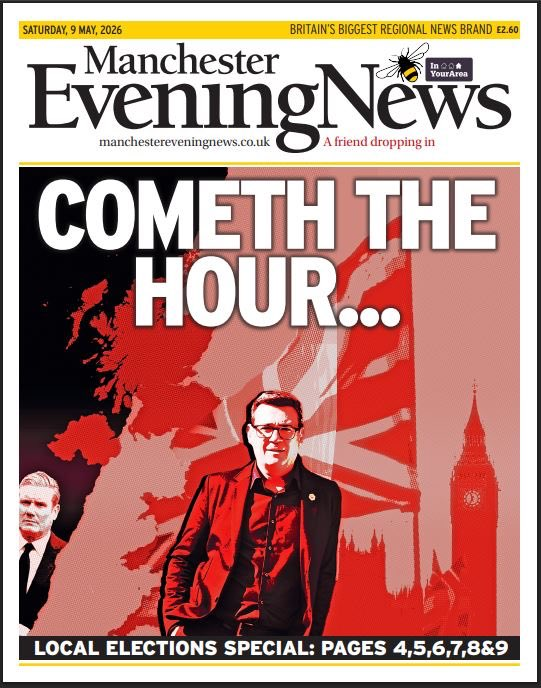
To me, the tragedy of Burnham’s wish to return to Westminster is that it means leaving a job that seems custom designed to take advantage of his skills and to mitigate his weaknesses. As the pandemic showed, and as you can see when he engages with voters in regular public Q&A sessions, he has an incredible gift for listening to people, speaking like them and feeling their pain. This is not a con trick or a gimmick: it’s something people need in a world in which it feels like so many of the entities we deal with are giant and remote from our lives. It’s the role that a vicar used to play: the shepherd of the flock; the buffer of communal sorrow and the vessel of hopes and dreams.
It’s built not just through clever digital communications but via something that only local leaders can realistically do: showing up in person, time after time. Everyone you speak to in Greater Manchester has a story about Burnham arriving at their fundraiser on a rainy Tuesday night or turning up to bless a tree-planting initiative at their leisure centre. The job he does is largely about turning up, seeming normal and showing that the person in charge is like one of us, not one of those robotic politicians on the TV. As one biographer wrote of the famous Fiorello La Guardia, mayor of New York City in the 1930s and 1940s – another municipal leader who crossed party lines and was supremely comfortable in his own skin – Burnham’s greatest asset is not his political programme or even his speechmaking, but his unvarnished empathy.
Would Burnham make a good prime minister? No one can know for sure, of course, but I don’t think so. The question reminds me of the scene in the HBO series Succession where Logan Roy, the Murdochian patriarch of a warring media family, is asked by his melancholic son Kendall whether he thinks he was ever cut out to take over the company.
"Do you think I could’ve done it?” Kendall asks. “The top job."
For perhaps the first time in the show, Logan hesitates before answering.
“You’re smart, you’re good,” he says. “But you’re not a killer. You have to be a killer."
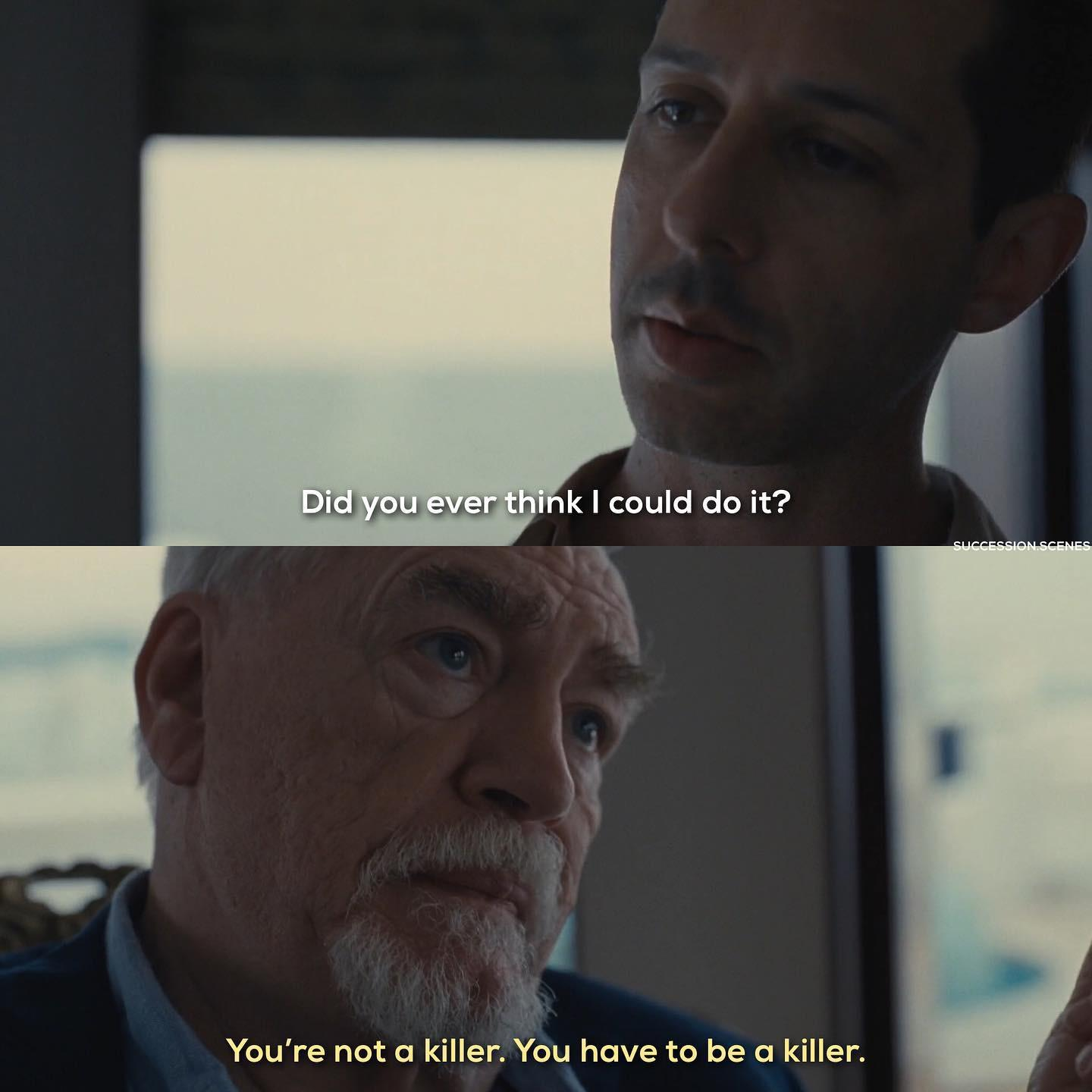
Logan then tacks on a half-hearted word of encouragement. “But... now-a-days... maybe you don't. I don't know.”
My impression after six years of writing and thinking about Andy Burnham is that he’s many good things, but he’s not a killer. He has an endearing emotional vulnerability that is rare among politicians I’ve met, and a wonderful sense of how to take hold of a moment. He’s brilliantly instinctive, as he said to me on that phone call, and he genuinely listens. He’s offered a brand of moral, pastoral leadership to the city that I think is not properly understood in modern politics and that is reflected in his popularity.
But to be prime minister – a job that involves making impossible choices every day and surrounding yourself with tough, calculating people who don’t mind asking hard questions and telling you when you’re wrong – you have to be a killer. Or maybe you don’t nowadays – maybe good vibes and fetching running shorts are enough. I don’t know.
Perhaps the closest thing to Burnhamism that I can divine is his belief in devolving power away from Whitehall. It’s not exactly a distinctive political philosophy but it has the benefit of being correct. We’re one of the most centralised countries in Europe, and economists like Coyle are right that it’s holding us back. Perhaps the best thing for Burnham to do, recognising his weaknesses at wielding hard power, would be to get himself into Downing Street and immediately start giving it away.
This is one of the best pieces of British political journalism I’ve read in a while. Made me sign up as a member for @ManchesterMill https://t.co/URcLpAy6tV
— Anshel Pfeffer אנשיל פפר (@AnshelPfeffer) May 24, 2026
Exceptional piece of journalism- I don’t often retweet but this really should be read. Not just insight into AB but truly thoughtful about real politics and the way it works in the world. https://t.co/S2Z35nTXy4
— Trevor Phillips (@TrevorPTweets) May 24, 2026