Dear readers — the question of "who is Howard?", the infamous graffiti writer behind Manchester's most talked about tag, is one that has bothered the writers at The Mill for some time now. So when we finally got to him (we're not telling you how), we bundled straight into a taxi and headed for Moston, where we finally met with one of Manchester's most elusive figures, and heard his story. That's after your briefing.
Your Briefing
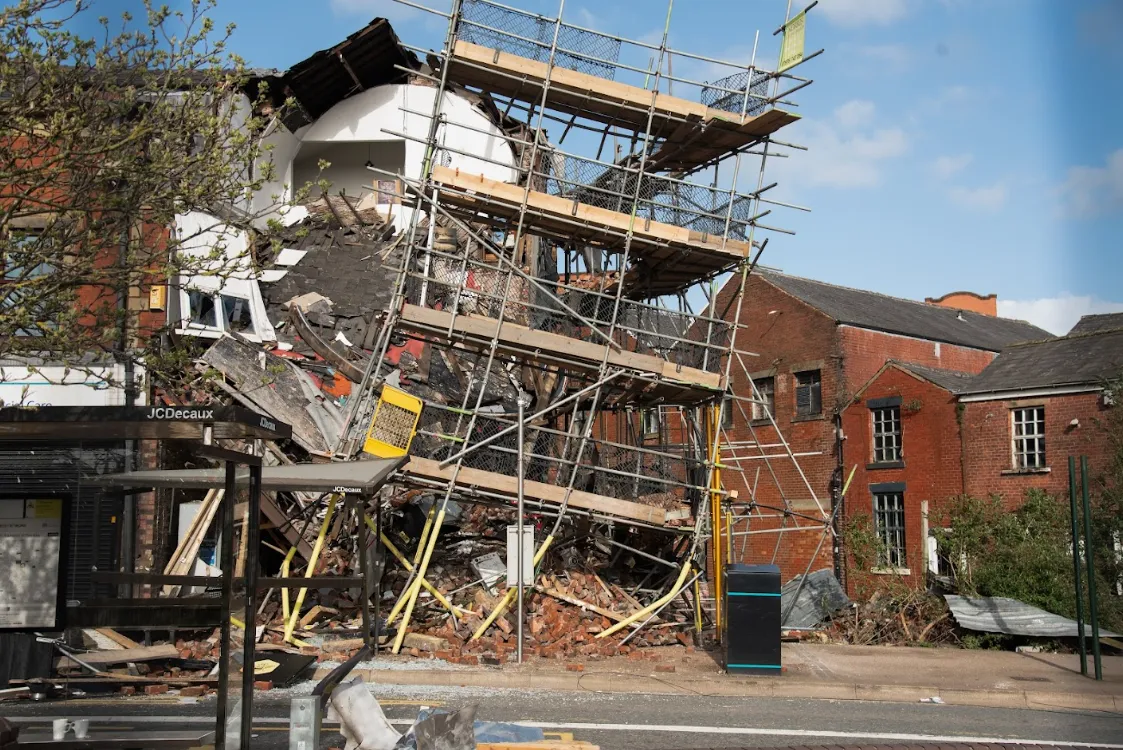
🏗️ Opposition councillors in Oldham have lodged a motion requiring supplementary planning documents for new schemes in the borough. It is part of a broader revolt against the town’s involvement in Places for Everyone, the strategic planning document allocating new developments across Greater Manchester (bar Stockport, which dropped out 2022). “It’s really regrettable how far some people will go to try to stop development when we know residents need homes,” said council leader Arooj Shah.
🏞️ The Environment Agency is investigating hundreds of “bio beads” — plastic pellets used in sewage treatment works to break down material — that have washed up on the banks of the River Irwell. The beads can be easily mistaken for food by local wildlife, but can be toxic. “Any pollution incident of this kind is deeply concerning,” a spokesperson for the RSPB told the BBC.
🕎 And finally, this piece, in the Guardian reports from Heaton Park synagogue in Crumpsall, where two tragedies were being mourned at once on Monday evening; October’s attack and the more recent Bondi Beach shootings in Australia. “The difficult part is that we’re sort of used to it, we grow up knowing the history,” says Sholom D. “It’s always part of us, but you just realise it more and more.” Rabbi Daniel Walker opened the Hanukkah prayers on the steps of the Synagogue. “Here on this spot, evil stood. But this is a place of joy and tonight we are reclaiming that joy, we are reclaiming that light and we’re shining it out into the whole world.”
Two years ago Benjamin Daye walked through Piccadilly Gardens in the wet or dry night, he can’t remember. It was 3am, and a homeless man sat by the Deliveroo drivers and the late-night drinkers. The man asked Ben for change — Ben didn’t have any. Ben asked the man his name, and he told him: Howard. “No one usually asks that,” Howard said. “Well, you’ll see it around more often,” Ben replied.
If you haven’t seen the name Howard scrawled across the train lines, junction boxes and white concrete walls of Manchester, you will now. Spray painted or drawn in thick marker, the name bears no regular style or colour; sometimes written in all-caps throw-ups (block or bubble writing), sometimes etched as simple tags with a lower-case “a”, and occasionally appearing as “Howard of Moston” when spotted a bit further north. Equal parts loved and loathed, the Howard tag can be found all over the city centre, plastered around the Northern Quarter, creeping out towards the M60 and all around the confines of the ring road.

The ubiquity of the tag has made it the subject of urban legend, as well as numerous Reddit threads, usually complaining about “yet another shit tagger” contributing to an “epidemic of shit tagging” supposedly gripping the city. But one question worms its way through all of it, a question that’s popped up in multiple MEN articles, headlined myriad emails to The Mill and forced Howard Donald of Take That fame to bat away allegations that he moonlights as a vandal. The question, of course, is: Who actually is Howard?
“When I started doing Howard I just thought, fuck it, I’m gonna do it scruffy,” Ben explains. We’re sat around the dining table of his childhood home in Moston — Ben in his early 30s, in a black tracksuit, with the well-worn physique of a marathon runner, talking in tangents and half-remembered anecdotes. When Ben met the man — the real Howard — in Piccadilly Gardens those years ago, he’d been looking at getting back into graffiti anyway. He’d never been all that good at lettering, but the letters in Howard seemed to work really well. Besides, Ben's artistic sensibilities lean steeply in the direction of quantity. “Graffiti is about just getting it up there, and doing it as many places as you can,” Ben explains. “Police didn’t like that, but.”

This wasn’t his first foray into graffiti writing. Ben’s love of street art can be traced back to his childhood across Manchester. Born and raised in Moston, he went to high school in Moss Side — two buses there, two buses back, on the odd occasions he attended. He travelled south for school because he was keen to know his black side. “Growing up in a white area, you just see yourself as white,” Ben explains, but his dad is black. In fact, Ben’s father is Junior Daye, once a singer for the Mancunian soul group Sweet Sensation, an occupation Ben tells me accounts for his many half-brothers and sisters. Still, as a child, he had little experience with Manchester’s black community. He describes his time at the Moss Side high school as “eye-opening”. “I didn’t know what being black was,” he says. “It was a culture shock to be honest.”
This shock wasn’t just down to race. Moss Side in the 2000s was well-known nationally for gang violence. Ben explains that while Moston was a rough area in its own right, going to school in Moss Side introduced him to a world of knives and guns. He particularly remembers the high-profile murder of a 15-year-old boy at his school named Jessie James, who was shot four times while cycling with his friends through Broadfield Park, and whose killer to this day hasn’t been caught. Ben’s friends heard the gunshots, but didn’t understand what had happened until they announced the death in school the next day. This incident was extreme, but the violence was commonplace. “I didn’t get involved though,” Ben insists. “I’m not cut out for that.”

Instead, Ben turned to petty crime: minor theft and vandalism. He’d skip school to go out onto the train tracks in his blazer and paint, or go to Halford’s and steal spray cans. He first encountered graffiti at age 11, when his family made regular trips to see his gran in Doncaster. At the changeover in Sheffield the tracks would be plastered with the tag “Bloodaxe”. “It opened a new world for me,” Ben says. By the time he was in secondary school, Ben and his friend from over the road had formed a two-man graffiti crew, spraying the letters “FME” around town, which stood for their crew name “Found More Evidence”. A few years later, as a young adult, Ben found cocaine, and then he found crystal meth.
If you’ve ever spotted a Howard tag in Altrincham, or found the name scrawled on a train track or an underpass in Wigan, and wondered how one person could appear out of nowhere and spread their name so far and so thickly, then here’s your explanation. By the time Ben met Howard in 2023, he was dependent on methamphetamines — colloquially known as Tina or T — as well as the sedative GHB, both commonplace in Manchester’s gay nightlife scene. Almost every night at 10 o’clock, high on stimulants that all but rid him of his desire to sleep, Ben would walk 30 miles across Manchester with his headphones on, plastering the city with the name of a man he met once and never again. To this day he’s not sure how he did it, and his body still bears the effects of his nightly walks, and years of drug dependency: when we meet, he’s too tired to come up the road to where I’m waiting; I have to travel down to him.

Why did he do it? “I have no idea,” says Ben, though he tells me that graffiti writing got him through some difficult times. “There’s a link between substance abuse, bad mental health and graff writers,” he says. “We like to be on our own and scurry around in the middle of the night. We want people to talk about us, but we don’t want anyone to know it’s us.” Ben tells me that the people you’d least expect are behind some of the city’s most notorious tags, though he’s reluctant to give details. “There are people in mad high up surveyor jobs going out and smashing track lines all night,” is as much as he’ll offer up.
For a few sacred tags, the appeal is one of toying with mortality, and immortality. Ben tells me about “Heaven Spots”: high, unreachable tagging locations on bridges, billboards, and motorways, where a false step could kill you — but a successful tag means leaving your mark forever. There is a “Howard” on the side of Mancunian Way that Ben’s certain will be there long after he’s gone, and another on Great Ancoats Street that for a short while was even marked on Google Maps as Howard’s Ledge. But as for the other tags, the appeal is far more simple. “I just love vandalism, to be honest,” he says. “I can’t lie. I just love a bit of vandalism. I just like to see a big mess on the side of a train.”

But like all loves pushed too far, his met a bad end. On a Friday morning in November of last year, Ben left his then-girlfriend’s house and walked to Oxford Road station. It was quarter to six — almost daylight, far too late to be doing what he does. He went down the steps, and saw what he can only describe as a “funny looking Network Rail van”. “You know when you get a feeling about something?” Ben asks me. “In my mind, I said ‘don’t tag that bin shed’.” Regardless, the bin shed was tagged. That night, Ben awoke to three 6-foot-tall policemen standing around his bed. He was charged with two counts of criminal damage, and will appear in court in just over a month's time. Labour councillor for Piccadilly Jon-Connor Lyons described his arrest as “[f]antastic news for the city centre”. He hoped that “the courts throw the book at him and set an example”.
Is this the end of Howard? Who can say. Ben had an art career outside of graffiti writing for years, painting under the name “From Virginia Ben” (his mother is called Virginia). Under this alias he did a campaign with Manchester City Council, and a mural for Adidas. He did six different pop-ups for Selfridges, despite being barred from their premises for shoplifting. He took on commissions that days later he’d be incapable of doing, eventually making up excuses, disappearing altogether without making the work or refunding the people who bought his art. “Throughout my art career, all I did was take,” Ben says. “I was selfish. I wasn’t really considerate. It took me going through addiction to actually take a look in the mirror.”
Nowadays, Ben is clean from methamphetamines, but he’s still addicted to their sedative counterpart GHB. He’s going into detox in a week’s time, and will be going on trial shortly after. Once he gets sober, his plan is to use his addiction, and his art, to make a positive impact on others. “I don’t know how I’m gonna do it yet, but I’ll do something,” he says.

Of course, none of this actually answers the question “who is Howard?”. On Monday morning I walk to Piccadilly Gardens, but the weather and the markets have displaced the area’s homeless. One man sets up camp by a dustbin on Market Street — rain-soaked cardboard on the rain-soaked ground. His name is Glen. He’s not heard of a Howard, but he promises to let me know if he meets him. Until then, Howard’s legacy lingers in Ben’s tags, and in his art — he tells me that when he starts painting again, he’s going to do it under Howard’s name. “I think,” he says. “I don’t really know. Or maybe just under ‘Benjamin Daye’.”
If someone forwarded you this newsletter, click here to sign up to get quality local journalism in your inbox.
Comments
How to comment:
If you are already a member,
click here to sign in
and leave a comment.
If you aren't a member,
sign up here
to be able to leave a comment.
To add your photo, click here to create a profile on Gravatar.