
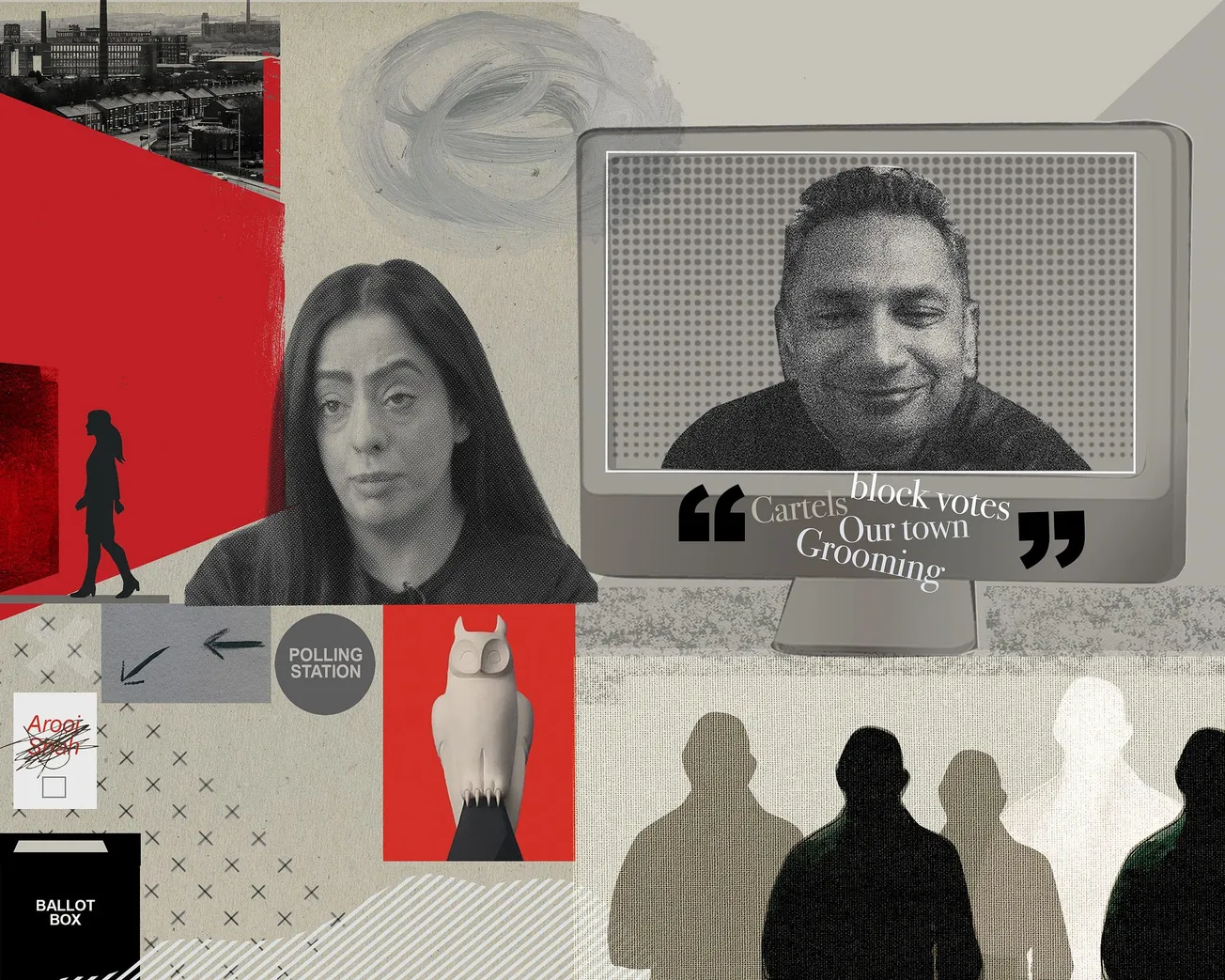
“As for the fake liberal metropolitan elite, who as I write this are polishing off their articles for their readers in the South Manchester suburbs of Chorlton and Didsbury to read alongside their Sunday morning oat milk lattes. Write us off as racists and far right activists all you want to. We know what we are. We know what we just achieved. We pulled off an election campaign of the kind that has never been seen before in this country. This is our town. And we are taking it back.” — Raja Miah, Friday May 6, 2022
By Joshi Herrmann
It was a couple of hours before dawn when the petrol bomb landed. Nobody was hurt — Oldham councillor Riaz Ahmad, his wife and four children managed to escape to the lawn, where they stood and watched their home burn. It was the summer of 2001 and the preceding days hadn’t been much quieter: the Oldham riots marked the worst racial disturbances the country had seen for 15 years.
Oldham’s council leader Richard Knowles wrote a letter to the prime minister Tony Blair requesting urgent help. Ahmad said he knew both Asian and white families “who were actually sat on their doorsteps all night, guarding against the fear of petrol bombs.”
Sensing an opportunity, the British National Party’s leader Nick Griffin pitched up to contest that year’s elections, proposing that non-white Oldhamers should be given money to return to their countries of origin. "White people in Oldham are being made to feel like second-class citizens while the Asians are given a free hand,” he told one journalist, and proposed building a “peace wall” to divide the town’s communities.
Griffin didn’t crash and burn. Between him and another BNP candidate, the party got 12,000 votes in Oldham, and so concerned were the authorities about further racial tensions that they banned candidates from making speeches in Oldham’s Queen Elizabeth Hall after the count.
‘Are you fucking joking?’
At the time, Ahmad was living on Denton Lane in Chadderton, a traditionally white town in the borough of Oldham. He represented a majority Asian ward which includes Glodwick, a neighbourhood where thousands of Pakistani families had made their home in the 1960s, finding work in the area’s fast-declining mills.
They included the family of Arooj Shah, whose parents arrived in 1968 and found jobs in the textile industry. Shah was born ten years later, and grew up with six siblings, attending a mostly Catholic school where she was in a small minority. She lives in Glodwick to this day, in the same house as her mum. Five of her sisters live nearby.
The riots “took place at the bottom of my street,” recalled Shah, who was 23 at the time. “I just remember so many people that I had gone to school and college with got caught up in the moment,” she told me when we spoke soon after she became the leader of Oldham Council this time last year.
The 20th anniversary of the riots was coming up when we spoke. But Shah had decided since becoming leader that she wanted to steer clear of discussing Oldham’s racial divides, a strategy best exemplified by her focus on the issue of fly-tipping and litter. “My priorities are simple: Oldham should be a place that we’re proud to call home,” she said in her first press release. “That starts with cleaner streets.”
I pressed her for her memories of the riots, but she pushed back. “This whole concept around the 10 years from the riots, the 20 years from the riots, incredibly frustrates me because it’s just not something that me or my social circle make reference to or discuss,” she said. Oldham had moved on, and had lots of positive things to say about itself.
Shah had been a councillor since 2012, and became leader after the shock ousting of Labour’s Sean Fielding, who lost his seat after a concerted and vicious online campaign by a local activist called Raja Miah. Miah accused Fielding — without evidence — of covering up the gang rape of Oldham’s white children in return for votes from the Asian community, and built up an online following with weekly “transmissions” on Facebook. In his live videos, he attacked Fielding and the council and shared folksy interactions with his growing audience of supporters, known as “Raja’s rabble”.
Reporting that story (“Grooming gangs, cartels and the poisoning of Oldham's politics”) had been my first proper engagement with politics in Oldham, and I could understand why Shah wanted to put the ugliness of the whole episode behind her. In our interview, she avoided referring to Miah by his name, as if not mentioning him might somehow lessen his power. “The backstory of the individual you mentioned, and his issues with the council, are already in the public domain,” she said at one point.
She had a particular vulnerability, which Miah had been exploiting long before she became council leader — her friendship with a man called Mohammed Imran Ali, known locally as “Irish Immy”, who she has known since the age of 11. Immy is a convicted criminal, and Miah often refers to his well-established role as a getaway driver for the notorious murderer Dale Cregan, who killed two police officers in 2012 (Immy assisted Cregan in a different murder of a gangland rival in the same year). Shah has condemned Immy’s criminality, but also said she is “not responsible for what other people do” and in 2019 used a phrase in the council chamber that has dogged her ever since: “I can condemn their individual and personal choices but I can’t condemn them as people.”
Last summer, a car belonging to Shah was firebombed outside the house where she lives with her mother in Glodwick, in an echo of what had taken place at Councillor Ahmad’s home back in 2001. Despite two arrests, no one has ever been charged in relation to the incident, and Miah has suggested that the attack might have been staged in order to elicit sympathy for Shah.
Around the time I spoke to Shah, there was a Zoom call to discuss what was happening in Oldham and whether lessons could be learned from Fielding’s defeat. On the call were Labour’s general secretary David Evans, Shah, Fielding and an official for the party in the North West. When the regional official praised Shah for her focus on cleaning up Oldham’s streets, Fielding — by his own admission — lost his cool. “Are you fucking joking?” he replied. “Do you really think that it is going to change the minds of people who think we are covering up for child abuse?”
The rise of the rabble
Miah made his name in the wake of the Oldham riots. He was the charismatic co-founder of a charity called PeaceMaker, that worked to bring communities in Oldham together. After the violence in 2001, Miah grew in prominence, impressing local politicians with his ability to act as a bridge with the Asian community. He soon established himself as an expert on community cohesion, and in 2004, at the age of 29, he was awarded an MBE.
In 2012, when he announced his plans to open an innovative free school that would break down “ethnic and religious barriers in Oldham”, Miah had assumed the public clout to do so in The Times. PeaceMaker closed the year before with debts of at least £200,000. Then, very quickly, Miah’s schools (there was one in Oldham and one in Manchester) started to fall apart too, with teachers describing Miah as a charismatic but narcissistic and dictatorial leader, and parents complaining about basic safety failings and general disorganisation. The schools closed with more than £1 million debts, and a government investigation found they had paid more than £2 million to multiple companies linked to Miah.
The report landed in 2019, and that’s the key pivot moment in the Miah story — the moment he seemed to switch from peace maker to troublemaker. Miah was furious with Jim McMahon — then Oldham’s leader and now a shadow minister and close ally of Labour leader Sir Keir Starmer — for highlighting the failings and apparent malpractice at his schools. But his first line of attack fell flat — he posted repeatedly on Facebook about McMahon and the council being too close to a mosque in Oldham, but the replies suggest he was no longer taken seriously within his own community. Some people called him a fraud, in reference to the schools.
At this point, Miah seems to have realised that if he wanted to wreak revenge on McMahon, he needed to try to mobilise a more receptive audience — a whiter audience. From the autumn of 2019, he began blogging about grooming gangs, alleging vast political corruption involving Asian block votes and a network of shisha bars used to sexually exploit white girls. You can see the striking shift if you analyse his social media from the time. In early 2019, Miah is retweeting Jeremy Corbyn and Bernie Sanders and posting lots about climate change. But after August, a switch is flicked, and grooming gangs are pretty much all he tweets about.
“The people of Oldham deserve answers from @OldhamCouncil,” he posts in September 2019. “Why was a Grooming Gang kept secret from parents whilst our children were lured in to these shisha bars and raped?”
Soon he is making videos on Facebook about that same topic and building a following with his weekly transmissions — the people he now calls his “rabble”. Who are they? Judging by their comments and other social posts, they seem to be the kind of people you would expect to be attracted to messages about corrupt councils covering up for Asian grooming gangs: mostly white; mostly over the age of 40; some comfortable with sharing racist jokes or slurs on Facebook. One of them, a white man named Stephen Walsh who has shared Miah’s posts in his Facebook group, was convicted for affray during the Oldham riots.
Several of Miah’s most influential supporters seem to have admired, at one time or another, the far-right activist and anti-Islam campaigner Tommy Robinson, the co-founder and former leader of the English Defence League. One member of the rabble is David Gidman, who attended a Robinson rally in Limeside and somehow ended up in the back of Robinson’s van. Debbie Barratt-Cole, one of Miah’s biggest supporters, who has joined his transmissions as a guest on several occasions, recently asked the large local Facebook group she runs why the far-right activist Tommy Robinson was considered racist. “I have found nothing racist in his content at all,” she posted. “I feel he is the only one actively fighting for our children”.
Miah has always reassured his followers that they are not racist, despite what the media might think, and offers his own identity as a guarantor of that. Who can accuse a rabble who follow a British-Bangladeshi man of being bigots? His videos are full of anti-Asian jokes and insults that would be immediately discounted as racist if they were uttered by a white person. He endlessly promotes the idea that Asian areas of Oldham are “cartel controlled.” His nickname for McMahon is “Samosa Jim” because the former council leader was once photographed eating samosas. Earlier this week, he posted a graphic that said: “With the samosas tasting sour, Arooj Shah loses her grip on power.” He has referred to Shah as a “Pakistani gangsters favourite good time girl” and headlined a blogpost about her “For the Muslim, Never mind the Many”.

For obvious reasons, this kind of rhetoric has proved attractive to people in Oldham who harbour clear racial resentments. One rabble member replying positively to one of Miah’s recent posts has far-right posts on his Facebook, including one condemning a Muslim call to prayer in Trafalgar Square. Another replied to a recent photo of Labour party activists with the comment “Good turn out from the East Asian community I have noticed.”
For some of these people, Miah has provided cover for expressing feelings about their town that decades of community work have sought to make taboo. “This platform has opened the eyes of so many in this town,” wrote one white man under a post on Miah’s Recusant Nine page this week. “Some of us knew what had been going on for a long time but it took someone to pull it all together, with the know how and the strategy to make the campaign count.”
Sometimes when I think about Miah, which over the past two years has been unfortunately often, I think back to one of my favourite essays, "The Paranoid Style in American Politics", published in 1964 by the American historian Richard J. Hofstadter. In that piece, he notices how often conspiracy theories seem to rely on the revelations of people who have emerged from the communities the conspiracies are about — in Hofstadter’s day that was mostly ex-Catholics (“the runaway nun and the apostate priest”) and ex-Communists. He writes:
A special significance attaches to the figure of the renegade from the enemy cause…the renegade is the man or woman who has been in the Arcanum, and brings forth with him or her the final verification of suspicions which might otherwise have been doubted by a skeptical world. But I think there is a deeper eschatological significance that attaches to the person of the renegade: in the spiritual wrestling match between good and evil which is the paranoid’s archetypal model of the world, the renegade is living proof that all the conversions are not made by the wrong side. He brings with him the promise of redemption and victory.
Really, really alarmed
On Saturday afternoon, I drove to Chadderton and hung around the area’s 1970s shopping precinct, a tired-looking stretch of shops notable for its large Asda and for having once witnessed the robbery about a decade ago — from a van parked here — of more than 3,000 British passports. “We’ve got all these bookies, I don’t know why,” says Maureen, 65, pointing at a Ladbrokes and a Betfred near where we are standing. Her surname is Keith-Wright (“A double-barrelled name in Chadderton!” she jokes) and she’s a Labour voter, although — crucially — not one who spends much time on the internet. That’s bad news for my chances of recruiting her as a Mill reader, but it also means she hasn’t heard about the grooming gangs or the block votes or the suspicious-seeming email from the former council leader to the BBC journalist about the dangerous shisha bars.
What she does know about is Chadderton and Oldham, and like many people you speak to in this neck of the woods, she defaults to talking about the past. Joan Didion once wrote of California that “time past is not believed to have any bearing upon time present, or future, out in the golden land where every day the world is born anew”. The opposite is true here, where people tend to look backwards, when Oldham was a white, Christian mill town that boasted about its market and put on new white dresses and socks for the brass band processions of Whit Friday.
Miah’s brand of local populism — invoking a lost and unified before-state in Oldham and presenting himself as the only means by which the pure citizens can “take back our town” — is cleverly tailored for a population who feel that something very important has been lost: the former identity of their town. The Dutch political scientist Cas Mudde defines populism as an ideology that ultimately sees society as separated into two homogenous and antagonistic groups — the pure people on the one hand and the corrupt elite on the other. That’s precisely the framing Miah promotes about Oldham, relentlessly branding the council and the ruling Labour party as corrupt, and suggesting that they are continually concealing important information from the populace. His videos suggest that if only the likes of Shah, Fielding, McMahon and their other Labour colleagues are removed from power, the town will be capable of recapturing its past glories.
This story is free to read - you just need to join our mailing list. And why wouldn't you? By becoming a Mill subscriber, you'll get our scoops, features, and insights into Manchester, in your inbox, the second we hit publish. No card details required.
Already have an account? Sign In