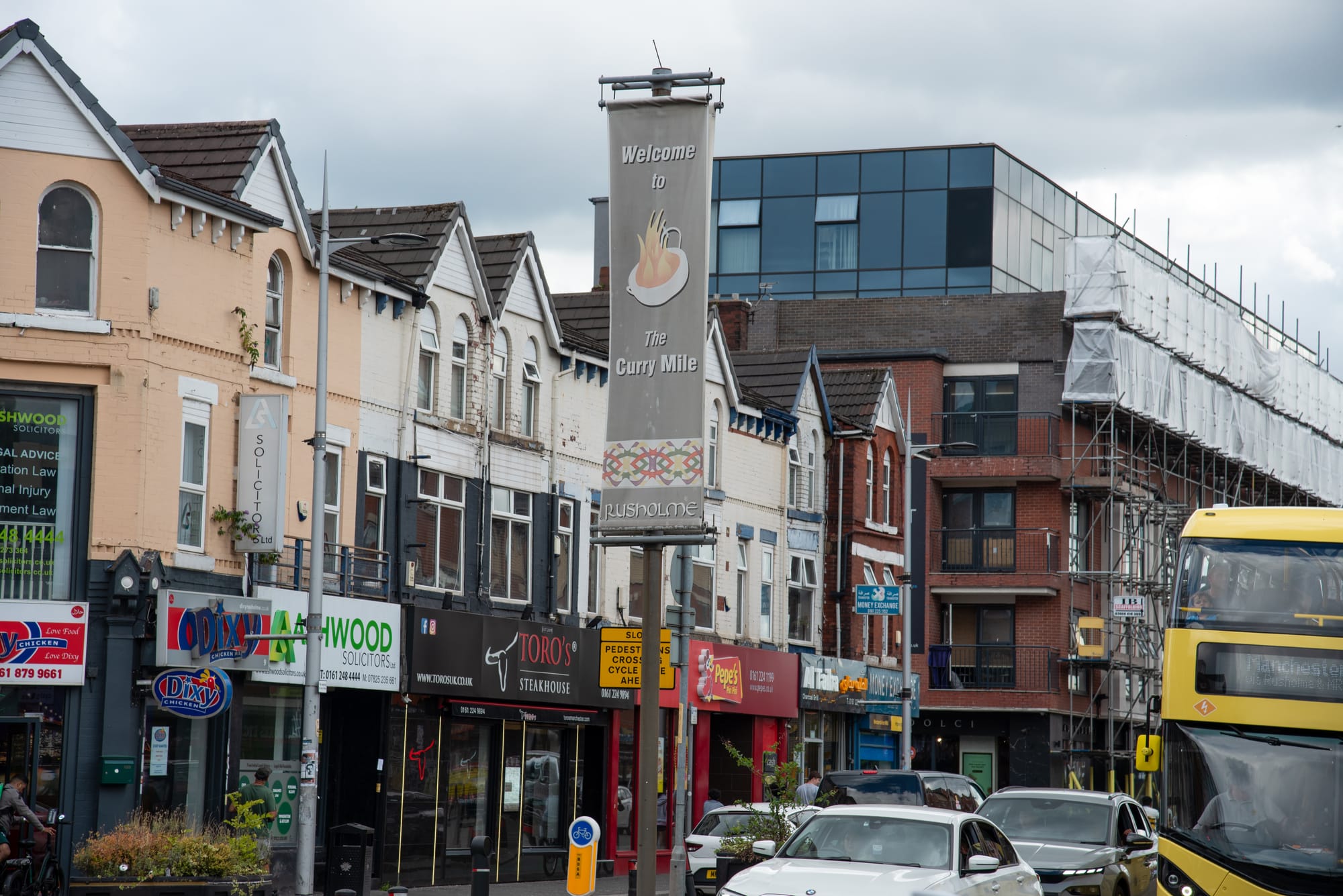


It’s a common misconception, but the so-called ‘Curry Mile’ is not, in fact, a mile long. If you were to say it starts a little south of Whitworth Park, where the Tescos and the Poundlands become shisha bars and karak street-punters, and ends a few strides before Platt Fields, then Google Maps would have it at some 0.65km. A 2023 Guardian article claims it to be just over a half-mile long, but I don’t know how they got this figure, and I don’t necessarily trust it. But while the true length of Manchester’s famous South-Asian stretch is shrouded in mystery, another point of contention about the name ‘Curry Mile’ seems to be increasingly common knowledge. That is, that these days, Wilmslow Road isn't actually selling that much curry.
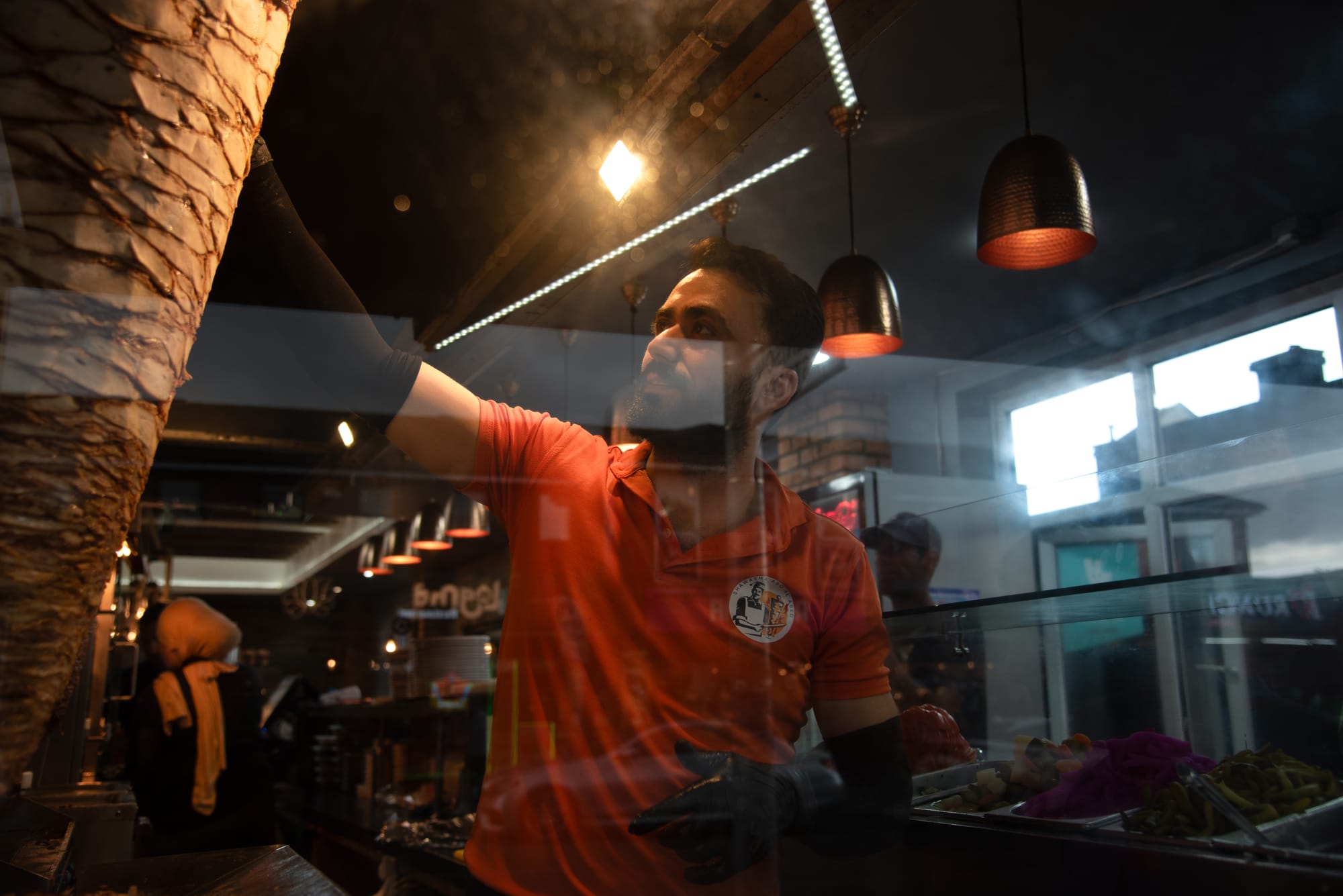
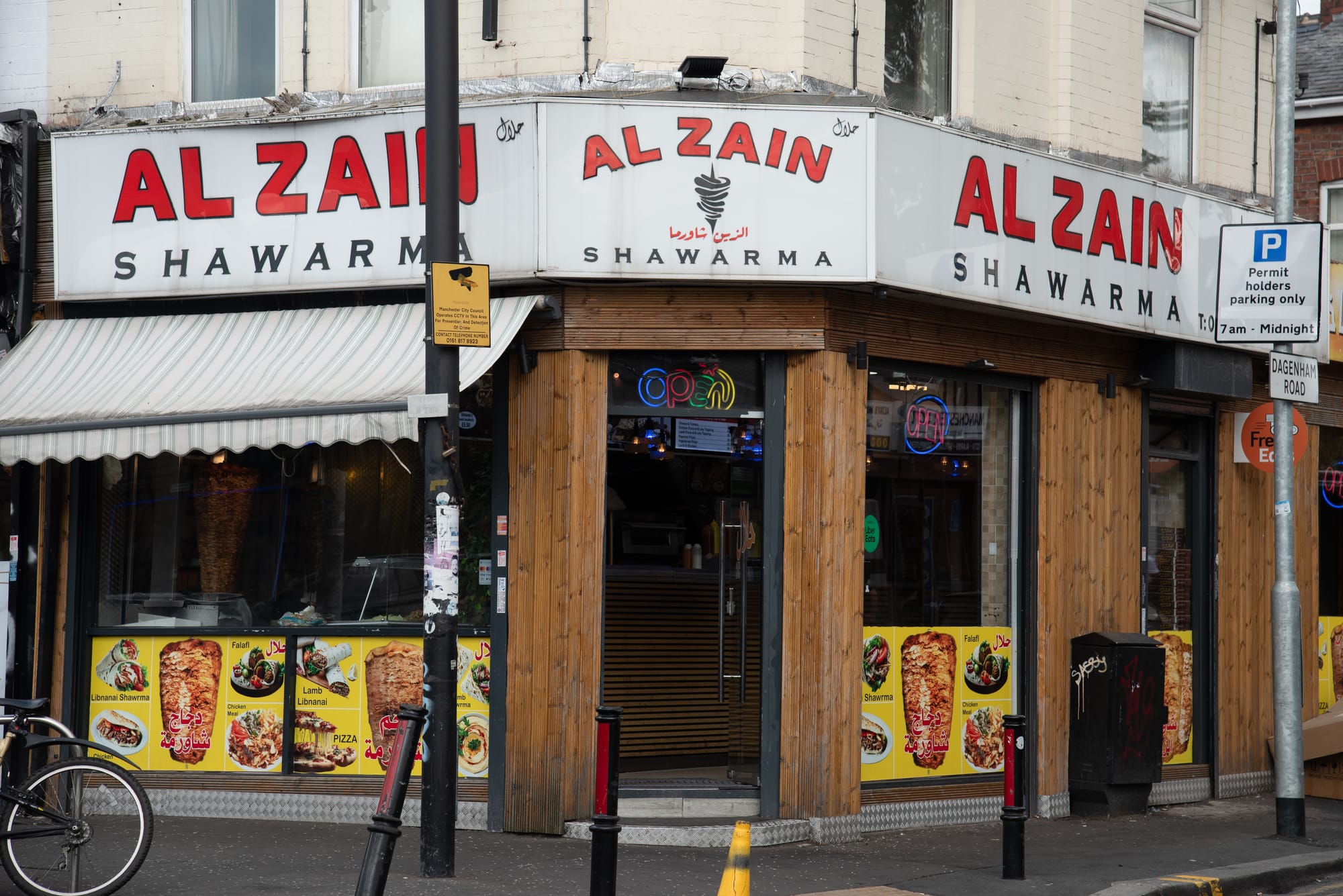
The Curry Mile is the nickname for a segment of Wilmslow Road, just after it’s finished being Oxford Road, in Rusholme, once considered to have the highest concentration of South Asian restaurants in the UK. The street gained its moniker in the ‘80s, but the restaurants began to appear 20 years previously, when migrants from the Asian subcontinent, primarily Pakistan, began to set up shop. It marked a crucial shift for Manchester’s South Asian community, when Pakistanis who came to the city as textile workers employed by white English bosses first became self-employed — often by running a restaurant, a shop, or a taxi rank. The Curry Mile was hugely popular, and by the ‘80s became a destination for South Asians throughout the UK, as well as white English people who had few other places to try traditional Pakistani food. But the last fifteen years have seen a noticeable influx of other communities to the stretch, namely Middle Easterners and Emiratis, who brought new kinds of businesses to Wilmslow Road. These days, the Curry Mile is perhaps better known for its shawarma shops, and less for its Pakistani cuisine.
Fancy a bargain? Become a paying subscriber for just £4.95 a month for your first three months. That’s just £1.14 a week. Supporting us means you're at the forefront of a renaissance in local journalism for Greater Manchester, as well as gaining access to all of our paid-for content. And did we mention? £1.14 a week.
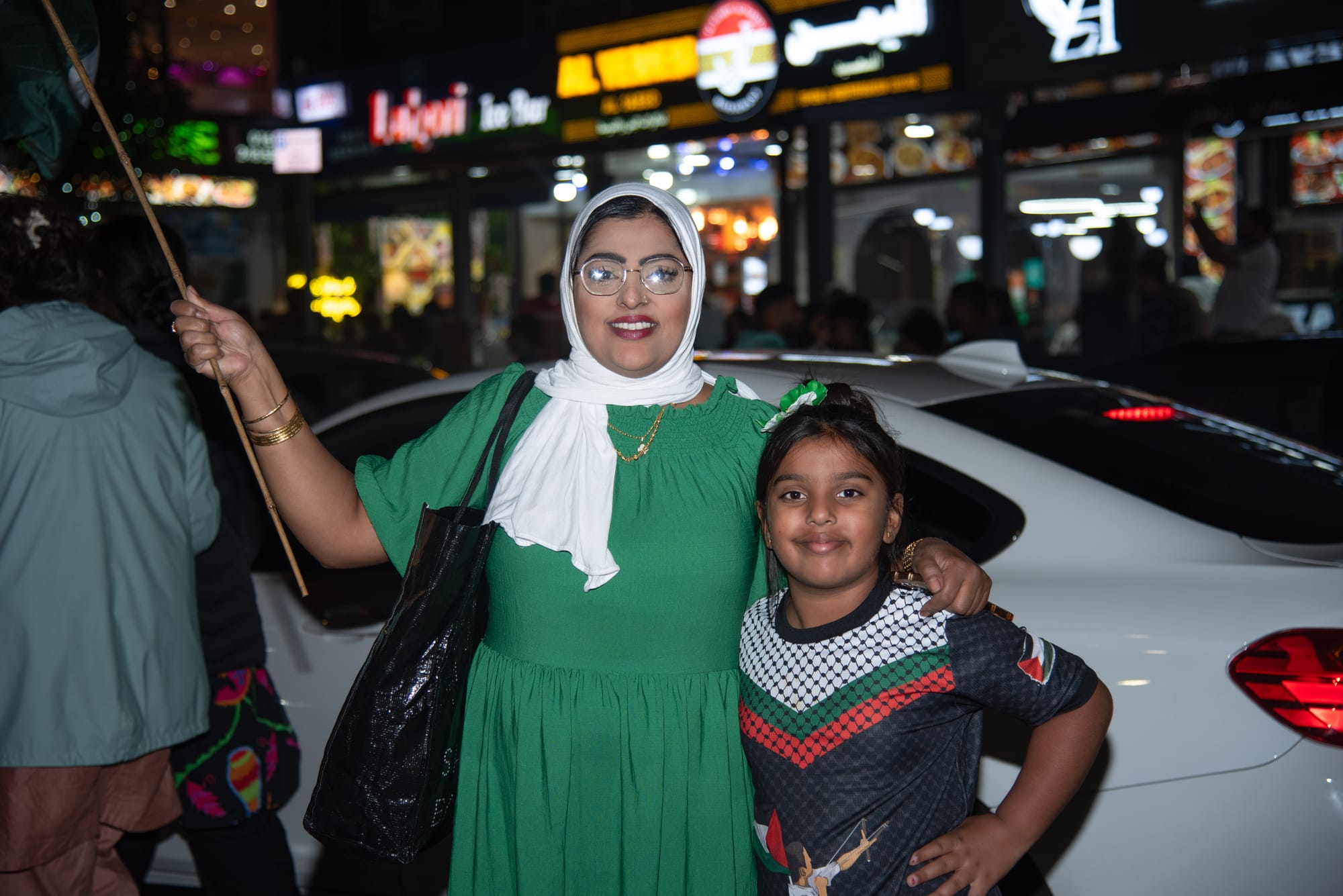
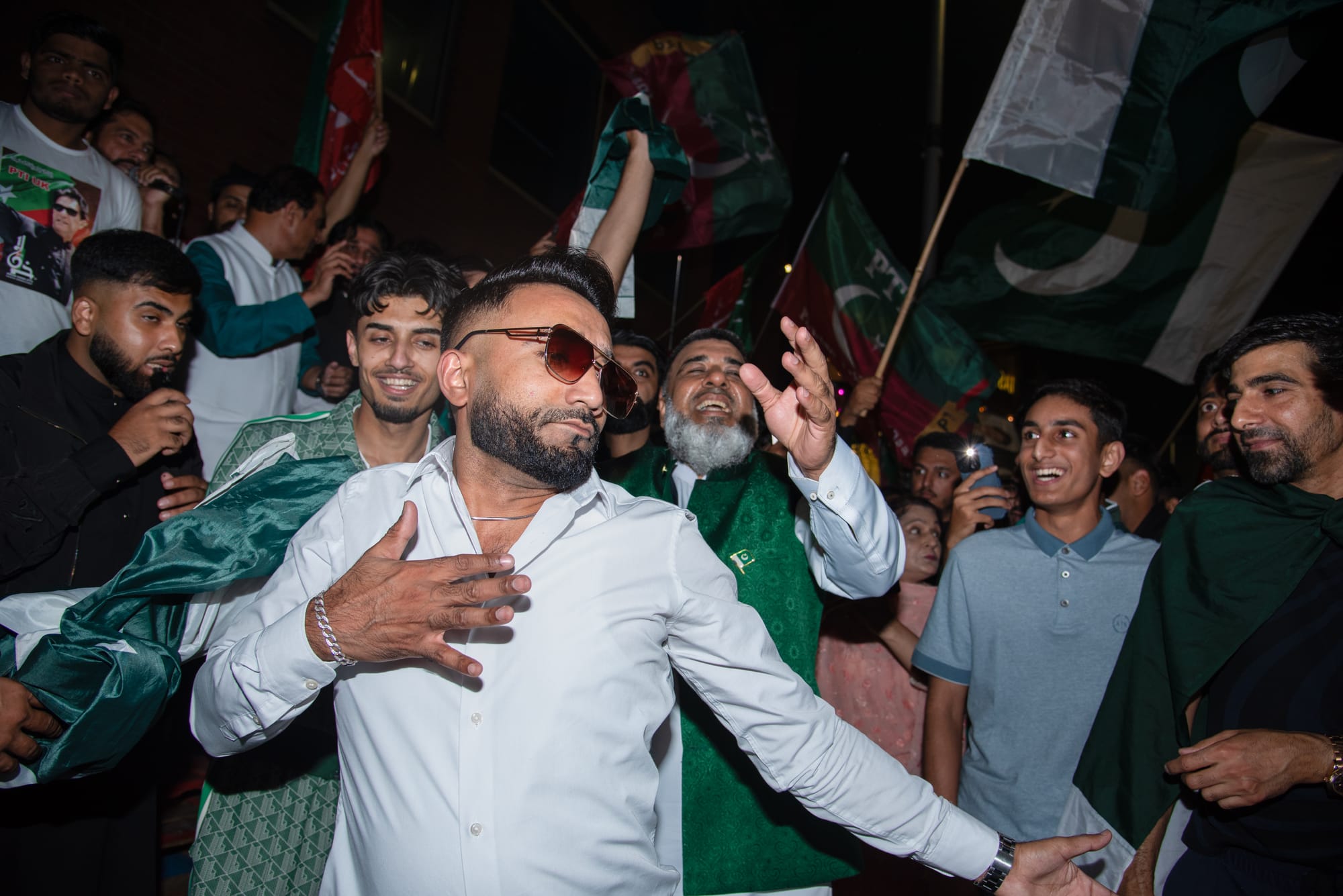
But Wilmslow Road, when I get there, is the green and white of the Pakistani flag. There are green and white scarves, hats, football kits, green and white street-carts selling all of the above. It’s only afternoon, but the signs of the evening’s Pakistani Independence Day celebrations are starting to emerge. Mohammed and his father Shabir sit out on the street by a table covered in pin-badges and light-up sunglasses, and bask in the August heat, Mohammed in a Pakistani Independence t-shirt, his father in a light blue Pathani kameez. The pair, from Lahore originally, have set up a stall in the same spot every Independence Day for the last four years. Mohammed tells me that the street has changed even in that short time, that the demographic of the Curry Mile has become increasingly Middle Eastern. “But if you come here for the celebrations tonight, you will know that the Pakistani community is still alive.”
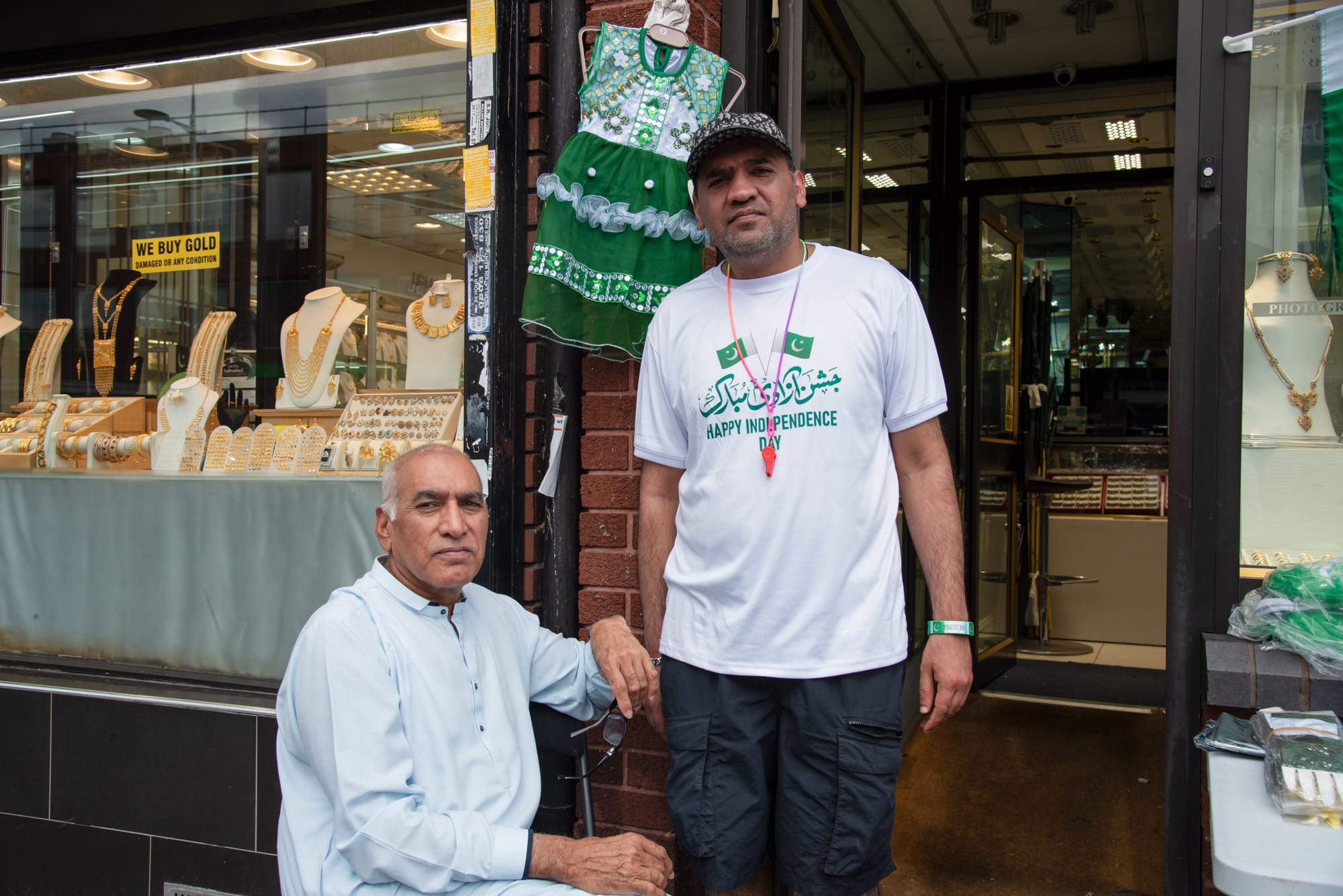
The makeshift stall is set-up on the pavement outside Eastern Gold, a jewelery shop full of buttery-yellow necklaces and diamond-set rings. A man rushes out from behind the counter to meet me when hears me chatting to Mohammed, and introduces himself to me half-jokingly as Mustafa, the Prime Minister of Wilmslow Road.
Eastern Gold is Mustafa’s father’s shop, and has sold jewelery on the Curry Mile since 1980. Even back then, the street’s nickname appears to have been a bit of a generalisation. Mustafa’s Great Grandmother came to Manchester in the ‘50s, and set up the first Pakistani gold shop in the city — a few strides down from where we’re standing, now converted into a Baskin Robbins. Eventually the rest of the family came over, and they now own 200 jewellery shops across the UK, but Mustafa stayed local. He’s lived on Wilmslow Road his entire life.
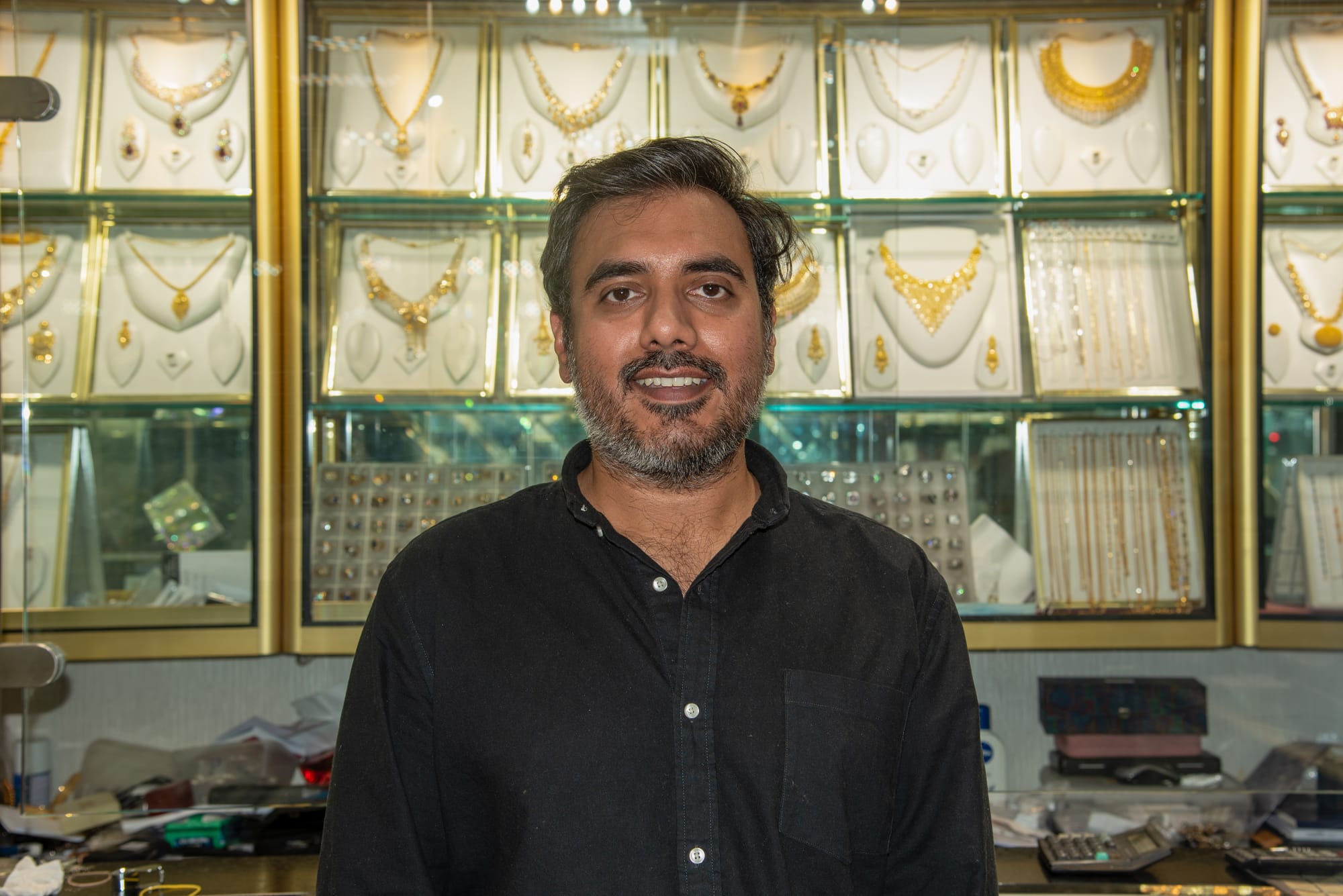
“I was around to see all the changes,” Mustafa tells me. “They started around the mid-2000s.” He explains that Pakistanis played a huge role in establishing the Muslim community in Manchester, after which many Middle Easterners moved into the same areas, where Halal shops and Mosques had already been set up. Soon, Iraqis, then Kurdistanis, then Emiratis, were arriving in the Curry Mile, at first opening barber shops, then shawarma joints, followed by a sudden influx in shisha lounges.
Mustafa tells me that language barriers and cultural differences initially caused some friction between the different communities, but over time this mellowed out. “There is cohesion,” he says, “though it depends which side of the road you’re on sometimes.” Over on the park-side of the road, he explains, between Olives Grill and up until Slemani Restaurant, the street is almost entirely frequented by Iraqi and Kurdish people, and likewise certain parts of the supposedly half-mile strip seem to cater only to the South Asian community. But this hasn’t caused any issues. “The road is so long, it’s big enough to accommodate everyone,” Mustafa says. “It’s just about finding a bit of balance.”
Mustafa tells me that people still travel from all across the north to experience a whole street where Muslim, halal, alcohol-free businesses remain open until 3am. “It’s a tourist area,” he explains, “sort of like the promenade in Blackpool.” But times have inevitably changed for the Curry Mile, and changed drastically. “The old guard have pretty much died out,” he says. “Now when we say ‘old’ businesses, we’re talking about like 20 years ago, that’s still new to me.”
One such business is the Lahori Ice Bar, a long and narrow dessert shop selling karak, falooda, and Kulfi ice cream, that’s been a go-to spot for Pakistanis on the Curry Mile for nearly 15 years. “This is the oldest place for traditional Pakistani desserts on Wilmslow Road,” the manager, Zahid, informs me. “But nowadays, everybody’s opened one.” This is noticeably true — while the number of traditional Pakistani restaurants on the road have decreased, ice-cream parlors and street-stalls selling karak seem to be growing in popularity. The Lahori Ice Bar is perhaps the most popular, getting busy every weekend from 9am, and staying that way until it finally shutters up at four in the morning.
While the shop hasn’t been around all that long, Zahid himself has been in Manchester since the ‘90s, when he moved from his hometown near Punjab. Back then he drove a Hackney Carriage, and he remembers the nightmare of trying to drive down the Curry Mile in its heyday. “You couldn’t move,” he tells me, “the entire road was packed.”
“Everything on Wilmslow Road has changed in the last 10 years,” he says, explaining that the newfound multiculturalism of the area altered the atmosphere. Like all the Pakistani business owners that I speak to, he tells me that nearly all his customers are also Pakistani — for Zahid, this is actually the biggest change to have come over the Curry Mile. Back in the ‘90s, he reckons, 80% of the street's customers were white English people. “It used to be that there weren’t curry restaurants in Manchester except for on the Curry Mile,” he explains. “But now you can get curry everywhere. English people don’t come here anymore.”
A few doors down, Omar Zeb works behind the counter of one of the remaining curry restaurants on Wilmslow road. Al-Madina opened in 1999 — Omar’s father, Mohammed, started it, but Omar and his brother run it now. He too describes how the demographic has changed. “You’ve obviously got a lot more Kurdish and Afghan places that have come around in the last 10 years or so,” Omar says. Like many Pakistanis I speak to, he hints that there was some tension in the years between 2015 and the early 2020s, when a large number of Pakistani restaurants were converted into shisha lounges, that the Pakistani community didn’t use. However, many of the lounges were unlicensed, and the majority have now been shut down by the council. Since then, there’s been far more cohesion between the different communities. “We might be from different locations, but most of us are Muslims,” Omar says. He tells me that the sales, and the atmosphere of the Curry Mile has “taken a bit of a hit,” over the last few years. “I still think it stands true to its name though,” he says.
Mustafa, the aforementioned Prime Minister of Wilmslow Road from Easter Gold, says the name has always been about attracting tourists, not accurately representing the demographic. “It’s a marketing term, isn’t it,” he says. “The idea that it’s Indian food… it’s not Indian food, it’s just from the Desi subcontinent.” Nevertheless, he’s never taken any issue with the moniker. “I don’t mind it, no,” he tells me. “In 10, 20 years from now there will be entirely different businesses. The name might be the same, but the road will always change.”
Did you grow up on the Curry Mile? Do you run a restaurant or cafe there? Let us know in the comments.