
Skip to content

‘Why the hell am I doing this?’ The man navigating Manchester’s biggest job

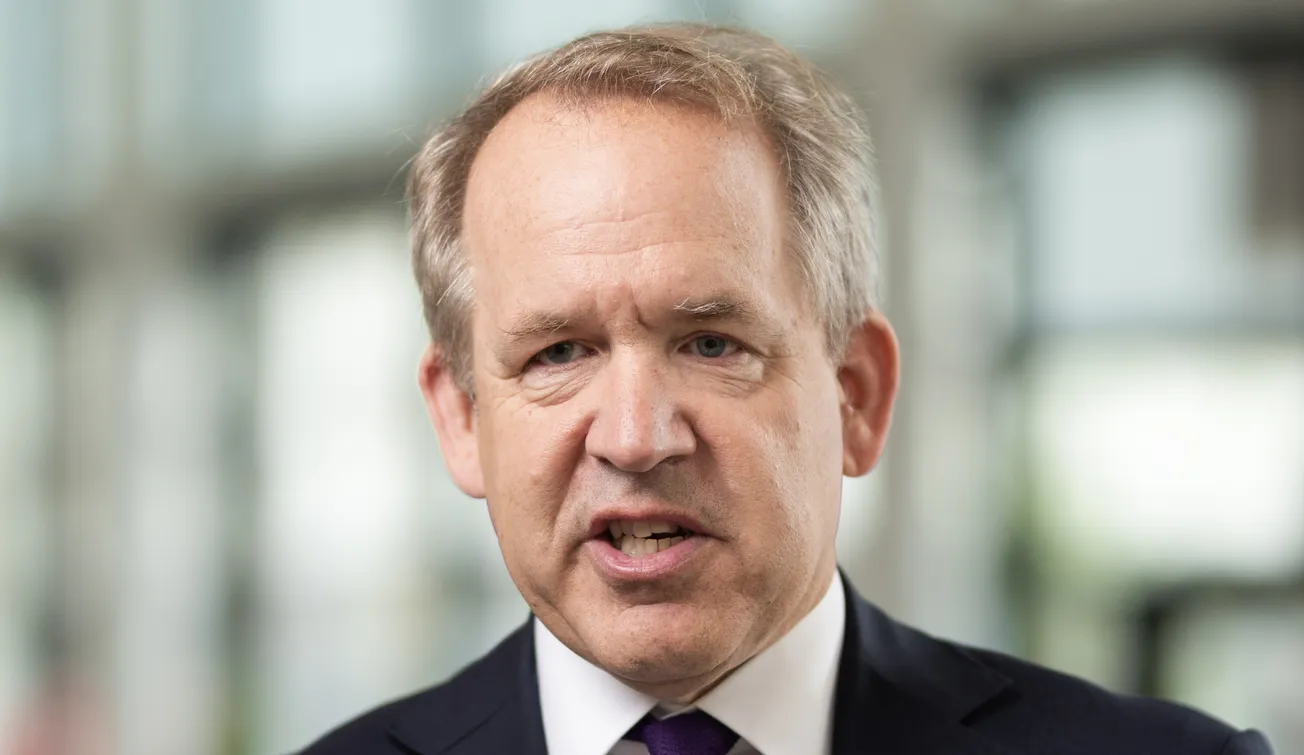
Duncan Ivison, the man in charge of 46,000 students and 12,000 staff. Source: University of Manchester.

Students cheating via AI and international applications ‘tanking’ – Duncan Ivison is at the helm of a big ship in stormy waters

A couple of weeks after coming to Manchester, Duncan Ivison was accosted on a bus. Ivison tends to wake up at 5.30am and gets into the university he runs around 7.15am, beating most of his students up Oxford Road and avoiding the pre-lecture havoc on the 142. On this summer’s morning in 2024, a woman heard him being greeted by a fellow passenger and spun around to ask if he was the vice chancellor of the University of Manchester.

“You really ought to look after your students a bit better,” she told him.

Ivison was perplexed and spoke to his team when he arrived at work. “Where would she get that from?” he asked them. Soon, he started to work out the answer.

There is arguably no public figure in Manchester – not even the mayor Andy Burnham – whose role matters as much to the prosperity of the city as the one held by Ivison, a 60-year-old Canadian academic who wears a hangdog expression and speaks with the pleasing precision of a political scientist.

The University of Manchester employs more than 12,000 staff and brought in £1.4 billion last year, more income than Manchester City and Manchester United combined. Its research makes waves around the world. Its 46,000 students are so pivotal to the economics of the city that when Ivison was recruited in 2023, Manchester’s council leader was part of the hiring process. When the BBC’s economics editor Faisal Islam analysed Manchester’s success recently, he noted that along with MMU, it makes up Europe’s biggest university campus.

“Everything comes back to this,” wrote Islam, a Mancunian himself. “The knowledge and the educated workforce are the essential raw ingredient upon which this growth has emerged.”

One university staffer describes Ivison as a “breath of fresh air” and a stark contrast to his predecessor, Dame Nancy Rothwell. But he’s taken over a university beset by challenges: frighteningly reliant for its income on Chinese graduate students, applications from whom are “tanking” according to one insider, and working out how to offer a meaningful education to a generation who can instantly gin up a 5,000-word essay using AI.

“I mean, there are days where you think, ‘Why the hell am I doing this? It’s almost impossible’” Ivison tells me in one of the university’s cafes in late November, the first of our two meetings for this piece, which has also involved speaking to multiple colleagues and associates of his, on and off the record.

Ivison captured by The Mill's Jack Dulhanty.

The role is difficult but also “an amazing sort of privilege,” he says, with some of his students sitting drinking coffee at the surrounding tables. It’s not a perfect setting for an interview covering sensitive questions about the university’s finances and relationship with autocratic regimes, but it matches his approach: he wants to be visible and approachable to his students in a way that Rothwell – widely caricatured as imperious – was not. “One of the dangers of these roles is that you start to believe your own bullshit and you get caught in an executive bubble,” he says, noting that when you’re the vice chancellor, people come into your office and say things “that they think you want to hear”.

It all sounds very Canadian and lovely. But are Ivison’s vast army of students, staff and partners in the city buying into his new style of leadership? 

‘Tanking’

It was late autumn last year when staff realised there was a problem: applications from international graduate students were much lower than expected. “I became more aware of the panic around it in October and November,” one administrative worker told The Mill. How bad were the numbers? “Tanking is the word that was used,” the staffer recalls.

The university admitted 19,356 international students for the 2024-25 academic year, second only to UCL in the country. These students, who pay between £25,000 to £50,000 a year – aren’t just important to its business model – they basically are its business model. 20 years ago, just after the modern university was formed from the merger of UMIST and the Victoria University of Manchester, it had 6,400 international students. That number has now more or less trebled, as has the university’s income, and their fees have allowed it to cope with frozen government funding for domestic students, which has crippled the sector.

A video on the university's Instagram encouraging students to seek help if they need it. Source: @officialuom on Instagram.

Ivison concedes that postgraduate application numbers are down this year, although he says that undergraduate numbers are strong. The government’s ban two years ago on master’s students bringing family dependents has hit many universities (particularly those with large Nigerian intakes) but Ivison thinks changes in the Chinese economy are a bigger factor. He’s also self-critical. “My own view is that we actually don't quite have the right ‘offer’ in the postgraduate coursework,” he says. He says a review is under way. “I don't think we're offering the kinds of programmes that students are looking for,” he adds.

If talking about creating the right “offer” sounds a bit capitalist, that’s certainly one criticism of the university’s model: that it has become hyper-marketised – competing against its peers in Paris and Pittsburgh to lure students from around the world. This is a concern raised by Dr Simeon Gill, a Reader in fashion technology who serves as the president of the UCU branch and who tells me Ivison has been more attentive to the union’s demands than his predecessor. “The University of Manchester hasn’t historically been free from the influences of free market capitalist and neoliberal ideas,” Gill says, conceding that this is true of the whole sector.

If you wanted to make a critique of the university’s model that avoids any use of the word neoliberal, you might say: isn’t it problematic to be so reliant on one country, especially one with as much geopolitical uncertainty as China? Well over one in five of the university’s students are Chinese (10,710 students in 2024-25, according to a Freedom of Information request submitted last year), and they represent 55% of the university’s international cohort. “We are highly exposed to the China market,” Ivison concedes, and says there are plans to diversify the international intake.

That might be a wise move, and not just from a financial perspective. In a board of governors meeting a couple of months before our first interview, one of the students on the panel raised a problem: the “clustering” together of different nationalities. This is an obvious risk when a university recruits so heavily from one market, and Ivison knows it. He says he is determined to avoid “international students not meeting and engaging with students from other ethnic and cultural backgrounds.”

Ivison on a trip to China last year, sitting next to Professor Li Luming, the president of Tsinghua University, holding up a letter of intent to facilitate the widening of a Dual PhD programme. Source: University of Manchester.

Closely allied to the problem of student segregation is the thorny issue of language skills, the subject of a 2024 Mill story which raised concerns from some lecturers that too many overseas students at the university don’t speak good enough English to take part in class. “Oh, no, I read it, yeah,” he says when I mention the piece (being a regular Mill reader is one of Ivison’s obvious virtues). “It is a genuine problem,” he says, surprising me with his candour. “It's a disaster if a Chinese student comes to Manchester and goes back and their English is worse than when they arrived, because they've only spoken Mandarin to their friends.”

How big a problem is the language barrier? “Big. It’s something we notice across every scheme we run,” says the staffer who works in the admin side of the university, echoing what more than half a dozen academics told The Mill. Ivison insists that the university has not lowered its English language standards to boost student numbers, but on this issue he is out of step with what his own lecturers and administrative staff say in private. 

Disagreeing reasonably

Ivison was himself an international student. His first ever overseas flight was to London in the 1980s to do his master’s at the LSE. Politically, this was like jumping out of the frying pan into the fire: he grew up in Montreal in the 1960s and 70s, during which time Quebec was “an intensely political place”. His middle-class parents were deeply involved in the church and their local community and his dad used to tell him: “You get the leaders you deserve”. How did that environment shape him? “I guess I’ve had a slightly unhealthy sense of wanting to contribute,” he says.

In London, he adopted the role of a fascinated outsider – a political scientist witnessing a tumultuous moment in British history up close. One of the first events he attended was a speech by Labour leader John Smith, followed soon by Jesse Jackson, Bill Clinton and Tony Benn. The left was in open revolt against Margaret Thatcher and students were marching nonstop, but Ivison was mostly an observer, not a joiner, interested in “new kinds of political formations, new kinds of political movements”.

Ivison in a video about free speech on the university's Instagram, speaking to Union Affairs Officer Lexie Baynes and political scientist Rob Ford. Source: @officialuom

As his academic career developed via a PhD at the LSE, three years lecturing at York and then stints in Toronto and Sydney, he wrote extensively about political liberalism. One of his favourite areas has been so-called ‘public reason’, in which he examined questions like how we justify political decisions in the context of reasonable pluralism. How do we have fundamental disagreements about values that are within a reasonable sort of range? “That kind of defines a lot of what goes on in liberal politics, and that’s kind of what happens a lot within universities as well,” he says. It’s notable that the university’s grand 2035 strategy announced last year talks about students “developing the ability to have difficult conversations – respectfully and generously – with those with whom they profoundly disagree.”

This research interest has fed into his leadership style. Everyone I speak to about Ivison says he’s an unusually, almost freakily, great listener, something I’ve also observed during our time together. Some people I interview in powerful positions seem to be reading out a script that bears little relation to the questions asked. Ivison comes from an academic world dominated by big egos, but he doesn’t like the sound of his own voice and he listens carefully.

A former colleague of his at the University of Sydney describes Ivison as “very relational”. Kirsten Andrews – who oversaw the university’s relationship with policymakers – remembers flying with Ivison to Canberra, the capital, to meet a raft of politicians and aides when he was promoted to serve as deputy vice chancellor. Ivison spent two days in back-to-back meetings with ministers, senators and advisors, and Andrews was struck by his ability to connect with them. “He wasn’t interested just in meeting big names,” she recalls, “And he also listened more than he talked, so he came to understand what they cared about.” Soon, he was being asked to serve on industry-wide committees, “because everyone knew him.”

A crisis over AI

Listening more closely to the students at the University of Manchester has involved hearing some difficult messages. The most basic one being: many students were feeling let down by their time in Manchester. “One thing we want is for our students to be telling us they’re receiving the kind of education, having the kind of experience, they’d hoped for and expected,” he says. “We haven’t done well on that front for many years.”

This, he thinks, is what the woman on the bus was talking about. He realised in the early days of his role that students didn’t feel like they were being listened to or well-treated. “This is a generation who are hyper-attuned to the way they are communicated with,” he says, and they didn’t appreciate the “anonymous corporate messages” they were receiving. Ivison made a point of recording casual-seeming social media video interviews with students walking around the campus and chatting to them when they approached him in cafes and on the bus.

Ivison takes questions from a student in one of his social media videos. Source: University of Manchester on YouTube.

He heard from students that they were waiting too long to get their tests and essays back, and weren’t getting good enough feedback, so he’s prioritised fixing that problem. He’s also trying to improve the quality of teaching by changing how lecturers are trained. 

What he doesn’t seem to have heard so well is a complaint emanating from almost every single staff member I’ve spoken to: the rampant use of AI. Students aren’t only submitting obviously AI-generated essays, but coursework proposals and answers to emails from lecturers. Some are even using these tools within lectures and seminars to formulate their answers to spoken questions. And it isn’t just in academic settings. “They just blatantly use AI on bursary applications and applications for trips — whenever there is an opportunity of students to write something, students are using AI,” says the worker in the admin office. 

This is a crisis engulfing every university (recent articles like “AI is Destroying the University and Learning Itself” in Current Affairs “Everyone Is Cheating Their Way Through College” in New York magazine give a sense of the problem), but how each one deals with it will be different. Ivison says there is a debate going on among staff, some of whom think that generative AI “means we can literally no longer validate the education that we're providing our students.” But I’m surprised by the lack of urgency in his response to it. “I think moving to a world in which we just ignore AI and try and keep it out of the classroom is hopeless,” he says vaguely.

A few days after we meet, I’m sent a press release announcing a “world-first” AI partnership between the university and Microsoft that will give all students and staff access to the company’s widely-panned 365 Copilot product. The scheme will “equip students with future-ready skills, strengthen teaching and research, and help address the emerging digital divide through equitable access to the advanced AI tools,” the release says.

The announcement, accompanied by a slick – I daresay “corporate” – video featuring Ivison and a Microsoft executive that was shared on social media, went down “really badly” says a staff member who is otherwise very complimentary about Ivison.

Ruffling a few feathers

The night before my first meeting with the vice chancellor, he was with Andy Burnham at the Portico Library, plotting how it can raise enough money to reclaim the pub downstairs. This is rather more prosaic work than his concerns with China and AI, but the vice chancellor seems genuinely committed to getting his hands dirty in the city.

The word “civic” appears 27 times in the 2035 strategy, notably in a reference to wanting to be “a great civic university for the 21st century”, and a paragraph about making “the city and region central to how we develop and apply knowledge to share with the world.” The university has been utterly central to Manchester’s reincarnation as a services-led “knowledge economy”. For one thing, the university has acted like a magnet: Many people reading this piece will have come to Manchester as a student and stayed. But Ivison wants stronger ties between the university and “the health system, the community associations, the cultural institutions.” He notes that the university already trains many of the region’s teachers, doctors and social workers. He mentions that this year, for the first time, some of his PhD students are teaching in local colleges that struggle to hire electrical or chemical engineering teachers.

Burnham and Ivison chat during a mayoral visit to the university last year. Source: University of Manchester.

The thing that could reap “quite extraordinary” rewards for the city region so far remains frustratingly elusive. For years, local leaders have talked about the potential for startup companies to “spin out” from the university, turning some of its cutting-edge research into massive job creation like happens at Stanford in California.

So far, the results in Manchester have been underwhelming. “Everybody involved would say that it’s something the city could do a lot better,” admits Chris Oglesby, whose family property firm Bruntwood is a key partner for the university. Oglesby says that the university is “more embedded” in Manchester than any other city he’s seen.

Soon after Ivison joined as vice chancellor, the university announced a new initiative called Unit M, which promised to be a “front door” to the university’s ideas. It would “transform how the University partners with startups, scale ups and industry” and Andy Burnham was bullish: he saw the new scheme “contribut[ing] to the broader prosperity of the UK.”

But last year I heard that there was trouble at Unit M, with bafflement among staff in other departments about what exactly it was doing. In November, the well-connected local entrepreneur Lou Cordwell stepped down as its first chief executive after a year in the role. Ivison says Cordwell was “fantastic” but I tell him that her departure doesn’t make it look like the university is on the brink of solving the startup spinout conundrum. “Look, whenever you’re creating something new, you’re going to ruffle feathers,” he replies.

When I ask the university to send me examples of successful spinouts, the companies associated with their Innovation Factory which they choose to highlight include one company (an impressive manufacturing firm called Holiferm) which LinkedIn estimates has between 51 and 200 employees. The rest of the examples are estimated to have fewer than 50 employees. There’s nothing wrong with small companies, but Silicon Valley this isn’t.

“The onus is on us to create a pipeline of investable stuff,” Ivison admits, saying that many staff still see commercialising their work as a grotty rather than admirable thing to do.

I push him to explain how the university could be of benefit to a Mancunian in Harpurhey or Whalley Range who doesn’t come from privilege and doesn’t see themselves attending the university. This seems to set something off in him.

“If you wake up in the morning in a shitty house with mould, with lousy public transport, in a city in which you see a lot of students maybe walking around, who you don't understand why they're there, and it's not an institution that you have any connection with…” Ivison has momentarily left behind his tight analytical answers and is building an image of contemporary Manchester.

The campus from the sky. Source: University of Manchester.

“And then nothing works. You can't get a medical appointment. Your kids' school is lousy and you're not able to find employment and you see all these things happening around you and skyscrapers going up and whatnot. This sense of decline – that's what fuels, I think, not unreasonably, a lot of the resentment.”

He wants his university to solve more of those problems in a practical sense – via partnerships with the health service and giving Mancunians in mid-career a path into the university. But he also wants the university to provide an antidote to resentment by showing that people can progress in their lives. Ivison leads an enormous, globally-facing organisation, but he spends more time than I had expected talking about the importance of “place” and becoming ever-more connected to Manchester. 

“I do think place-based politics is one of the most powerful responses to the age of populism that we're living in,” he says. “It anchors people.”

If someone forwarded you this newsletter, click here to sign up to get quality local journalism in your inbox.


Share this story to help us grow- click here


Comments

Latest