
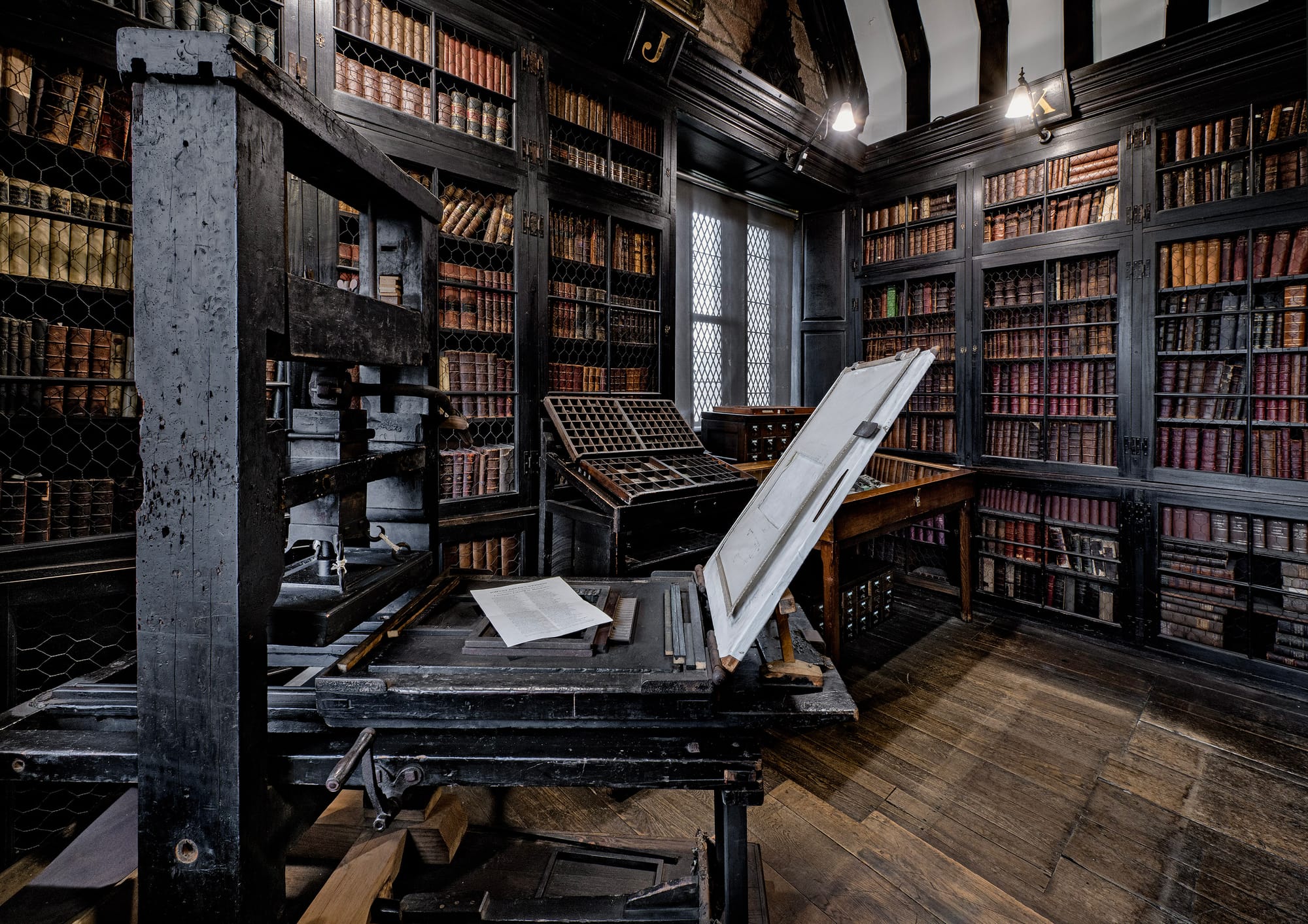
Chetham’s Library preserves Manchester’s printing history
We, as journalists, owe a lot to the invention of the printing press. And just down the road from where we currently publish (albeit by a very different mechanism than traditional ink-lined pages) lives a 17th-century wooden printing press.
The press is suitably housed in Chetham’s Library, the oldest public library in the country, where it has been on display for 125 years. Originally donated in 1900 by George Falkner & Sons – a local Deansgate Printer – and made of 17th-century wood, it remains preserved in immaculate condition. Fewer than 70 similar wooden presses survive globally. You can see it, and thousands of other rare objects, on a guided tour of Chetham’s Library - click below to book your place and see this iconic piece of Mancunian history.
Early on in her reign as council leader in Manchester, Bev Craig faced a taunt that still seems to irk her. In a meeting with property developers, a “man of a certain age” put up his hand and challenged Craig over one of her key priorities. “Why should I think about social housing in the city centre if you’re just the David Moyes of Manchester?”
The football barb stung, particularly because she’s a fan of Manchester United. It was at this club that the Scottish manager David Moyes succeeded Sir Alex Ferguson in 2013 and was gone by the following April, becoming a cultural shorthand for a failed successor to a long-serving leader. When she took over the council in 2021, Craig was succeeding Sir Richard Leese, who set the course for the city for 25 years.
This week, if national polling is correct, she’s set to be filling even bigger (or at least, more famous) boots. She’s the favourite to win tomorrow’s mayoral by-election that was triggered by Burnham’s march on Downing Street (polling stations open at 7am – click here to see details about how to vote and find your polling station here).
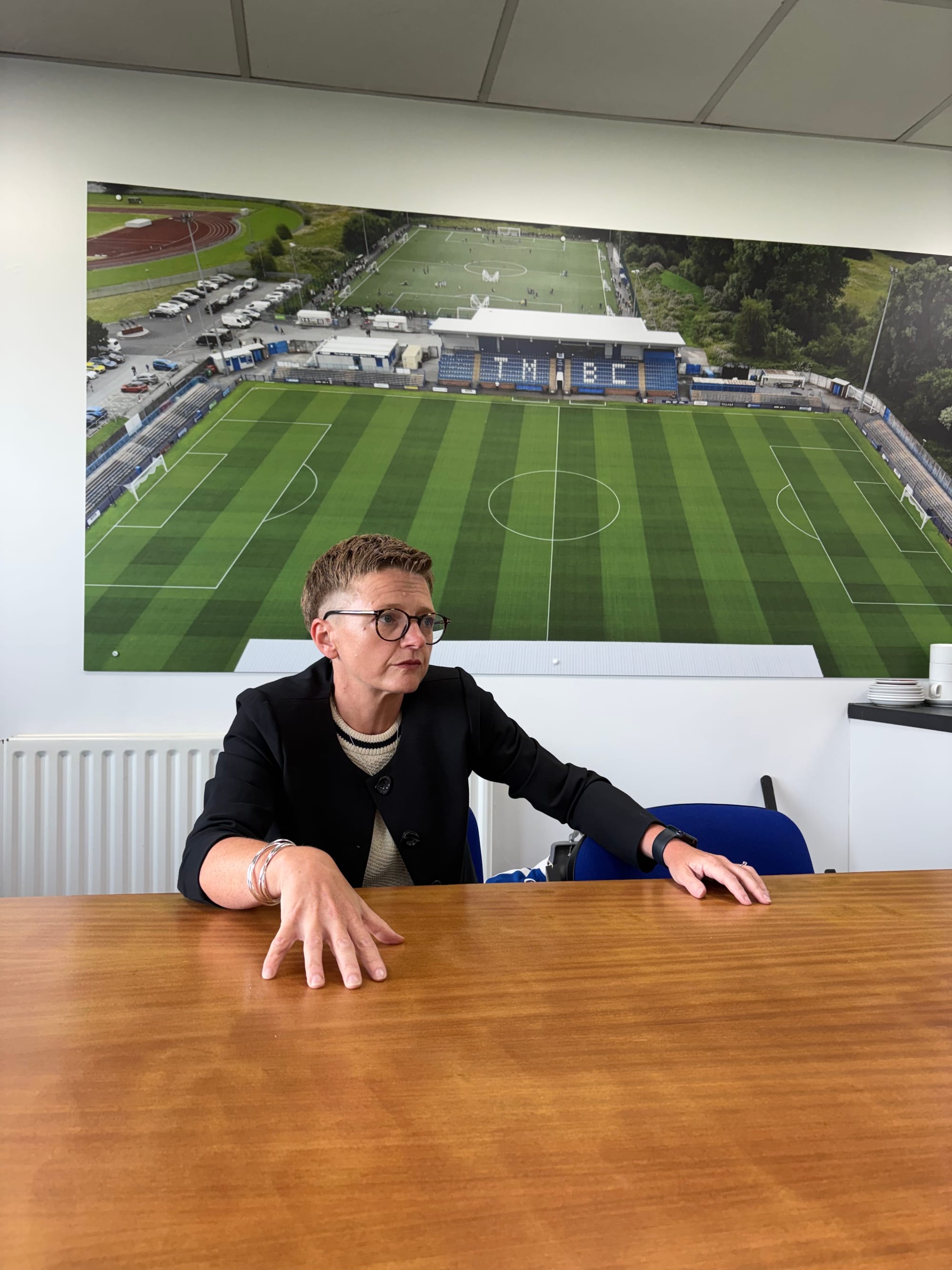
Perhaps it’s because we’re sitting in the boardroom of a football club – not at Old Trafford but the more modest environs of Curzon Ashton FC – that the Moyes comparison comes to her mind; she mentions it at the start and end of our interview. Craig resents the idea that she’d have to define herself against Leese and Burnham, who she describes as “two men that have dominated Manchester politics for the last two decades”.
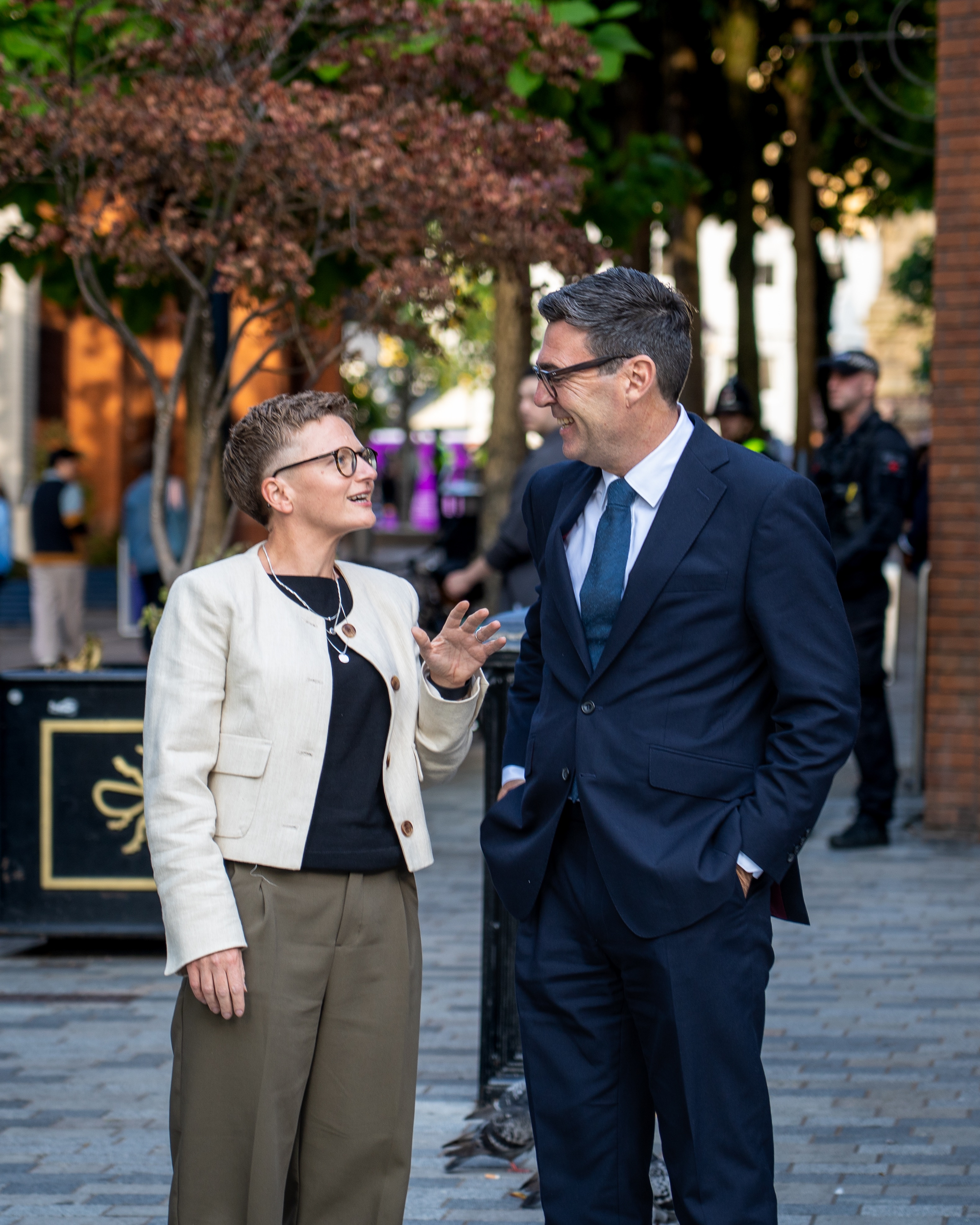
But that doesn’t mean we can’t draw comparisons. For one, her background as a councillor and then council leader means that Craig relishes the minutiae of local government. Unlike Burnham, who was chided by Leese in his early months as mayor for announcing things before the details had been decided, Craig is cautious about over-promising and speaks fluently about funding schemes and obscure policy initiatives.
She is a more extroverted figure than Leese, but like him, her political ambitions seem to be genuinely local. With Burnham, everyone knew he had an eye on Westminster. Craig, however, hasn’t followed some of her peers by sizing up seats in parliament, and it’s thought that she turned down the chance to be Labour’s candidate in the Gorton and Denton by-election earlier this year. In fact, the position she has coveted is the one she hopes to be elected to this week, although she expected it would only become available at the end of Burnham’s term in 2028. In that sense, she is more of a creature of “place” than her predecessor was.
"If you want to shape a place, you don't get to do that from [Westminster],” she says during our first conversation a few weeks ago, while wandering past the rather bleak and recently closed-down Longfield Centre in Prestwich. The shift from being a council leader to being a combined authority mayor actually involves giving up a few hard powers, but Craig is gambling that the mayoralty will soon be beefed up by Burnham.
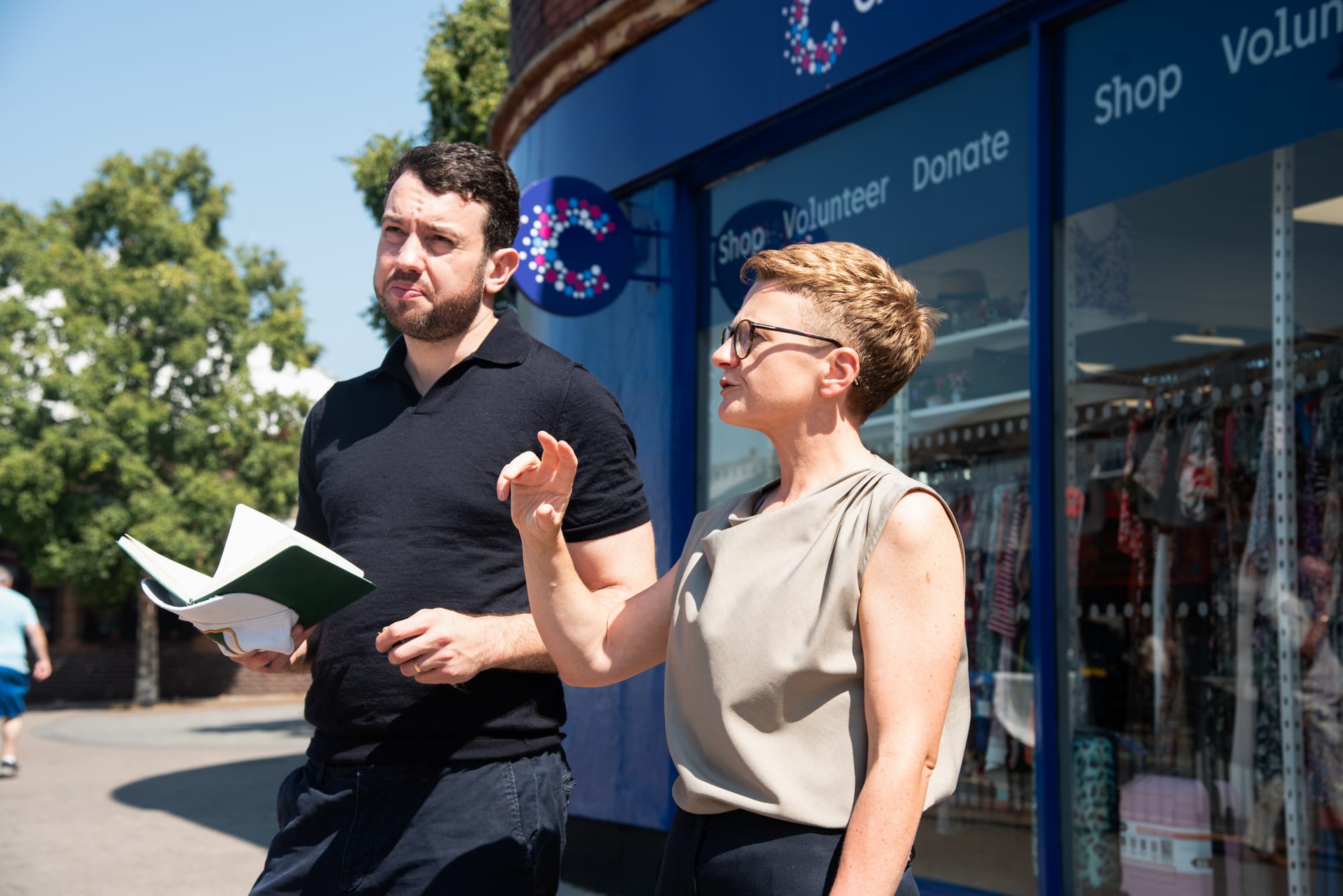
She’s optimistic that Number 10 North will deliver faster devolution, and she particularly wants new powers and funding to tackle skills shortages and unemployment. This includes getting some of the support budget that currently sits with the Department for Work and Pensions and JobCentres, so that local groups can do a more effective job of getting people back into work. She would also like more powers to “step in” and remediate brownfield sites and to revive high streets, and the ability to integrate local trains into the joined up transport network.
Given her close relationship with Burnham, should she become mayor, she will be confident of getting those new levers.
‘Politically astute’
One CEO of a development firm – not the one behind the Moyes heckle, we understand – remembers meeting Craig soon after she became council leader. At the time, there was trepidation in the development world that Craig would wrench the council leftward and away from the pro-development stance of Leese and his chief executive Sir Howard Bernstein. Instead, the CEO left a roundtable with her impressed. “Everyone, on the way out, was saying she was bright,” the CEO recalls. “Her willingness and speed of thought, she’s very very clear in her own mind and how she responded and articulated.”
“You often hear people saying ‘oh she’s very good isn't she?’”, says Vaughan Allen, the chief executive of city centre business group CityCo. “She is just as bright as Richard [Leese], but in a different way. She wears it more lightly.” Allen and others say that Craig as mayor would feel more stable than Burnham, who is liable to fire from the hip with new policy ideas or reactions to the political moment. “She won’t say anything she can’t deliver,” says Rabnawaz Akbar, who recently served as the city’s executive member for finance until he lost his seat in May’s local elections to the Greens. “She won’t say anything that’s not costed.”
Akbar is a close ally of Craig who may get a job in her mayoral administration if she wins, so his praise for her (“She’s a once-in-a-generation local leader,” he adds) should be taken with a pinch of salt. Nevertheless, it’s notable that so many senior Manchester councillors are loyal to her and stuck with her during her turbulent early days, when the man she beat – deputy Luthfur Rahman – was vying for her role. “She’s politically astute, and she understands what working people are going through,” says Akbar.
Those who work with her say she is comfortable leaving her executives to their work, but is also across every aspect of what they’re doing. “Nothing gets past her,” one laughs.
Continuity Craig
A less flattering portrait of Craig has come from her pugnacious Green rival for mayor, Geraldine Coggins. In The Mill’s hustings on Monday evening, Coggins clearly irritated Craig by calling her a continuity candidate and a stooge of private developers. In one of her leaflets, Coggins criticises “Labour’s develop-led approach” and its stance on Gaza. Coggins has run a strong campaign and her high-energy debating style contrasts with Craig’s more measured delivery. The fact that one of them (Coggins) is from Dublin and the other (Craig) is from Belfast drew fire from the Conservative candidate Phil Eckersley, who pointed out he was the only person on the hustings stage who hails from Greater Manchester.
Has Craig run the city in the interest of developers, as the Greens allege? When she sat down with The Mill in 2021, early in her tenure as council leader, she said the city could now be more demanding with property investors and builders, saying: “I think Manchester’s hand has shifted, and it’s my job to make sure we properly play that hand”. Has she played her hand well? At the hustings, she boasted about building more social and genuinely affordable housing than any other city last year.
She’s also proud of building social housing in the city centre for the first time in 40 years, despite scepticism from “some within the development community” that this was achievable. She points to the former Boddingtons Brewery site on Great Ducie Street, where 115 of the 505 homes are being built for social rent. There’s no doubt Manchester has started building a lot more social homes in recent years, albeit from a very low base, with the help of new government funding. 439 social homes were built in 2025-26 according to the council, and thousands more are expected in the next few years. Is she satisfied with that pace? “I would prefer it to be faster,” she tells us.
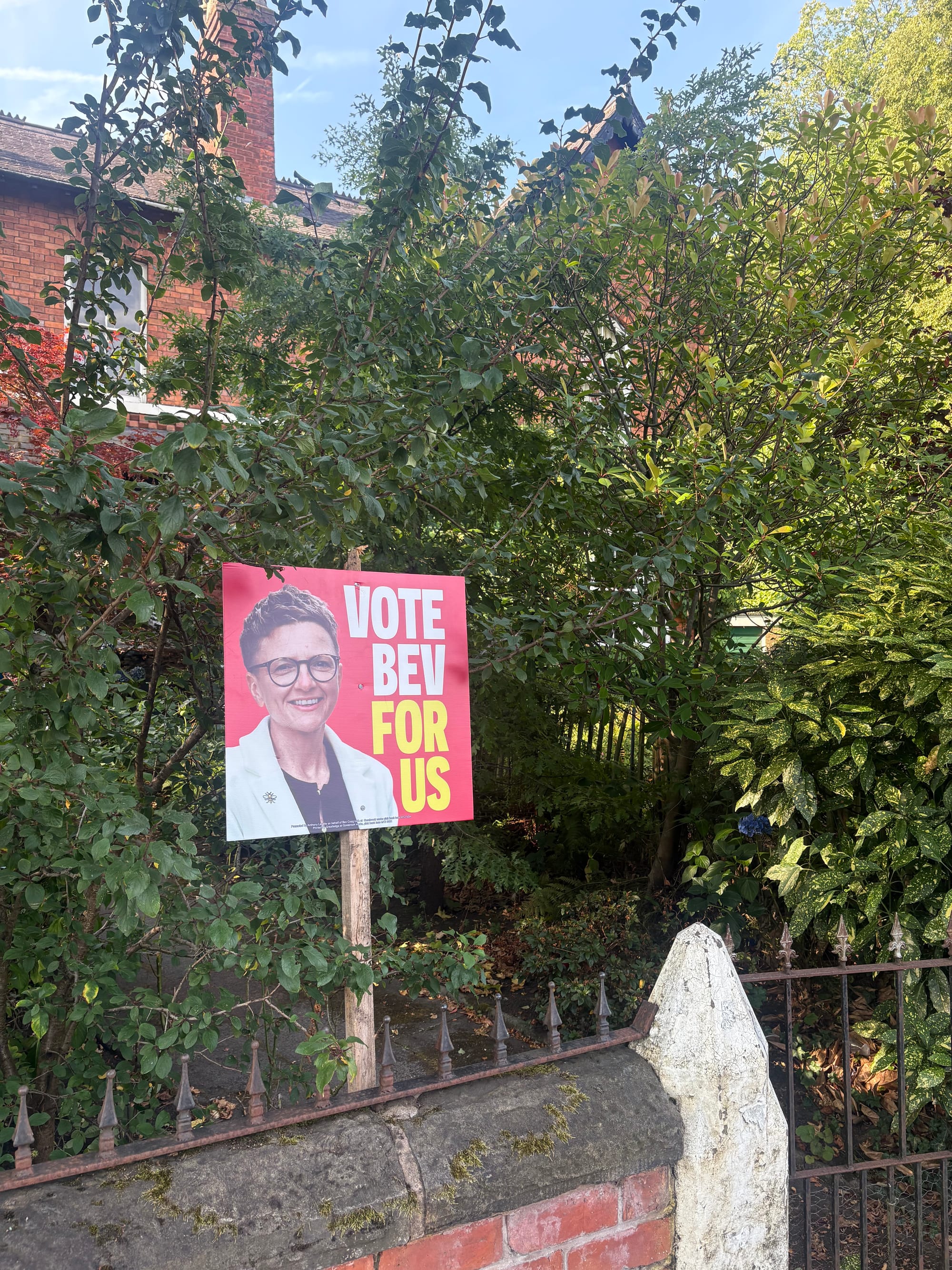
Craig’s campaign has emphasised her as an individual more than it has her party, perhaps understandably given Labour’s modest polling. Her main campaign leaflet is entitled “Bev’s plan for Greater Manchester” and her yard signs (“Vote Bev – For Us”) don’t even mention Labour, echoing Burnham’s approach in Makerfield.
What she does emphasise heavily is her plan to extend free bus passes, currently available to 16-18 year-olds, to 11-18 year olds, which she says will save a family with two children in secondary school around £20 a week. This will be paid for from existing funds rather than new taxes, she adds. Her detail-focused style of politics comes into view when she starts explaining the mechanics of this change: she looked at extending the pledge to older groups but the data shows that the bus seats taken for free by this new cohort are already available and empty.
Still she’s sensitive to the suggestion that she’s a boring policy wonk who uses terms like “revenue foregone” (in an interview with the MEN earlier in the campaign, she got slightly stuck on trying to prove that’s she’s normal and fun, pleading with the interviewer to believe that she’s a right laugh with her hockey mates). “It’s not about being in the detail all the time, but using the detail to confidently say to the public of Greater Manchester: ‘I’ve thought about this’”.
There is another interesting contrast between Craig and Burnham that has come out in the last week. Burnham has taken over mid-term of a Labour government and is promising to “rewire the British state”. Craig sees her chance to complete Labour’s mayoral term — lasting another 18 months, after which we will have the scheduled mayoral election in 2028 — as a chance to set out her stall. “This isn’t about achieving a long-term vision, this is building a long-term vision and delivering now.”
Working with Reform
The Burnham comparisons can only go so far, because Craig would be elected mayor in a very different political moment. During his time as mayor, Burnham faced little political opposition from Greater Manchester’s councils, which were mostly run by Labour leaders. As this May’s local elections showed, Labour’s dominance of the region is being washed away by Reform and the Greens, and within a year or two we could have several Reform-led councils. Getting them to pull in the same direction on things like local planning, development and renovation will require a deft touch.
Craig says she is confident she can work with a more oppositional group of leaders, pointing to her work as vice-chair of the Local Government Association, whose board includes figures from across the political spectrum. “In my view, a mayor convenes, corrals and leads.”
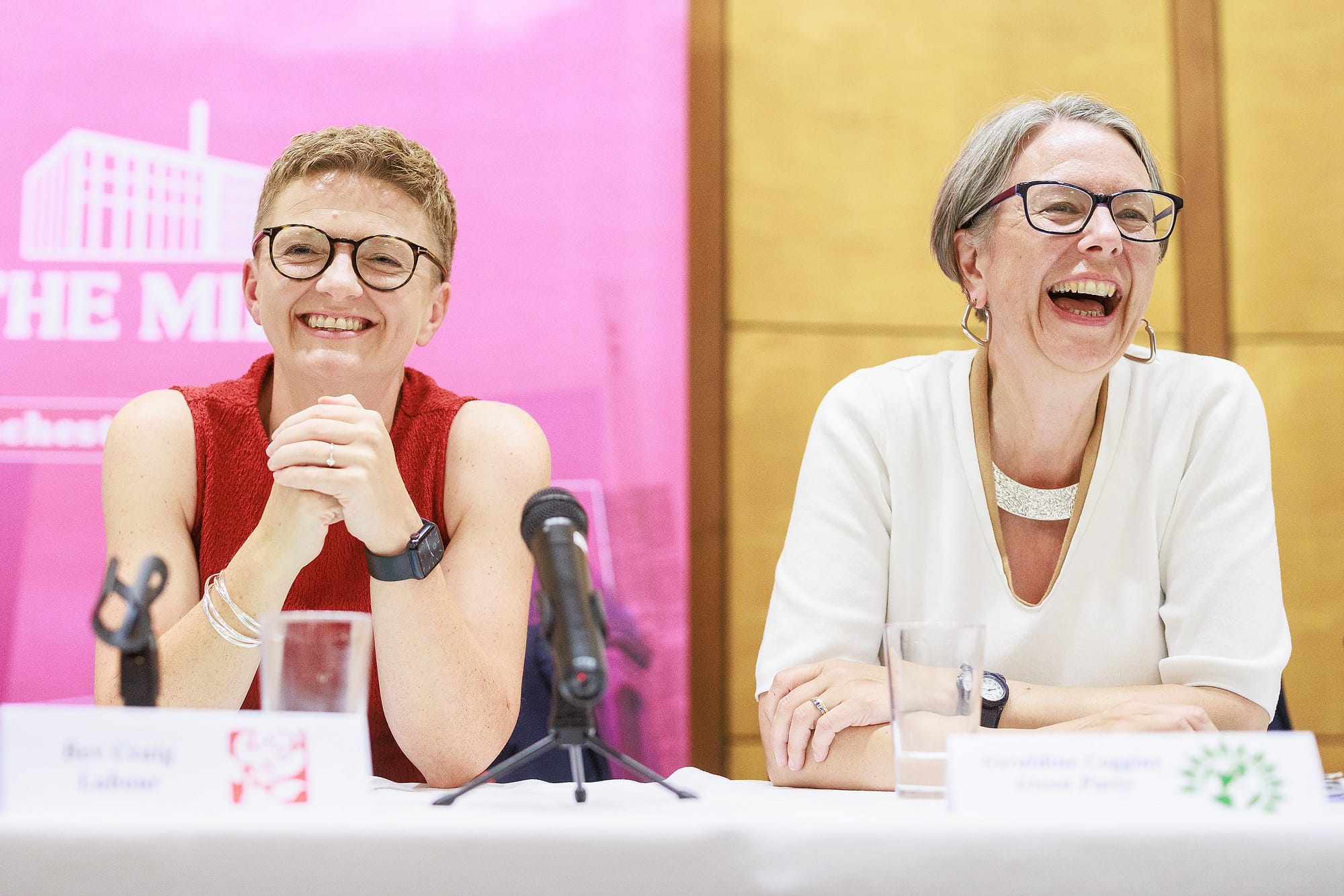
But it’s not clear how well she understands the appeal of Reform to local voters. In one of our interviews, she puts Reform’s support in Greater Manchester down to voters being angry about their quality of life not improving. She doesn’t mention immigration, which is core to the campaign being run by Reform’s candidate for mayor Sian Astley (“Migrant HMOs have exploded in numbers across Greater Manchester. These men are unvetted. We have no idea who they are,” says a typical Astley tweet). Can a mayor who doesn’t grapple with public anger over immigration successfully govern Wigan, where Reform won 24 of the 25 council seats on offer in May, or Tameside, where they won 18 out of 19?
Perhaps Craig’s promise to create a new High Streets Fund “paid for by growth from the city centre” and to “clamp down on the dodgy shops blighting our areas” is a nod to the concerns of Reform voters, among others. Craig says she will restrict the opening of vape shops, and during our walkaround in Prestwich she talked about the need to support independent businesses. Is that possible outside of affluent areas like Chorlton and Didsbury? The independents we meet as we walk tell us they’re struggling to compete with chains, and she’s spoken to residents in places like Wythenshawe who complain that when an area gets regenerated, affordable shops disappear and their replacements only sell a “six quid oat milk latte”.
Another area where her council has struggled to make serious progress is on homelessness. In its 2015/16 budget, the council allocated just under £5m to its homeless, refugee and asylum seeker service. In the most recent budget, £32m was allocated to homelessness alone. Most of that money is spent housing thousands of homeless families in the misleadingly-named “temporary accommodation", the state of which “really shocked” Craig when she became leader.
The Mill has reported extensively on the wild west of private firms who stand to gain from this problem, including the extraordinary tale of the semi-detached property in Harpurhey that changed hands for £1.8m on the same day it was purchased for £575,000. The council described this deal as an example of “property market manipulation,” but didn’t seem to realise – until we got in touch – that one of the companies involved in the transition was HSPG, a company to which it has paid millions for homeless accommodation.
‘Terrified’
In October last year, Craig appeared at a vigil following the terrorist attack on the Heaton Park Synagogue. “It was pouring, totemic Manchester rain,” she recalls, and speaking before her, deputy prime minister David Lammy was struggling badly. Lammy was on stage, trying to peel the pages of his speech apart. Hundreds of people, many angry and hurt by perceived inaction from the government on anti-semitism, had gathered and were growing impatient.
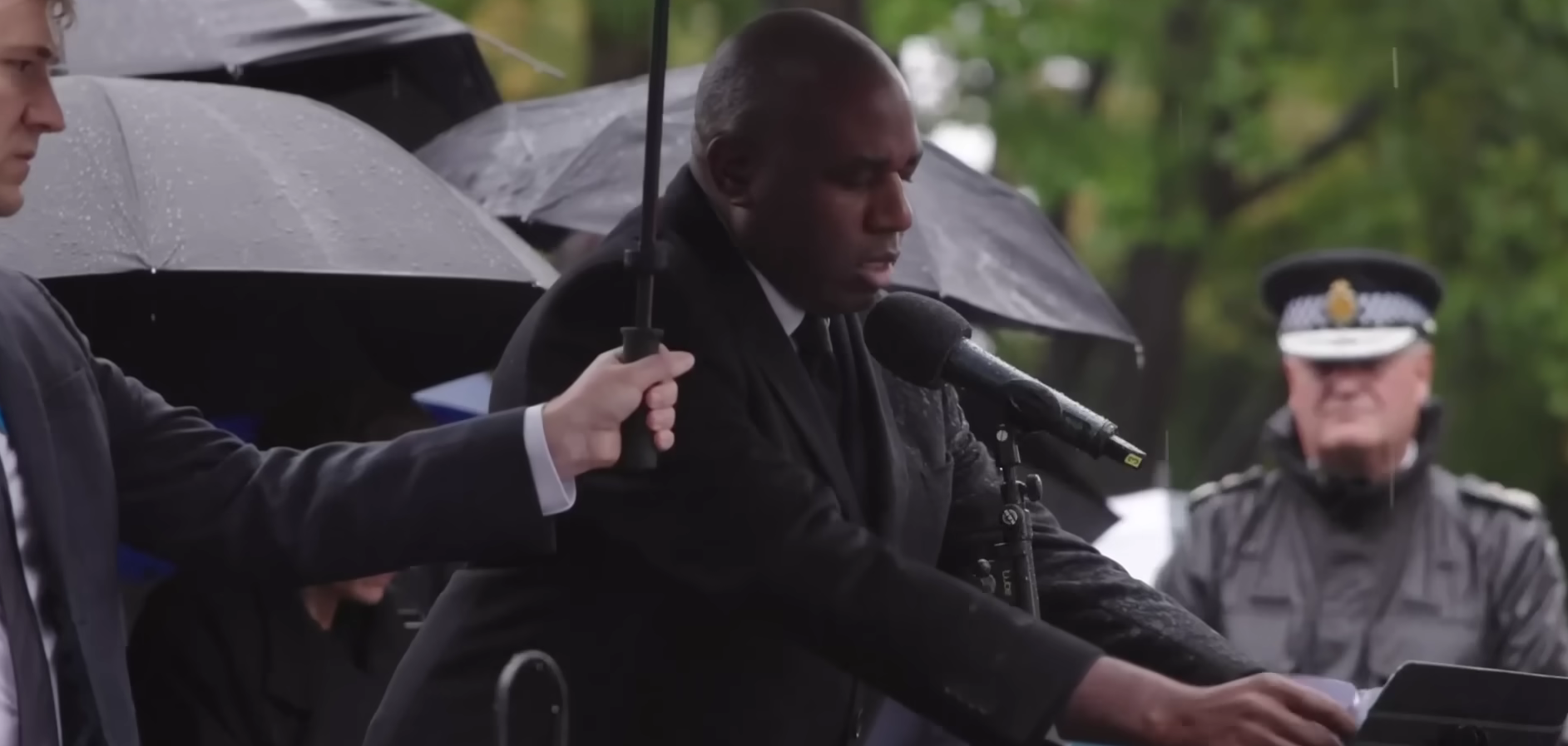
As he got to the end of his speech he said: “And for those that are considering marching over the weekend: I ask them to reflect with all human dignity, grace and understanding, to stop and to stand back,” at which point the crowd did the opposite, and erupted in boos and jeers. Craig was scheduled to speak directly after him, and she wondered whether it was a good idea. “I’d be lying if I said I wasn’t on stage terrified because I could see the situation that David Lammy was getting himself into,” Craig remembers.
She felt someone tugging her arm; did she want to skip it, and just let the chief constable speak? “Well, no,” she now says. “Having national politicians speaking about a local, painful event isn’t what they need.” She went up and said what she needed to say “with no notes, and controlled the crowd,” remembers Akbar. “That defines, to me, leadership.”
To Akbar, that appearance was a key moment for Craig: one in which she proved that she was a leader of substance who can communicate in difficult circumstances. Craig isn’t the same kind of politician as Burnham – she says she wants to build trust with the public by showing real change, “not in 10-second TikToks” – but she also isn’t the leader after the Lord Mayor’s show. After all, it wasn’t David Moyes’ muted press conferences that brought him down – it was his team’s performances on the pitch.