


Editor’s note: On 31 August, Stephen Garvey, the principal of Cedar Mount Academy, wrote The Mill to register several complaints about this article. In response to his concerns we have added his denial that a particular interaction between himself and a teacher occurred as it was described to us. We have also clarified our description of a conversation between him and Katie Allen-Gyves in which she told him about her high blood pressure. We have removed the word “worryingly” because our reporting does not indicate that she communicated to Garvey the severity of the symptoms she was experiencing. We have corrected our account of the number of times Allen-Gyves approached him to request a reduced workload. It was once to Garvey and twice to Louise Stubbs, according to a teacher, not three times to both. On 7 October we removed an incorrect reference to the school’s head of Geography. The position was vacant; the person was not on maternity leave. The Mill apologises to Mr Garvey for these errors.
On 15 October, Mrs Stubbs wrote to us to deny that Allen-Gyves had approached her twice about a reduction in teaching and said that their final text conversation was about fairies, not fairy lights.
Last Friday, the morning after the media reported on an inquest into the death of a teacher at Cedar Mount, a member of the secondary school’s staff walked into the principal’s office. A number of teachers at the school were angry after reading the coverage and this staff member is said to have expressed that feeling to principal Stephen Garvey.
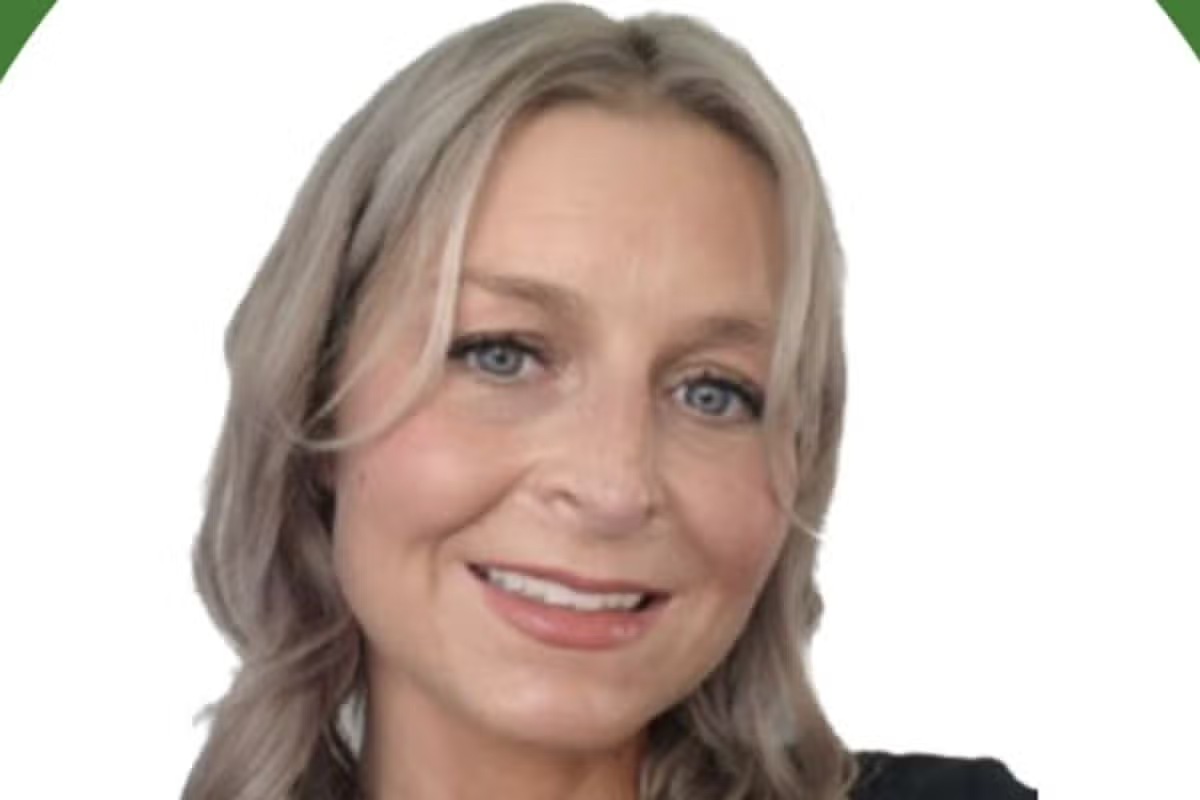
Katie-Allen Gyves was found dead in her home on 6 December last year, aged 38. Despite some colleagues initially suspecting that she had died of a stress-induced heart attack or even taken her own life, the inquest established that she died accidentally after taking prescribed medication to treat an opioid addiction and over-the-counter sleeping pills, a potentially fatal combination.
But the staff’s anger wasn’t about Katie’s cause of death. Instead, it centred on whether senior leaders at the school had been honest about the circumstances leading up to it. According to two people who heard about the encounter soon after, the teacher accused Garvey of giving a misleading account to the coroner.
Garvey was taken aback, steadfastly denying the accusation — as the Gorton school has continued to do in response to questions from The Mill. He supposedly replied that the news reports had taken his words out of context. He also apparently pushed back against the idea – growing among staff – that Cedar Mount was partially to blame for the death of their colleague. (After the publication of the story, Garvey wrote to us to say that the encounter never took place: “No member of staff approached me on the Friday following the inquest and accused me of giving a misleading account to the Coroner.”)
It was a moment seven months in the making. The inquest into Katie’s death, attended by The Mill, concluded last week, and it painted a picture of an energetic and hardworking teacher who was struggling with the enormous demands of her job. She was the school’s assistant vice-principal and Special Educational Needs and Disabilities Coordinator (SENDCo), a responsible and time-consuming role.
The Manchester Evening News published its report of the inquest last Thursday night, 16 July, under the headline: “Tragic death of ‘determined’ teacher ‘under stress ahead of Ofsted inspection’”. The news report was an accurate depiction of the inquest, quoting witnesses who described Katie as “bubbly” and “happy” in the lead-up to her death. But when the story came out, staff group chats immediately lit up with furious messages.
To the staff concerned, the MEN headline suggested that it was the prospect of an imminent Ofsted inspection at Cedar Mount — scheduled for 9 December — that had put Katie under stress. This had been implied by the senior teachers who appeared at the inquest. But Katie's colleagues who have spoken to The Mill feel that this masks what was really going on: that she was visibly struggling with her workload and needed more support from the school.
Only two staff members from Cedar Mount attended the inquest: Garvey, who has a boyish appearance and began his teaching career in 2011, and the school’s interim vice-principal and Katie’s line manager, Louise Stubbs — slightly older, and seeming visibly distressed by the weight of the proceedings. In the past week, The Mill has spoken to four current and four former staff members at Cedar Mount in an attempt to untangle what is clearly a complex and emotionally charged story. All eight requested anonymity.
“I can’t describe the strength of feeling in the school,” one staff member who was close to Katie says. “This is the official record and document of what happened in [Katie’s]... life and it’s not true.”
A spokesperson for Cedar Mount Academy told The Mill they are "devastated" by Katie’s death and will always “look for ways to learn and improve [their] support following such a traumatic event”, but they strongly reject any suggestion that evidence given by Garvey and Stubbs at the inquest was misleading.
Throughout the inquest, the spokesperson said “there were no disclosures about Katie’s behaviour… from any members of staff”, nor were there any concerns during her line-management meetings or wellbeing check-ins. They told The Mill that they do not dispute that Katie experienced workload pressure, but stated that she spoke positively about the school and staff thought “she was doing an excellent job”.
A struggling school
Katie started at Cedar Mount in September last year. She was recruited by Garvey, who had worked with her at a previous school. According to her mother, who spoke at the inquest, Katie was initially excited about the role and quickly made friends. The workload, however, was intense from the beginning. A SENDCo’s job is regarded as among the most difficult in a school: Katie was ultimately responsible for her own SEND team as well as every child with SEN requirements in a school with over 700 students.
Katie was also the point of contact for all children displaying behavioural difficulties. Staff tell me she was interrupted numerous times each day by members of the pastoral team, who would bring distressed children into her office.
She also had teaching responsibilities amounting to 12 hours timetabled over a fortnight, including two GCSE Geography lessons. Another staff member tells me that Katie approached Garvey on one occasion and Stubbs twice to request a reduction in teaching, but this didn’t happen because the position of head of Geography at the school was vacant.
A spokesperson for Cedar Mount told The Mill that Katie had a team of 10 supporting her within the SEND department, alongside help from an outreach team. They added that when she requested a different external SEND consultant, they acted upon it “immediately”. They said the school supported her in numerous ways, such as by providing a quieter office space and protected time away from teaching, adding that Katie’s “documented teaching allocation remained low.”

Cedar Mount serves a low-income area: Around two thirds of pupils are eligible for free school meals and many arrive speaking little English. Competition from the highly rated Co-op Academy Belle Vue, which opened its gates in 2021, has squeezed the school’s numbers, leading to redundancies and fewer resources. The MEN described the school as “troubled” after it was put in special measures in 2016. It has improved in recent years, but Ofsted’s most recent report states that, while three of its criteria are of “expected standard”, the other three “need attention”.
The downturn
The change began in October last year. When Katie came back from the half term break, her colleagues thought they noticed a change in her. This is the time period that several of them point to as when they recall her appearance visibly deteriorating. I’m told she “looked grey”, was spotted crying numerous times — including in front of parents during meetings — and her “tics” became increasingly noticeable. She was reportedly twisting and grabbing at her hair constantly, as if “she was trying to pull it out”. Separately, three members of staff use the same phrase: “she looked like a nervous wreck”.
Katie was also complaining to colleagues, Stubbs and Garvey about high blood pressure. The inquest heard that she was feeling dizzy in lessons and staff say she was struggling to concentrate due to headaches. Weeks before her death, one staff member says Katie cried when speaking to them, expressing that she “couldn’t do [the job] anymore”.
Two days before Katie’s death, she exchanged emails with Garvey to discuss the possibility of working from home one day a week to complete more complex admin tasks, a request she’d been making since November (at the pair’s previous school, staff had a half day each week to work from home). The request was declined because it didn’t conform to the trust’s policy. Also, Garvey didn’t know how the school would make it work while an Ofsted inspection was imminent — although he floated the idea of approaching the trust to discuss it, and Stubbs said she’d talked of an ad hoc working-from-home arrangement with Katie.
The day before her death, Katie again visited Garvey in his office to discuss her workload. That night, she contacted colleagues by text message, complaining that she was not being listened to. The messages, which we have seen, express multiple points of frustration with the school and have a stream-of-consciousness quality to them. Further messages to colleagues about high blood pressure, difficulty sleeping and the demands of her job continued until the early hours of the morning on Saturday, 6 December.
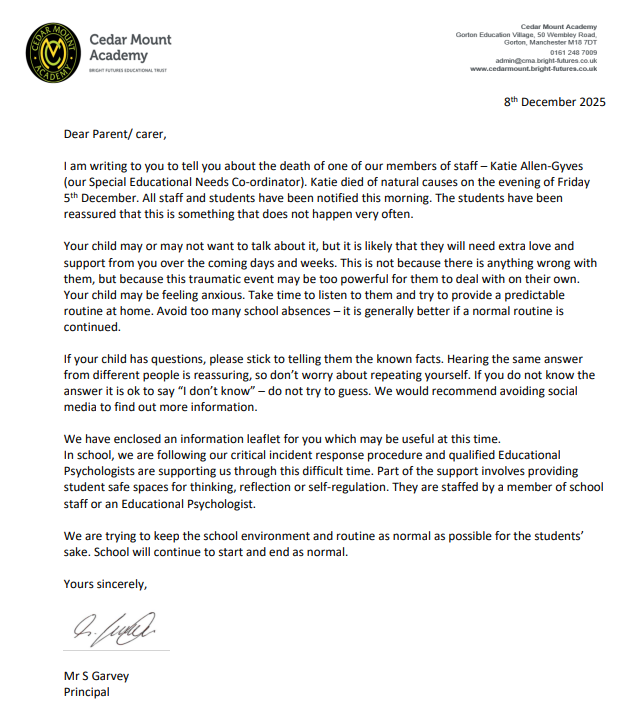
The following Monday morning, staff were called in for a briefing and informed by Garvey that Katie had died from natural causes. Classes went ahead as usual, but one teacher recalls seeing numerous staff members walking down corridors in tears, and says the atmosphere in the school was “horrible”.
That day, Garvey sent a letter to parents informing them of Katie’s death. The letter — which was attached to an email and also published on the school’s website — stated that the school was following its “critical incident response procedure” to support everyone “through this difficult time”.
Staff who attended that meeting have told The Mill that shock was soon followed by anger. They say it was widely believed that Katie had died of a stress-induced heart attack, and word spread that she had recently complained about high blood pressure. “[We] thought it was 100% due to the workload and stress and not being supported in the workplace,” one former staff member tells me. They were unaware of Katie’s previous opioid addiction and her resulting use of sleep medication.
A Cedar Mount spokesperson said that, to the school’s knowledge, such concerns “were not widely expressed”, adding that only a singular “isolated” concern was reported at the time. They told The Mill: “There were no concerns that Katie was unwell, unsafe to continue working, or showing a significant deterioration in her presentation. Again, if concerns had been raised, they would have been considered and acted upon immediately.” The school also cited numerous “excellent examples of the work Katie was delivering” during this period.
The cause of death
Last week, at Manchester South Coroner’s Court in Stockport, Katie’s family sat in the front row of desks. Her ex-husband appeared on a screen above the court with his eyes downcast. Behind them was a lawyer for the school’s trust, Bright Futures Education. To the lawyer’s right were Stubbs and Garvey.
The central question of an inquest is establishing how someone died — not just the medical cause, but the circumstances around it. And central to this case was the toxicology report. As senior coroner Alison Mutch began to read from the report, Katie’s stepfather clasped her mother’s hand.
Mutch explained that Katie had been diagnosed with ADHD soon before starting at Cedar Mount, and began taking medication in the middle of September last year to help her focus. She had also struggled with anxiety and opioid dependence in the past, although it wasn’t specified how long ago.
At the time of her death, she’d been taking an opioid medication called buprenorphine, which she had been gradually reducing (sleep difficulties can be a side effect of managing down buprenorphine, though Katie’s struggles with sleep were a longstanding problem). However, alongside these medications, a “significant level” of promethazine was found in her system. Promethazine is an antihistamine with sedative effects, and is commonly used in over-the-counter sleeping aids.
Katie was a patient at Achieve Trafford, a drug-and-alcohol-dependency service. At the inquest, staff from Achieve described her as relentless in her determination to recover. However, the combination of the opioid medication and the sleeping tablets is known to be potentially fatal. Katie would have been instructed not to combine the two, and had never mentioned taking promethazine to Achieve staff. But she had spoken about working late, the pressure of her job and her difficulties sleeping.
A statement from Katie’s GP, read aloud at the inquest, confirmed that five days before her death, she visited her doctor for work-related stress and anxiety, as well as high blood pressure. At the appointment, Katie said she was up till 3am marking assessments and was worried about the looming Ofsted inspection. Following a diagnosis of hypertension, Katie was handed a sick note valid from 1 December 2025 to 1 April 2026, recommending she work from home one day a week, with a supply teacher brought in to cover her in-person teaching that day.

When Katie came into work after that appointment, she told Stubbs that her high blood pressure was due to the ADHD medication she was taking. However, Stubbs and Garvey say she never mentioned, or handed in, the sick note.
The day before her death, Katie again approached Garvey to request working from home one day a week, but he said she needed to be visible in school, though he told the court he remained “open” to the arrangement. Both Stubbs and Garvey say that they would have behaved differently if they’d been aware of the sick note. It’s unclear why Katie never handed it in.
Living with her parents at the time of her death, she caught up with her mother, Rebecca Gyves, each night before bed. Gyves bears a striking resemblance to her daughter and spoke at the inquest with gentle resolve, even as tears rolled down her cheeks. She told the court she repeatedly urged Katie not to return to work, saying the demands of her job were untenable, but her daughter was adamant: “I’ve got to get it done,” she’d say.
The night before she died, Gyves again told Katie not to return to work after Christmas, adding that she would support her financially.
“No mum, I’ll go through the official channels,” Katie said.
The pair said goodnight at 11:30pm, with Gyves suggesting her daughter have a lie-in after a week of poor sleep.
But when Katie still hadn’t stirred by 10:15am the following morning, Gyves knew that something was wrong. By the time paramedics arrived at the scene, they were unable to resuscitate Katie and she was pronounced dead.
‘A very different picture’
Police coroner’s officer Nicholas Belfield told the court there was “a bit of a pattern” to Katie’s text messages in the days before her death, and it was evident that she was struggling at work and didn’t feel listened to.
When Stubbs, Katie’s line manager, was called to give evidence, she told a different story. She said that Katie “always seemed really happy in work,” adding that “she was working hard but she was making a difference.” Mutch said she was struggling to reconcile this account with Katie’s text messages about work. Stubbs’ voice broke and she grew visibly upset. “I’m struggling to reconcile it too,” she said.
Stubbs added that her own messages with Katie were not included in the police bundle of evidence and would have shown “a very different picture”. As Katie’s manager, and with classrooms across from each other, the pair saw each other nearly every weekday and frequently exchanged texts. Stubbs said their last text conversation was about fairy lights the pair had been eyeing up in TK Maxx.
When Garvey took the stand, he turned to Katie’s parents and tearfully offered his condolences for their loss. In his evidence, he echoed Stubbs in saying there was “no indication she was unwell”. He told the court he was unaware of the extent of her mental health problems, adding that he wished he knew how much she was struggling, but at the time believed she was being fully supported. On the day of their meeting before her death, Garvey said Katie “seemed to be enjoying work”.
It’s the dissonance between this Katie – as recalled by senior staff – and the Katie in the text messages to her other colleagues that lies at the heart of this story. Perhaps, instead of some kind of deliberate dishonesty, it points more than anything to divergent responses to a common trauma, and the complicated ways in which human beings present themselves to the different people in their lives.
Cedar Mount strongly rejects “any suggestion that either Stephen or Louise were dishonest”. They added that Katie’s characterisation “reflected their observations and contemporaneous records”, such as from wellbeing check-ins, while still acknowledging her workload — although the spokesperson said the pressures Katie was under, evidenced at the inquest, were “more significant than senior leaders understood at the time.”
Concluding, Mutch said it was clear that "to be a teacher in this day and age is a really tough job.” She told the court that Katie “clearly felt very frustrated at times” towards the school and was worried about Ofsted, but added that she was highly intelligent: Katie knew how vital sleep was, which was why she’d been self-medicating with sleeping pills. But the toxic mix of promethazine and buprenorphine ultimately proved fatal. The verdict was recorded as a “tragic accidental death”.
Many of Katie’s colleagues harbour guilt over what happened. Several of them break down during our conversations. “I run through that last week in my head all the time,” one of them says. But no amount of replaying the death of Katie Allen-Gyves will reconcile the competing feelings about her final weeks at Cedar Mount Academy.
Join The Mill to receive all of our journalism, including up to 12 extra editions a month, and the knowledge that you’re helping to support a sustainable model of local news. We are only able to do reporting like this because of our paying members, and being reader-funded allows us to give stories the depth, time and nuance that they deserve.
If someone forwarded you this newsletter, click here to sign up to get quality local journalism in your inbox.