
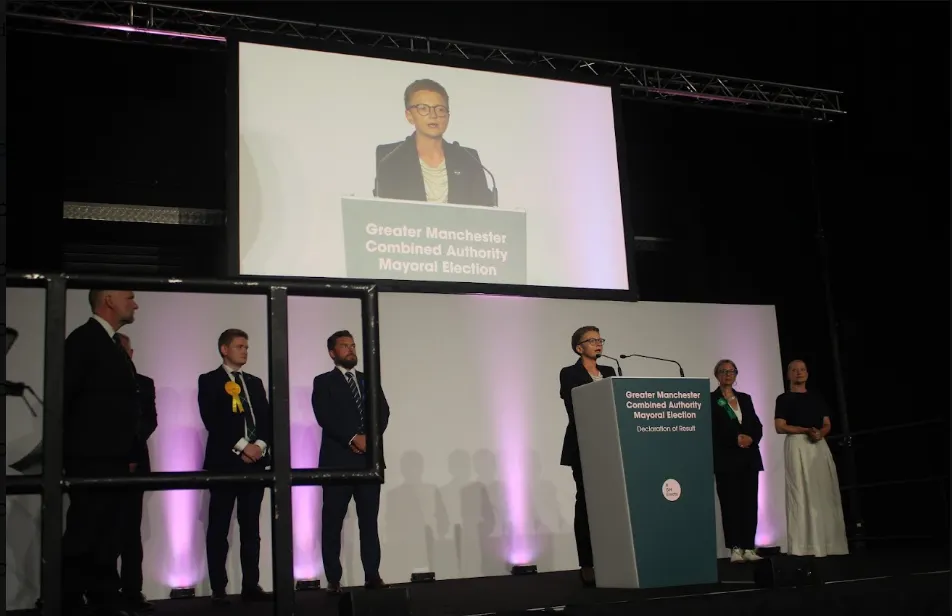
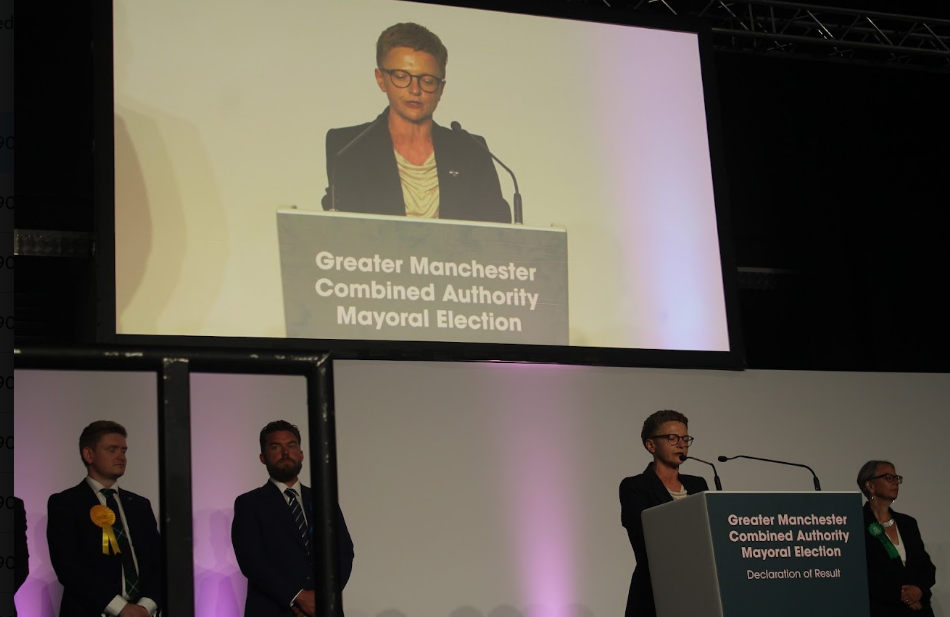
It’s just past 11pm and raucous applause erupts as Bev Craig climbs the podium at Co-op Live’s arena. Labour are celebrating victory at the biggest by-election in British history, and retaining their dominant position as Greater Manchester mayor since the role first formed in 2017.
Seven candidates were in the running, but this was not a close race. Craig beat Reform’s Sian Astley, who came second, by 309,525 votes to 157,178 (reflecting a combination of first and second-preference votes, as per the reintroduced supplementary voting system).
During Craig’s victory speech, Greater Manchester's first female metro mayor spoke in her typical measured tone, telling constituents: “I will defend this city region with every bone in my body and I will fight for a better life for all of us. So, the hard work begins”.
Craig became Manchester City Council leader in 2021, and has been a councillor in Burnage since 2011. She has been leading the polls, but even Labour supporters seem shocked by the scale of her victory. By midday, our phones had lit up with messages from Labour sources excitedly informing us that in boroughs like Tameside — where 18 of 19 council seats up for grabs went to Reform in May — a resounding victory was imminent.
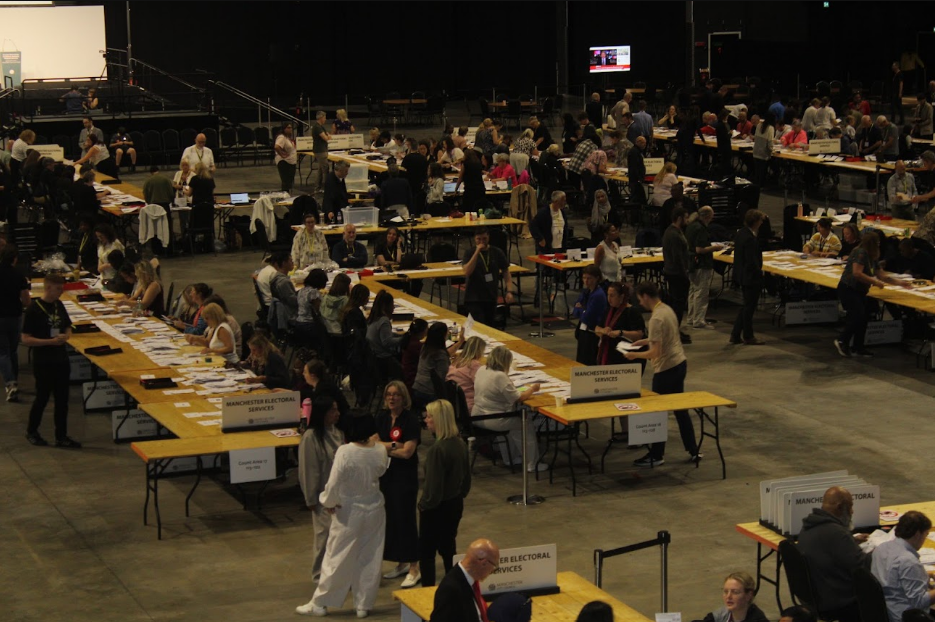
But while the outcome seemed certain as early as mid morning, candidates waited 14 hours for its confirmation. By 6pm, rumours circulated that the delay in announcing first votes was caused by a re-count in Trafford, which later morphed into accusations that “something had gone wrong” in Wigan. When a journalist repeated the Trafford rumour during a live shoot, they were reportedly scolded by Greater Manchester Combined Authority officers, who attributed the circulation of misinformation to “bored journalists” with little else to do but gossip among themselves. By this point, the MEN’s live blog included the following update: “Back from Maccies. The Labour councillors who nipped to McDonald’s have returned” — one of them is said to have ordered a chicken burger, while the other had a Fillet-O-fish.
No ‘ringing endorsement’ for Labour
The announcement came at around 7pm: no candidate had received more than 50% of the vote share and Reform and Labour were entering a run-off. Coggins organised a media huddle to discuss her defeat, and despite many of her and Craig’s pledges bearing similarities — affordable housing, free bus passes — the Green candidate remained critical of the new mayor, insisting the result was no “ringing endorsement” for Labour.
Granted, this is the lowest share of the vote Labour has ever received in a Greater Manchester mayoral election; since 2017, Andy Burnham has won between 63% and 67% on a considerably higher turnout.
The Greens, meanwhile, received 64,968 (12.2% of the first-preference votes). Just two years ago, Gorton and Denton MP Hannah Spencer ran as their mayoral candidate, receiving 6.9% of the vote.
They’re not the only party to have made gains since 2024. Restore Britain, led by ex Reform MP Rupert Lowe, was officially registered in February, and has been something of a wildcard in this election — their biggest contest to date. The party will likely be pleased with the result: Restore’s candidate, Marlon West, came fourth with 8.7% of the first-preference vote share — ahead of the Conservatives’ Phil Eckersley on 7.7%.
While Reform will have hoped for greater support, especially considering their seismic victory in the outer boroughs in May, the party has at least gained considerable ground since 2024’s mayoral election, where they scooped up less than 7.5% of votes. When I put this to Astley after the count, she said she “is not interested in talking to The Mill”.
Readers who followed our hustings coverage on Tuesday will know this is likely because Marcus Farmer, the independent candidate, was not invited. Astley left just before our hustings began because we refused Farmer entry (Farmer was not on the ballot when we initially organised the event, and contacted us only on the day to request entry). He came in seventh with 2,969 votes, receiving 0.6% of the first-preference vote share. Ahead of him was Richard Kilpatrick for the Lib Dems, on 14,702 votes.
The ‘Burnham bounce’
How has Craig stormed to victory less than three months after unprecedented Labour losses across the city region? One reason is that the by-election has been somewhat overshadowed by the so-called ‘Burnham bounce’. There have been near daily policy announcements from the new prime minister, and a Labour source involved in canvass returns for the by-election (door knocking to compile data on who is voting for their party) told us: “After Number 10 North, the canvass returns went through the roof… we just started to scoop up votes”.
For Astley, her party’s media coverage has been less favourable — Farage is mired in controversy over his finances, and his decision to call a by-election in his own constituency of Clacton has diverted money, resources and attention from Astley’s mayoral campaign. A Bolton councillor tells us “Reform just hasn’t got their vote out like they did in May”.
Then there’s the reintroduction of supplementary voting, which has benefited Labour and disadvantaged Reform, since Labour has broader electoral support and can rely more heavily on scooping up second-choice votes.
But turnout was also very low, even by mayoral standards, at 25.14% (in the past three elections, turnout has been between 28.9% and 32%). The lowest areas for turnout were Wigan and Oldham at 22%, closely followed by Bolton, Manchester, Rochdale and Salford at 23%. Trafford had the highest turnout at 35%, which reflects typical discrepancies across boroughs.
Perhaps the most significant factor for these lacklustre figures is the sheer operational complexities involved in campaigning to a region of more than two million people in little over a month. When a mayoral vacancy occurs, it must be filled within 35 working days, and when we reported on voter intention earlier this month, many people we interviewed had little awareness that a by-election was happening or knew who their candidates were.
Then there’s the possibility of voter fatigue: Greater Manchester residents are back at the polls less than three months after the local elections, and if you live in Makerfield or Gorton and Denton, you may have voted three times since February. The season doesn’t help either. People are away on holiday, and a significant proportion of the student population, which is especially prevalent in central Manchester, has travelled home for summer. Sir Richard Leese, the former Manchester City Council leader, posted on Facebook that he was the first “customer” yesterday morning at Cheetham Cricket Club to vote for Bev Craig, hours after the polls opened.
What’s next?
So what will this result mean for the city region? Much of the same, in a lot of ways. A key pledge of Craig’s manifesto is building 50,000 new affordable homes by 2039, building on Burnham’s record of beating national housebuilding targets. She also wants to keep the £2 bus cap — though she plans to extend free bus pass offers to 11 to 16 year olds — and she’s pledged to expand the A Bed Every Night scheme, a homelessness initiative launched by Burnham in 2018.
Craig may be giving up some hard powers transitioning from council leader to mayor, but she will be eagerly anticipating the new responsibilities handed to her as a result of Burnham’s devolution agenda — just yesterday the prime minister announced that English mayors will be able to keep more of the tax raised in their regions (you can read our in-depth profile on Craig here).
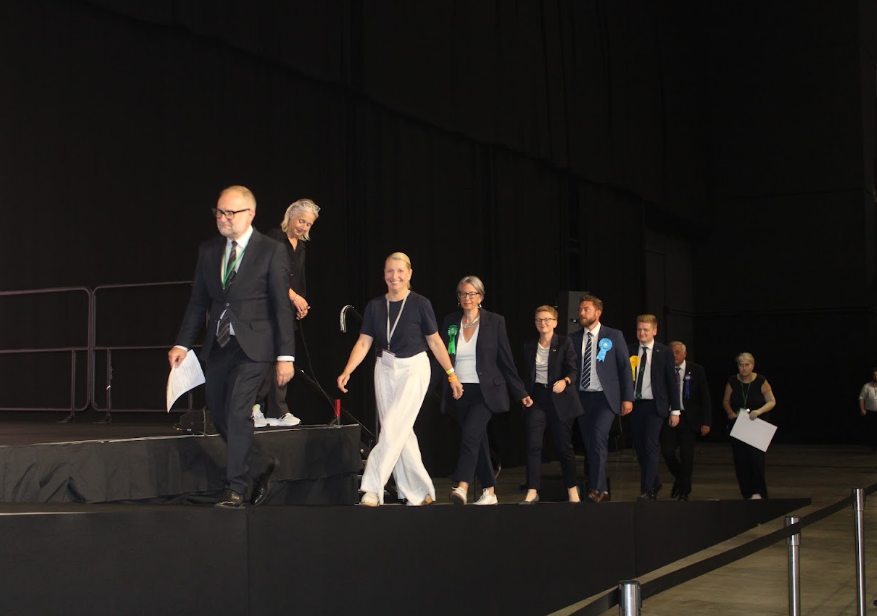
But our new mayor has a short stint: there are 18 months before we hit the polls again for a mayoral election, as Craig is only seeing out Burnham’s tenure. While this has been a resounding Labour win, it comes mere weeks after seismic losses in the locals, pointing to just how febrile the current political climate is. Craig might not be presiding over the same kind of city region by next year’s local elections, where councils could flip to Reform or the Greens. But before we get ahead of ourselves, there is yet more voting to be done: Manchester Council’s Labour group needs to choose their new leader, and Burnage residents are not done with the polls — with Craig gone, a councillor vacancy needs filling.
Greater Manchester mayoral by-election results
Electorate: 2.14 million
Turnout: 25.14% (538,659)
The first-round results:
Bev Craig, Labour Party — 251,449 (47.15%)
Sian Astley, Reform UK — 111,928 (20.99%)
Geraldine Coggins, Green Party — 64,968 (12.18%)
Marlon West, Restore Britain — 46,289 (8.68%)
Phil Eckersley, Conservative Party — 41,021 (7.69%)
Richard Kilpatrick, Liberal Democrats — 14,702 (2.76%)
Marcus Farmer, Independent — 2,969 (0.56%)
The second-round results:
Bev Craig, Labour — 309,525 (66.3% overall vote share)
Sian Astley, Reform — 157,178 (33.7% overall vote share)
If someone forwarded you this newsletter, click here to sign up to get quality local journalism in your inbox.